


Entrepreneurial Finance Readiness Level (TRL, but for founders raising capital)
Most startups are familiar with the technical readiness of their product, commonly referred to as ‘TRL’ or Technology Readiness Level. But what about ‘investor readiness level’. What would a EFRL, Entrepreneurial Finance Readiness Level look like? Based on our work with 1000’s of founders across 1000’s of fundraising programs, processes and Masterclasses, we explore what a similar EFRL might look like.
Our key insight: very few founders around the world are actually ‘investor ready’. Much work remains in most ecosystems and the various ‘supporting infrastructures’ the ecosystems operate.
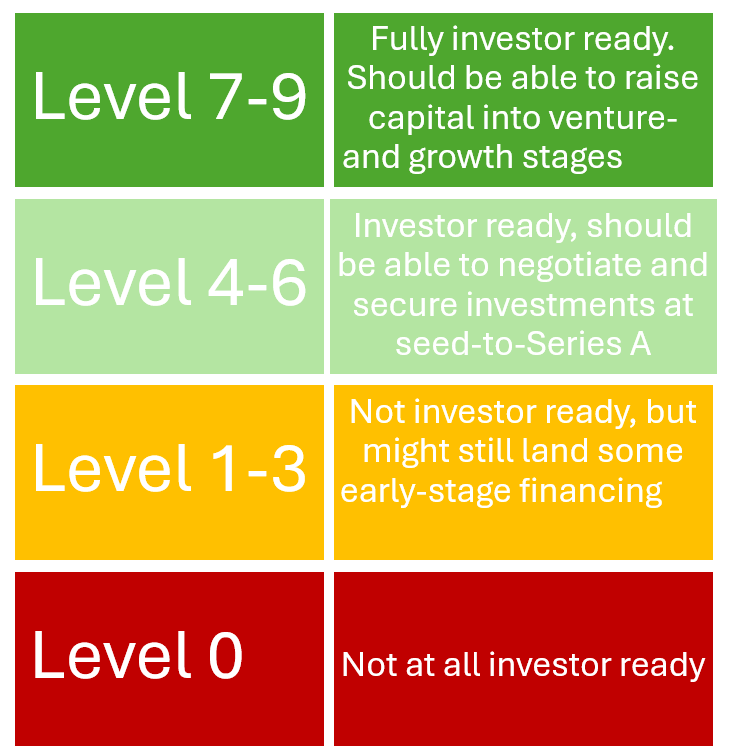
How to read the EFRL
Level 0: not at all investor ready
Level 1-3: Not investor ready, but might still land some early-stage financing
Level 4-6: Investor ready, should be able to negotiate and secure investments at seed-to-Series A
Level 7-9: Fully investor ready. Should be able to raise capital into venture- and growth stages

0. Below minimum
- Not familiar with a basic cap table
- Unable to manage a simple cap table exercise and update
- Unable to read, understand and analyze a basic term sheet
- Not familiar with how SAFEs, CLAs work
- Not familiar with conversion into equity
- Unable to structure two or more seed-stage funding rounds correctly
- Lacking basic understanding of investor expectations and liquidity
- Unable to articulate or discuss liquidity scenarios
—

1. Minimum
- Understand the basics of a cap table
- Understand the difference between company issuing equity and founders selling equity
- Understand the basics of SAFE, CLA
2. Basic
- Familiar with the basics of cap tables, including 2-3 updates and changes
- Familiar with pre- and post-money valuations
- Able to identify price per share and why it matters
- Able to read and understand most entry-level term sheets
- Able to read standard SAFE and CLA
3. Getting it
- Comfortable with a basic term sheet, including standard provisions
- Familiar with a basic shareholder agreement
- Can follow a conversion process for SAFE, CLA into equity
- Comfortable with cap tables, including doing 3-5 rounds of new equity raises in a cap table
4. Entry level
- Can spot good, bad and standard terms in a SAFE and CLA
- Understand the basic idea of value creation and value uplift for investors and founde
- Can set up and structure ESOPs correctly
- Can set up and structure advisor shares, board shares,
- Comfortable converting standard SAFE, CLA into equity, including correctly using caps, discounts and MFNs
- Can read, structure and discuss term sheets from seed into series A/B
5. Competent
- Very comfortable with cap table math
- Able to spot ‘good’ and ‘bad’ term sheets easily, including excessive terms
- Comfortable with most key terms in a term sheet
- Can navigate most aspects of a SAFE or CLA instrument, including stacked conversions
- Understand common shares vs. preference shares, and the long-term implications, including liquidation preferences, anti-dilution mechanisms and more
- Understand investor expectations
- Understand investor protection mechanisms
- Understand the basics of investor liquidity and returns
- Can structure 2-3 rounds ahead, and discuss entry-valuation, uplifts and return multiples
6. Qualified
- Can develop a long-term capital strategy, including structuring 3-5 funding rounds, with clear 3X value uplift between each of them
- Can easily manage a full cap table from start to exit, often across 5-12 equity rounds, including ESOPs, advisors, common and preference shares
- Comfortable with all key terms in a term sheet, can spot and negotiate on the most critical ones
- Comfortable structuring secondaries and basic partial liquidity solution
7. Advanced
- Can easily write up a full Outcome canvas, with outcome scenarios and outcomes math (less than 10. Minutes)
- Can write and discuss a full investor memo
- Can easily spot good/bad/standard terms in a term sheet in just seconds
- Fully understand the long-term implications of various investor terms and protections
8. Expert
- Able to easily discuss different liquidity strategies, exit scenarios, current market conditions, key value drivers and how to ensure optimal exit outcomes
- Can easily spot errors, mistakes in cap tables
- Fully understand how to structure a fundraising round based on investors’ timelines and return requirements
9. Pro
- Able to quickly flesh out a ‘Fund returner’ math case in investor conversation

Summary
The idea of a EFRL is still forming. We hope this overview can be helpful to your work.
We explore this topic in-depth in the Scale Up! Masterclasses. Delivered globally, the Scale Up! Masterclasses allows founders, angels, investors, ecosystem developers and innovation agencies to master the founder’s journey, growth strategy, term sheets, investment instruments and cap tables in just a few days of work.
Scale Up Masterclasses Case Studies
Scaling to exit with Dubai Future District Fund
Read the full case study.
From Advisors to Growth Partners: How Norway’s Largest Bank DNB Elevates Startup Advisory with the Scale Up! Masterclass
Read the full case study.
Scaling up in the rising Egyptian ecosystem
Read the full case study.