


With 100’s of sessions and 1000’s of participants, we’ve seen every outcome imaginable in Scale Up! One thing we learned: clearly define a ‘winning goal’ that resonates with your participants. Here are 12 ways you, the facilitator can define ‘winning’ in Scale Up!
Why winning matters
In Scale Up! founders, investors, students, angels, ecosystem builders form teams, select a case company and race to outcompete their fellow ecosystem founders. With Accenture in London a few years ago, we had 15 teams. In Vancouver recently, we had 12 teams, in Dubai we had four teams; all leaning in to outcompete the market.
Just like in real life, scaling a young startup is a race, it is a competition. You are competing for market share, for investor attention, for the best advisors and, ultimately, for the best outcome for the people sitting on your cap table. Startups are inherently competitive. So, it makes perfect sense to bring the same attitude, the same animal spirit into the Scale Up! programs. In fact, there is no doubt, that pushing the competitive spirit, pushing the ‘winning’ narrative move the best teams to step up and scale up. Winning, if you will, make everyone do their best work.

How…… winning?
So, if that’s the case, who should teams be structured to win? What should or could be the winning aspiration? What’s the goal line? In real life, these goal lines are fledging. Raising a seed round marks a big LinkedIn celebration, hitting 25M ARR and securing a Colt title in Dealroom’s data set is ‘winning’, hitting Unicorn is ‘winning’, even delivering a wildly successful IPO is ‘winning’, even if it might crash just weeks later (case in point, Figma (down 42%), Klarna (down 65%) and Stubhub, down 71%). I guess, in some cases, doing an IPO might need feel like winning just weeks after (remember, most shareholders have six-month lock-ups….)
Given that, how can you, as facilitator structure ‘winning’ in Scale Up? We offer three categories and 12 options you can explore.
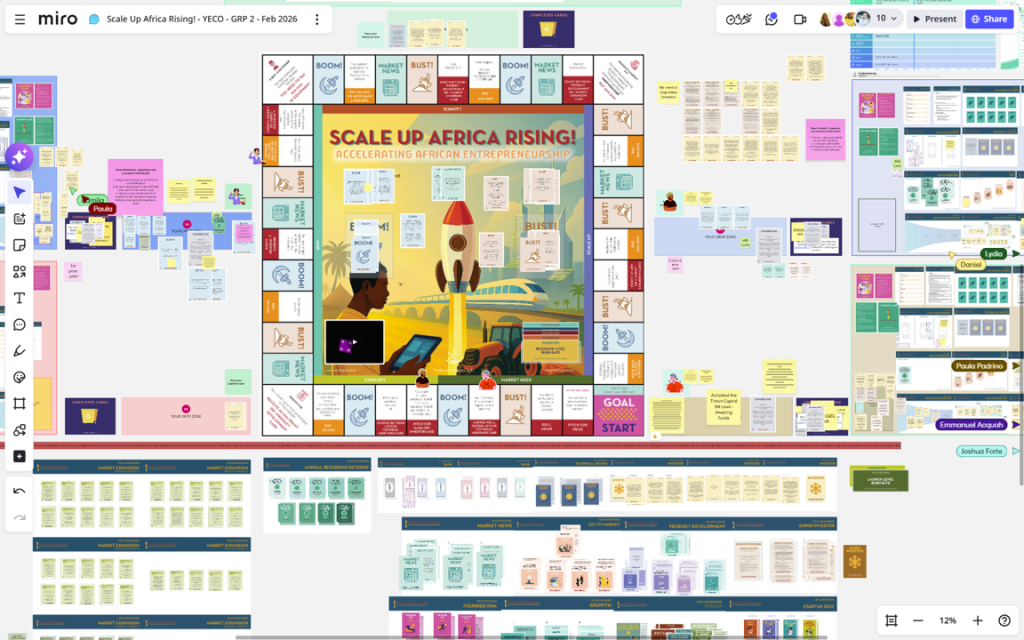
Introduction level
For entry-level participants, your definition of ‘how to win’ should be simple to understand and simple to achieve. Yes, might want to throw in some Founder Tasks, Strategic dilemmas and canvases, but the idea is, keep it simple. This also applies if your are running short Discovery sessions, where time is limited.
1. First team to complete a round (one year)
2. Raise three rounds, make it across the ‘goal line’
3. Raise 10M, make it across the ‘goal line’
4. Hit 10M ARR, make it across the ‘goal line’
1. First team to complete a round (one year) The first one is easy. First team that makes it one round around the board, without going bankrupt, wins. Using a single dice, that should be around 10-15 throws of the dice. Enough for a taster.
2. Raise three rounds, make it across the ‘goal line’ More interesting, more realistic even, is the ‘equity fundraise’ focus. Raise three rounds (psss…, you can select ‘any instrument’ or ‘only priced rounds’. Once a team has completed three rounds, you need to review and approve their cap table. Then, they still need to pass whatever space is left to pass ‘goal’. This version allows you to keep a tight focus on equity fundraising.
3. Raise 10M, make it across the ‘goal line’ Almost identical, but with a slightly different metric. First team to raise 10M in investor financing – and make it across – wins. Allows for more luck and randomness, as a single round can be 50.000 or 20M depending on deal terms.
4. Hit 10M ARR, make it across the ‘goal line’ Similar, but with a go-to-market, market expansion and revenue focus. Secure 10M ARR, by any mean possible, and make it across ‘goal’. This version allows you to push cap tables and deal structures way into the background. Great for shorter sessions or with teams with a limited understanding of entrepreneurial finance.
Across these first four, they are all simple to follow, require only a limited amount of prep work and reduce cap table math to a bare minimum.
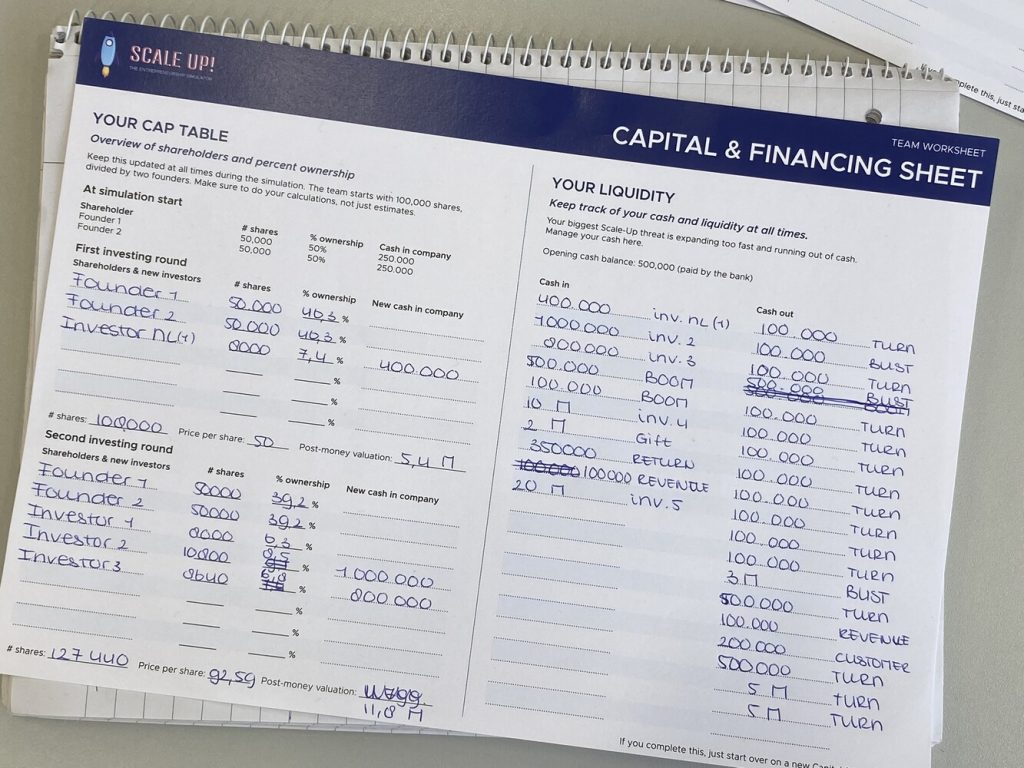
Intermediate level
At this level you expect more from the participants. You expect people to be more experienced, more prepared and better equipped for the work ahead of them.
5. Outperform
6. Survive
7. Expand
8. Five rounds

5. Outperform In this scenario, you select a widely recognized scale up in the ecosystem and ask ‘can you outperform’? For MENA, we use Careem, $3,1BN exit in just seven year. In Africa, we use MOOVE, $2BN valuation and global market expansion. For Europe we use Helsing’s Rocketship journey, with €12BN Series D in just four years. You can choose your own ‘outperform benchmark’, but the point is you use an actual, real-life company everyone can recognize and challenge teams to outperform them before time runs out. Personally, I’ve seen this work very well multiple times, and you can score winning on valuation, dilution and time to get there.
6. Survive Can you scale to a 1BN valuation – or a 10BN valuation – before going bust? Can you race against rising burn rates, demanding investors and meticulous cap table requirements? Can you survive to Unicorn? In this version, you focus on equity fundraising, cap table management and ‘first team to hit unicorn’. You also turn up the heat, the burn rate and keep tough market news coming. In Survive, you expect most teams to go bankrupt, move back, start over again, and run fast for a second or even third time. This is fast-paced, hard-charging scale up entrepreneurship in action.
7. Expand First team to (XX) Active Markets – and make it across the goal line wins. In this version, global expansion is the name, and aggressive growth is what it takes. You set the target, I prefer 20 active markets, first team wins.
8. Five rounds This feels a bit simple, but first team to complete year five is another easy winning milestone. I don’t really like it, as I expect more at the intermediate level, but for an easy facilitated session, this works pretty ok.

Advanced level
In advanced, you want to make sure you have scorecard mindset, and aim for a successful exit transaction. You also keep a strict eye on the cap table, auditing all transactions.
9. 50M ARR, 10 markets, 1 syndicated round, ‘best’ exit
10. 100M ARR, 15 markets, ‘best exit’
11. 100M ARR, 15 markets, ‘best exit’, founders retaining 40% equity
12. Best IPO outcome
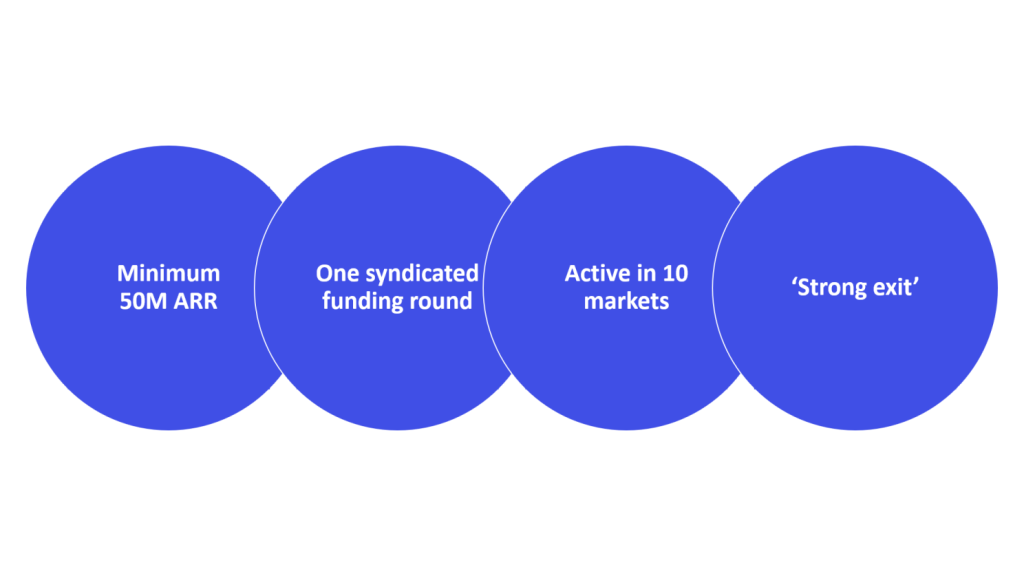
9. 50M ARR, 10 markets, 1 syndicated round, ‘best’ exit A great, balanced approach. Teams have multiple milestones to hit, but none of them too challenging. The 10M ARR can be delivered by most teams. The 10 markets are possible but more challenging. A syndicated investment round is not too difficult. Along the way, teams are likely going to raise between two and 15 rounds of financing, raising capital, taking dilution hits and trying to keep their cap table clean. Ending that the best possible exit outcome is a great way to run a Scale Up! Counting ‘best exit’, leave a bit of flexibility for the facilitator, considering highest exit value, lowest dilution, best outcome for investors and best outcome for founders. Sometimes, in low- and medium case exit transactions, we’ve seen preference shares and liquidation stacks really bite. Good lesson, all around.
10. 100M ARR, 15 markets, ‘best exit’ Along the same lines, but more expansive. We here aim for 100M ARR (which should imply a 1BN valuation), more active markets and still the ‘best exit’. Run this if you have more than two days. If not, stick with the one above.
11. 100M ARR, 15 markets, ‘best exit’, founders retaining 40% equity Ok, this winning scenario is really interesting. We recently ran a version of this in Canada. Turned out, not a single team could claim undisputed winning. ARR, markets and exits; all good. But retaining 40% equity going into the exit transaction, turns out to be really hard. Equally, scaling to 100M ARR requires hard focus, and we see teams slipping up and forgetting that 40% founder equity was even a target.
12. Best IPO outcome Advanced groups only, let them race towards ‘best IPO outcome’. Sure, revenue, product development, GTM and market expansion all matters, but ultimately, teams are only assessed on their IPO performance. This scenario is suitable for real-life startups, like the teams we worked with in Dubai recently, where an actual, real-life IPO is something tangible on the horizon. For very early-stage founders, don’t’ try this one, as they might find it ‘too unrealistic’, given the early stage they are at.
Do you want to learn more about the Strategy Sims methodology? Check out the 2025 Strategy Sims in Action report, co-authored by the global ST community. Get it today.
Planning your next session
For your upcoming Scale Up! session, think about your audience, think about their interest, think about how much time you have available and use that to set your ‘winning’ scenario. Only got a few hours? Keep it simple with the entry-level options.
Got an advanced group? Aim for a balanced scorecard with a mega-exit at the end? Got early-stage founders who are raising their first or second round of financing in real life? Aim for Outperform and have some fun with early-stage investment instruments, conversion and cap tables cleanliness as companies scale. Whichever you choose, feel free to experiment with what winning looks and feels like in your program.
Want to bring Scale Up! to your ecosystem, classroom or accelerators? With over 50 certified facilitators globally, we deliver high-impact Masterclasses and Programs for innovation agencies, accelerators, angel networks and investment firms globally. Contact us today.