

A high-level analysis using the 10 Principles of Transformation
By: Chris Rangen & Claude.
Gearing up for multiple, upcoming C-level programs on leading transformation, we explore some of the most visible, ongoing transformation cases out there. First out: Intel.
Intel Corporation stands at one of the most critical inflection points in its storied 56-year history. Once the undisputed king of semiconductors, the company has watched rivals like Nvidia surge ahead in artificial intelligence, AMD reclaim performance leadership in CPUs, and TSMC dominate advanced manufacturing. With revenue declining from $79 billion in 2021 to $53.1 billion in 2024 and the company implementing its largest workforce reduction to date—21,000 employees following last year’s cut of 15,000—the question isn’t whether Intel needs to transform, but whether it can.
Using the 10 Principles of Transformation as our analytical framework, we examine Intel’s strategic positioning, execution capabilities, and prospects for successful reinvention in an era where computing infrastructure is being fundamentally reimagined.
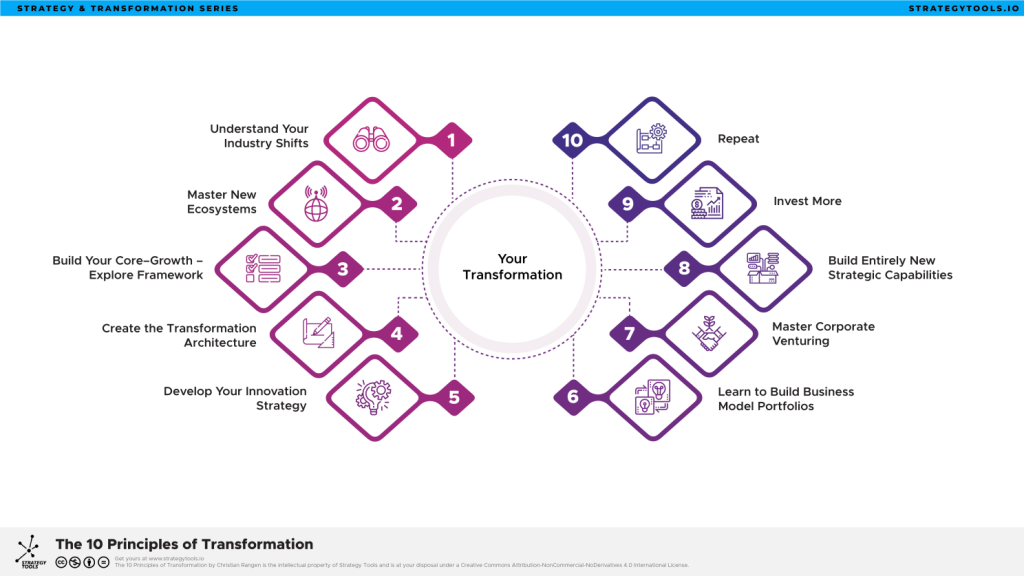
Principle 1: Understand Your Industry Shifts
Assessment: Partially Successful
Intel has correctly identified the mega-trends reshaping computing. The company recognizes three fastest-growing opportunities: AI, 5G network transformation, and the intelligent and autonomous edge, acknowledging that “we are now entering the era of distributed intelligence, where computing is pervasive.”
Under new CEO Lip-Bu Tan, Intel has sharpened its focus on these shifts. Tan emphasized creating “a culture of innovation driven by a renewed focus on customers and an engineering-first mindset” during Intel Vision 2025, signaling awareness that the industry’s center of gravity has moved from pure processing power to specialized AI acceleration and heterogeneous computing.
However, Intel’s response has been reactive rather than proactive. The company missed the initial AI wave that propelled Nvidia to unprecedented heights, and its acknowledgment of industry shifts came after competitors had already established commanding leads.
Principle 2: Master New Ecosystems
Assessment: Work in Progress
Intel is attempting to master multiple ecosystems simultaneously—a ambitious but necessary strategy. The company is transforming “from a CPU to a multi-architecture xPU company, from silicon to platforms, and from a traditional IDM to a new, modern IDM.”
Key ecosystem initiatives include:
- AI Ecosystem: Intel’s Gaudi accelerators and AI PC portfolio, with over 40 million AI PCs expected to ship by end of 2024
- Foundry Ecosystem: Positioning as a “foundry powerhouse” to serve both internal needs and external customers
- Edge Computing: Leveraging its x86 dominance to capture edge and IoT opportunities
The challenge is execution scale and speed. While Intel has identified the right ecosystems, competitors like Nvidia have built more cohesive, developer-friendly platforms that create stronger ecosystem lock-in effects.
Principle 3: Build Your Core–Growth – Explore Framework
Assessment: Framework Exists, Execution Lagging
Intel has articulated a clear framework with distinct horizons:
- Core: x86 processors and traditional markets
- Growth: AI accelerators, data center solutions, autonomous systems
- Explore: Advanced packaging, quantum computing, neuromorphic chips
The company’s “five-nodes-in-four-years strategy” represents its core technology advancement, with Intel 18A on track to be manufacturing-ready by end of year and production wafer start volumes in first half of 2025.
However, resource allocation between these horizons has been problematic. Intel’s cost structure became bloated, with “costs too high” and “margins too low,” suggesting insufficient discipline in portfolio management and resource allocation across the core-growth-explore spectrum.
Principle 4: Create the Transformation Architecture
Assessment: Still early days
How should Intel structure itself for the future? Could parts of the company be spun off and listed as a new, younger, high-growth case? Could a strategic restructuring help unleash new innovation cycles for Intel?
New CEO Lip-Bu Tan is implementing structural changes to “flatten bloated management structures” and eliminate slow decision-making layers, with teams that were once “eight or more layers deep” now operating leaner and faster.
The architecture appears sound on paper, but execution has been inconsistent. Multiple strategy pivots, leadership changes, and the massive workforce reductions suggest the transformation architecture required fundamental redesign rather than mere optimization.
Principle 5: Develop Your Innovation Strategy
Assessment: Strategy Reformed, Results Pending
Intel’s innovation strategy centers on regaining process technology leadership and expanding beyond CPUs. The company focuses on “six areas of innovation: process and packaging, architecture, memory, interconnect, security, and software” to create differentiated xPU platforms.
Recent innovation highlights include:
- Intel 18A featuring RibbonFet, PowerVia, and advanced packaging technologies
- Xeon 6 CPUs with E-cores boosting efficiency by 60% and performance by 150%
- AI-optimized solutions across client and data center segments
The strategy represents a departure from Intel’s historically CPU-centric approach, embracing heterogeneous computing architectures. However, innovation cycles in semiconductors are long, and Intel must execute flawlessly while competitors continue advancing.
Principle 6: Learn to Build Business Model Portfolios
Assessment: Portfolio Expansion Underway
Intel is diversifying its business model beyond traditional semiconductor sales:
- Foundry Services: Competing directly with TSMC to manufacture chips for other companies
- Software and Services: Expanding beyond hardware to complete solutions
- IP Licensing: Monetizing intellectual property more aggressively
- Government Partnerships: Leveraging geopolitical tensions to secure foundry contracts
The company is “expanding beyond the CPU to better solve customers’ problems through solutions and platforms” rather than just delivering individual components.
This portfolio approach is necessary but risky. Each business model requires different capabilities, customer relationships, and success metrics. Intel must avoid the trap of being mediocre across multiple models rather than excellent in a few.
Principle 7: Master Corporate Venturing
Assessment: Limited
This represents perhaps Intel’s weakest area in transformation execution. While Intel Capital has historically been active, there’s limited evidence of systematic corporate venturing aligned with transformation goals. In fact, in January 2025 Intel announced the intent to spin off the CVC arm, only to reverse the decision in April the same year.
Successful transformation typically requires aggressive CVC; Intel now needs to rebuild its CVC strategy.
Principle 8: Build Entirely New Strategic Capabilities
Assessment: Significant Investment, Uncertain Returns
Intel is making substantial investments in new capabilities:
- Foundry Operations: Building customer-facing foundry services from scratch
- AI Software Stack: Developing comprehensive AI development tools and frameworks
- Advanced Packaging: Investing heavily in chiplet and 3D integration technologies
- Ecosystem Development: Building developer communities and partner networks
The company expects to generate “$1 billion in savings in non-variable cost of sales in 2025” while maintaining investments in strategic capabilities.
The challenge is that these new capabilities require both significant capital and different organizational cultures. Building world-class foundry services, for example, requires customer-obsessed operational excellence—a significant departure from Intel’s historically internal focus.
Principle 9: Invest More
Assessment: Constrained by Financial Reality
This principle highlights Intel’s most significant constraint. While transformation requires increased investment, Intel is simultaneously implementing a “$10 billion cost reduction plan” and reducing “gross capital expenditures in 2024 by more than 20%”.
The company suspended its stock dividend beginning Q4 2024 to preserve cash for strategic investments, but free cash flow remains negative. Intel faces the classic transformation dilemma: needing to invest more while generating less cash to fund those investments.
Government support provides some relief, with CHIPS Act funding helping sustain manufacturing investments, but private capital allocation must be ruthlessly prioritized.
Principle 10: Repeat
Assessment: Too Early to Evaluate
Transformation is iterative, requiring multiple cycles of learning and adjustment. Intel is early in its transformation journey under new leadership, making assessment of this principle premature.
However, the company’s history suggests challenges with consistent execution across cycles. Previous transformation attempts under different leaderships have yielded mixed results, indicating potential organizational impediments to sustained iterative improvement.
Transformation Verdict: Possible but Perilous
Intel’s transformation faces three fundamental challenges:
Resource Constraints: Unlike successful transformers like Microsoft or Amazon, Intel must simultaneously defend eroding core businesses while building new capabilities with limited financial resources.
Technology Convergence Speed: The pace of AI and computing evolution may outstrip Intel’s ability to catch up, particularly given the long lead times in semiconductor development.
Ecosystem Momentum: Competitors have built powerful ecosystems with strong network effects that create increasingly high barriers to entry.
However, Intel retains significant advantages:
- Unmatched x86 ecosystem relationships
- Deep engineering talent and IP portfolio
- Strategic importance to Western governments ensuring foundry supply security
- Manufacturing scale that few competitors can replicate
The Cliffhanger: An Unexpected Lifeline
Just as this analysis was being completed, the technology world was stunned by breaking news that fundamentally alters Intel’s transformation equation. Nvidia announced it will invest $5 billion in Intel’s common stock at $23.28 per share as part of a collaboration to jointly develop multiple generations of custom data center and PC products.
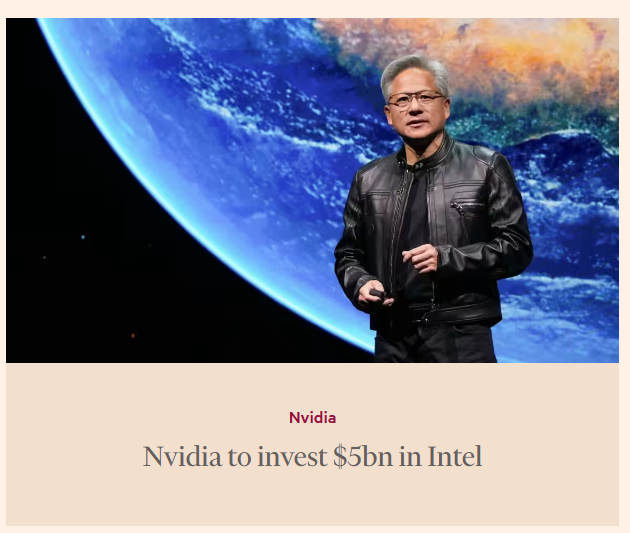
Jensen Huang called it a “historic collaboration” that “tightly couples NVIDIA’s AI and accelerated computing stack with Intel’s CPUs and the vast x86 ecosystem—a fusion of two world-class platforms”, while Intel shares jumped 33% in premarket trading following the announcement.
This development represents more than financial investment—it’s validation of Intel’s x86 ecosystem value and a potential accelerant for several transformation principles simultaneously. The partnership could provide Intel with immediate access to AI capabilities while offering Nvidia deeper integration with the dominant PC and server architecture.
But will this lifeline prove to be Intel’s transformation catalyst, or merely a temporary reprieve in a longer decline? The answer will define not just Intel’s future, but the competitive structure of the entire computing industry for the next decade.
The transformation game just changed. The question is whether Intel can now play it to win.