

Most founders say they are “raising”. Few can tell you exactly which investor they are looking for. Here are the five investor types every founder needs to know, how to spot them, and three examples of founders who got it right (and wrong).
“Do you know any investors?”
“Chris, we are raising our seed round. Do you know any investors?”. I get this question almost every week. From founders in Oslo, Dubai, Cairo, Vancouver. In Scale Up! Masterclasses, over coffee, by e-mail late on a Sunday night.
My answer is always the same question back: “Which investor are you looking for?”
Most founders stop flat. “Well, any investor. Someone with money.” And that is exactly where the problem starts.
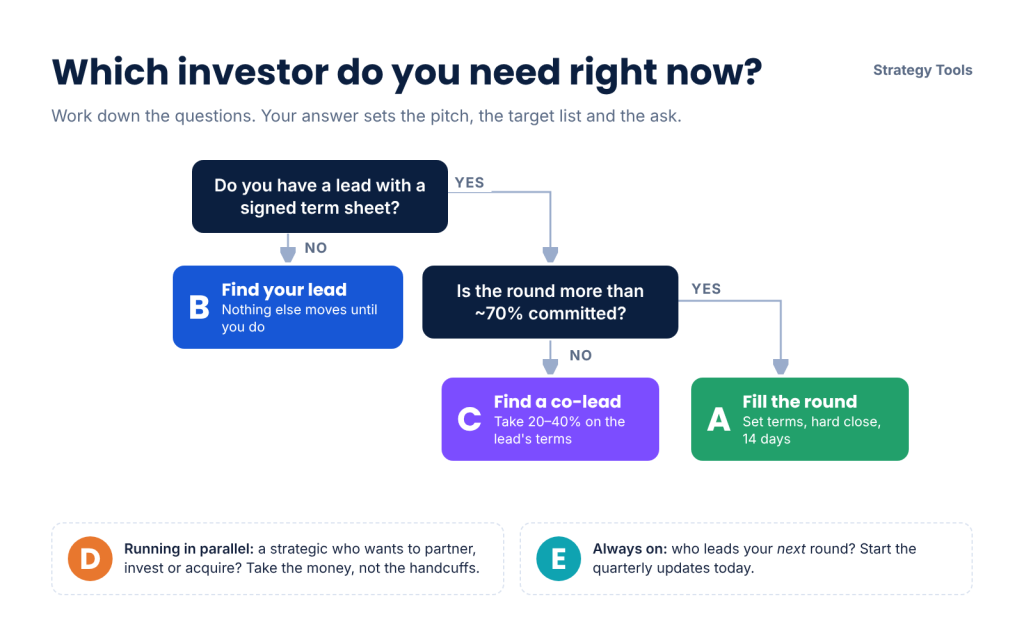
Across 7.000+ founders, angels and investors in Scale Up!, we see the same pattern again and again. Founders treat fundraising as one long, unstructured search for “money”. They pitch angels when they need a lead. They chase a lead when the round is already 70% committed. They spend six months courting a Series B fund that will never, ever write a seed check.
Time burns. Runway burns. Morale burns.
Here’s my thinking. Before you send a single e-mail, before you update the pitch deck one more time, know what you are looking for. In practice, there are five very different investor types. Each plays a different role in your round. Each needs a different pitch, a different timeline and a different ask.
Five investors. Five different jobs.
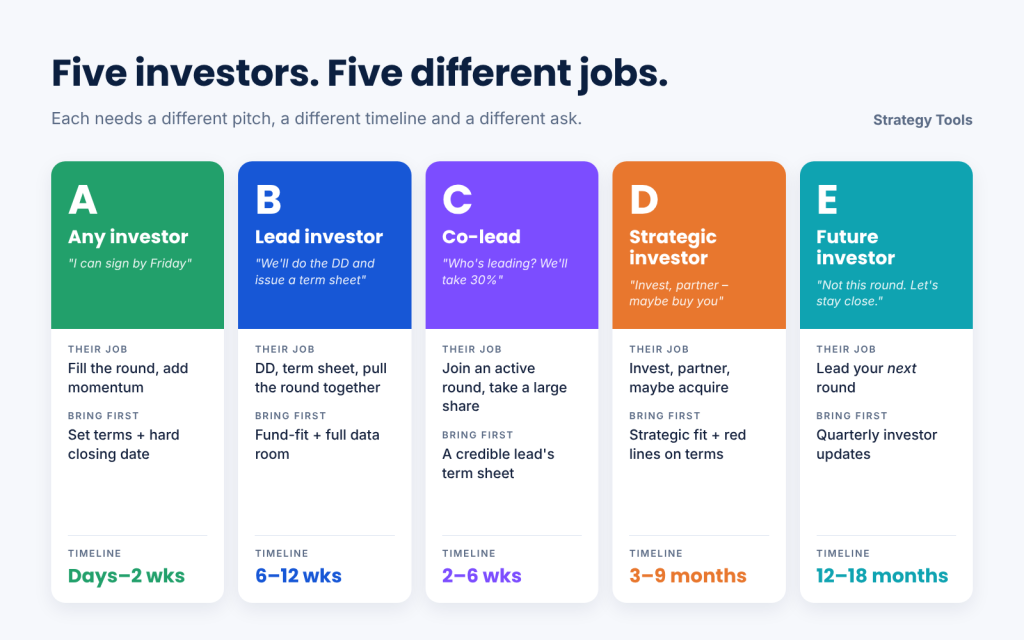
“I can sign by Friday”
A) ‘Any investor’
The investor who can sign on relatively short notice. Business angels, angel syndicates, operator-angels, family friends with a real investment track record, sometimes a small micro-fund with a fast IC.
They don’t set the terms. They don’t run the DD. They follow. And that’s fine. Their job is to fill the round, add momentum, and close the last 10–30% of the allocation.
What you need to bring: clear terms already set, a short deck, a data room that’s ready, and a hard closing date. Ask them to lead, and you’ll wait forever. Ask them to join, on agreed terms, by a specific date, and many will move in days.
“Send me the data room. We’ll do the DD and issue a term sheet.”
B) ‘Lead investor’
The investor who does the DD, issues the term sheet and pulls the round together. This is the most important – and the hardest – investor to find.
The lead sets the price. Sets the terms. Often takes a board seat. And, critically, gives every other investor the confidence to join. No lead, no round. It’s that simple.
What you need to bring: a fund-fit (thesis, stage, sector, ticket size, geography), a full data room, a sharp investment case and the patience to go through a real DD process. Expect 6–12 weeks from first meeting to signed term sheet, if things go well. Pitch 40 angels and you still won’t have a lead. Find one real lead, and 40 angels may suddenly call you.
“Who’s leading? Great, we’ll take 30%.”
C) ‘Co-lead’
The investor who can join a round that is already happening. Often a VC fund that likes the company, but doesn’t want – or can’t – lead. Too small a ticket to lead, too early for their thesis, or simply happy to lean on a lead investor they trust.
A co-lead comes in on the lead’s terms, rides on their DD (and adds their own confirmatory DD), and takes a meaningful share of the round. Often 20–40%. Good co-leads bring a second set of eyes, a second network, and a second pocket for the next round.
What you need to bring: a signed (or near-signed) term sheet from a credible lead. Without it, a co-lead is just another “keep us posted”.
“We could invest, partner, and – who knows – maybe buy you one day.”
D) ‘Strategic investor’
The investor who can come in as an investor, partner and/or acquirer. Corporate venture arms, industrial groups, large tech companies, sometimes a sovereign or state-owned player with a strategic agenda.
The upside can be massive: distribution, customers, credibility, technical support, and a likely future exit route. The downside can be just as large: slow processes, strategic-not-financial priorities, information rights that make competitors nervous, and the dreaded right of first refusal (ROFR) that can quietly scare off every other future acquirer.
What you need to bring: a clear strategic fit, a commercial partnership on the table, and a very clear view of the terms you will not accept. Take the money, not the handcuffs.
“Not this round. But let’s stay close.”
E) ‘Future investor’
The investor who will not join this round, but who is already discussing the next round(s) with you. Typically the Series A fund while you’re raising seed, or the growth fund while you’re raising Series A.
Most founders ignore them. Big mistake. A future investor is your next lead, if you treat the relationship right. Send them quarterly updates. Share milestones. Let them watch you execute, in real-time, over 12–18 months. By the time you raise, you’re not a cold pitch. You’re a story they’ve followed, and believed in, from the start.
What you need to bring: discipline. A short investor update, every quarter, without fail.
Three examples
“We pitched 60 investors. Everyone loved us. Nobody committed.”
Example 1: The climate tech team that pitched the wrong investors
Imagine a climate tech startup in Oslo. Three founders, strong tech, first pilot customers in place. They set out to raise a €3M seed round.
For five months, they pitch. Angel networks, founder dinners, demo days, LinkedIn intros. 60 meetings. Great feedback. “Love the team.” “Keep us posted.” “Come back when you have a lead.” €400.000 in soft commitments. Zero signed.
The problem? They were pitching type A investors, when they needed type B. Nobody in the room was able – or willing – to do the DD, set the valuation and write a term sheet. Everyone was waiting for someone else to go first.
The turnaround came when they stopped and mapped it out. Twelve seed funds in the Nordics and Germany with a climate thesis, €1–3M tickets, actively investing. They built a full data room, ran a focused 8-week process, and landed a term sheet from a Copenhagen-based fund leading €1,5M. Within three weeks, the angels who had said “keep us posted” converted. The round closed oversubscribed at €3,4M.
Same company. Same pitch. Different investor.
“We have a lead. We have six weeks. We’re €1M short.”
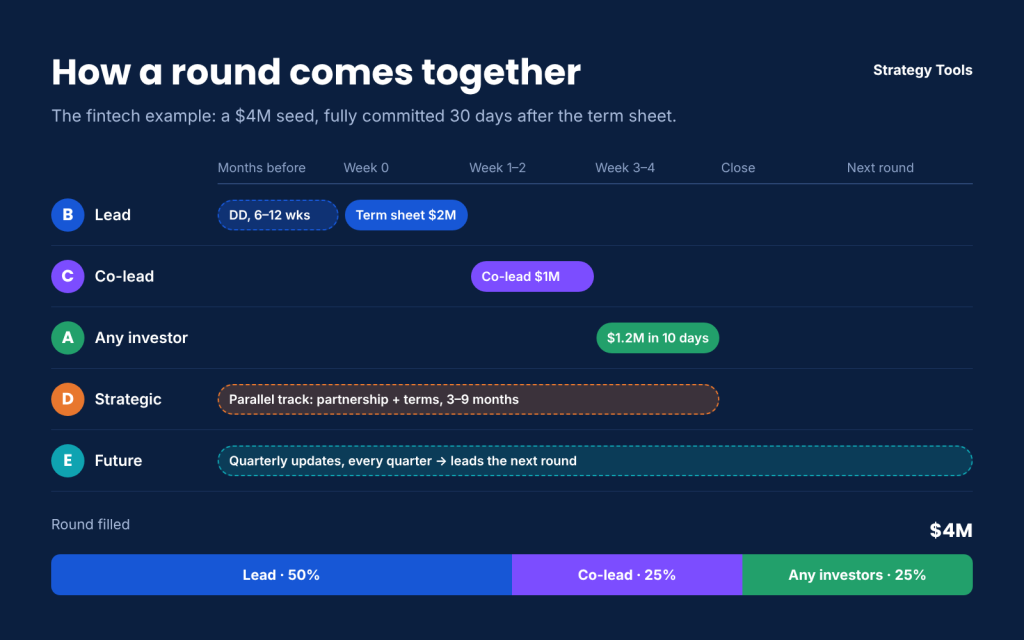
Example 2: The fintech that filled the round in 30 days
A fintech in Dubai has done the hard work. A regional VC has issued a term sheet to lead a $4M seed, committing $2M. The lead has done full DD. Terms are set. But the lead wants the round fully committed within six weeks – or they’ll walk.
The founders know exactly what they need: one type C co-lead for $1M, and a handful of type A investors to fill the last $1M.
They go to three funds they’d met six months earlier – funds that liked the company but didn’t lead at seed. With a credible lead’s term sheet in hand, two say yes in under two weeks. One takes $1M as co-lead, on the lead’s terms, with light confirmatory DD.
Then, the final $1M. The founders send a short, sharp note to 25 angels and two syndicates: terms, data room link, minimum ticket $50.000, hard close in 14 days. $1,2M in commitments within ten days. They cut back the allocation.
Total time from term sheet to full commitment: 30 days. Because they knew exactly which investor they were looking for, at every step.
“The corporate wants in. Should we say yes?”
Example 3: The deep tech startup with a strategic – and a future – investor
A deep tech hardware startup in Munich, building sensor systems for industrial and defense applications. Raising a €6M Series A.
A large European industrial group approaches. Their corporate venture arm offers €2,5M, a joint development agreement, and access to their global sales channel. A perfect type D strategic investor. On paper.
The first term sheet comes back with a right of first refusal on any acquisition, exclusivity in the industrial segment for five years, and board observer rights with full information access. The founders run it past their seed investors. Their verdict: take the money and the partnership, not the ROFR and not the exclusivity.
After four weeks of negotiation, the strategic comes in at €2M, with a commercial agreement, no ROFR, and a narrower 2-year exclusivity in one product line. A financial VC leads the remaining €4M.
But the smartest move happened two years earlier. Since their pre-seed, the founders had sent quarterly updates to a growth-stage deep tech fund in London – a type E future investor. Never pitched. Just kept them informed. When the Series A closed, the London fund called. “We’ve followed you for two years. When you raise your B, we’d like to lead.” Eighteen months later, they did.
One round. Three investor types. All planned.
Boil it down
If you boil it down, every round needs three things.
1. Know your lead first.
No lead, no round. Before anything else, find the investor who will do the DD, set the terms and issue the term sheet. Everyone else follows.
2. Sequence the rest.
Lead first. Co-lead second. ‘Any investors’ last, on set terms, with a hard closing date. Get the order wrong, and you’ll get 60 “keep us posted” and zero signatures.
3. Build for the next round, now.
Your next lead is out there today. Treat strategic investors as partners, not just money. Treat future investors as relationships, not just names. Send the update. Every quarter.
So, next time someone asks, “do you know any investors?”, ask them back: “Which investor are you looking for?”
In Scale Up!, founders practice exactly this: mapping investor types, sequencing a round, negotiating term sheets with leads, co-leads and strategics – in days, not years. Accelerator manager, angel network, innovation agency? Want to bring Scale Up! into your ecosystem? Let’s talk!
Good luck with the raise!