


Startup founder, looking to raise investor capital? Working on your pitch deck? Building out your data room? Currently in one of our Investor Readiness programs? This one is for you.
In recent weeks, we have worked with 400+ founders from pre-seed to Series B. A question that everyone asks; “What do we need for fundraising materials?”. Our answer: it depends, but probably more than you think. In this article we explore the current market expectations for founders going to market to raise capital.
Before we start….
Not every startup founder should raise outside investor capital. In fact, most probably should not. Bootstrapping, growing through revenue, is a perfectly good strategy. In fact, this can lead to a far better outcome for many founders than taking on outside investors, with dilutive financing and liquidation preferences stacked on each other and more.
Today, using a wide range of AI tools, we see more and more founder hit breakout revenue just bootstrapped, but for many founders, outside financing is still needed.
An exception to every rule
While most founders need to spend significant amounts of time on fundraising materials, fact is that some can skip it entirely. If you have an extreme outlier team, ARR velocity or any other factor that puts you in that top 1% – 2% bracket; most likely, investors will come to you, throwing term sheets at you faster than you can reject them. For these, exceptionally few, founders, fact is, you don’t have to make, build or prepare anything. Other, of course, than hitting $100M ARR in your first 18 months, and having a team of five people that just left Anthropic.
For the rest of us, here’s the checklist.
Choose your level, choose your materials
We identify eight levels of ‘startup founder maturity’. For some founders, thanks to unique team and breakout traction, level 1 might be sufficient, but in our experience, it pays off to work through all levels, with a goal to complete level 8, our most advanced maturity level, with all six decks, all materials and a full data room to boost.
Which level you choose to go for, is, of course, entirely up to you.
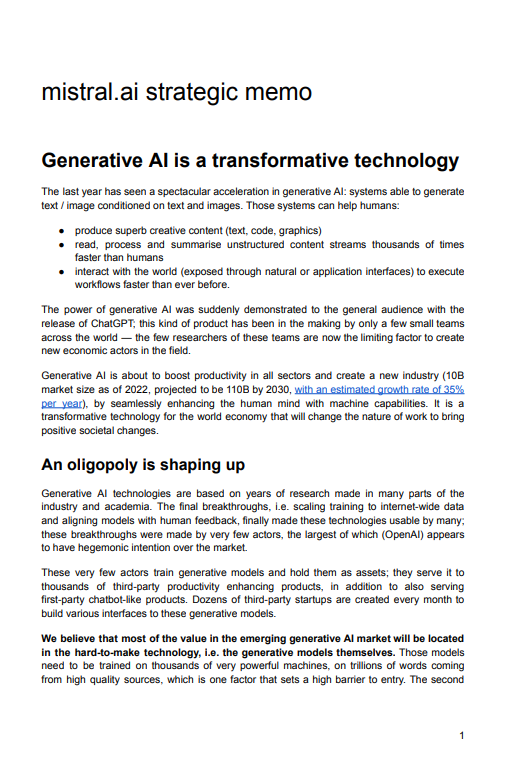
1. Strategic Memo
Want to do this quick and different? Got the confidence to fundraise ‘differently’? Follow Mistral’s Strategic Memo. When French AI startup Mistral raised a solid €105m pre-seed round with no product, four weeks after launching and just days after hiring its first employees, the startup world took attention.
For some founders, maybe a Strategic Memo is the right way to go?
2. Pitch deck
For most founders, including 1000’s of accelerators, incubators and startup hubs, ‘The Pitch deck’ is a must for anyone looking to raise capital.
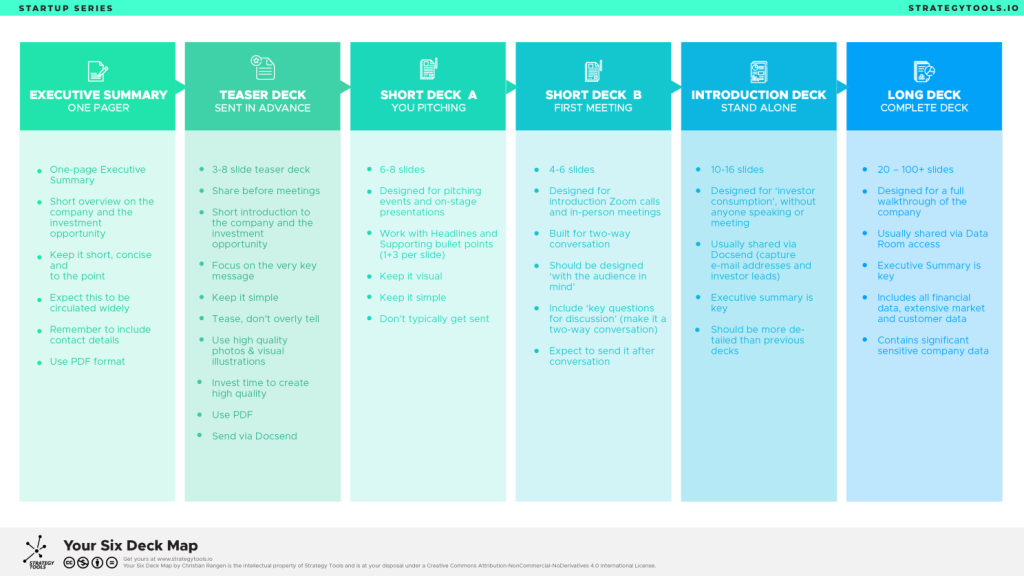
But, did you know, there are actually six different investor decks you would want to develop?
We describe these six in more details in our “Founder? These are the six decks you need” if you are aiming for level two, you should pull together a 10-12 slide deck (what we call Short deck A: Your pitch deck), sufficient for pitch events with you on stage and early meetings; just don’t expect this to take you to anything resembling a successful funding round.
3. Two decks, financial model
Slightly more advanced, you now develop both Short deck A: Your pitch deck and Introduction deck: Investment teaser.
But more than that, you also take the time to develop a robust financial model. This is a model showcasing your business model and your growth trajectories. Maybe also a base, bull and bear case scenario.
Now, investors will have a chance to dig into and test your assumptions, your CAC, your LTV, your margins, churn rates and all key factors in your business model.
Pro tip: if you are aiming to share your financial model, you might want to consider shooting a short Loom video where you walk through it, you know, just to make life a little bit easier for the junior analyst trying to understand your spreadsheet logic.

4. Three decks, financial model, Investor FAQ
OK, so you got the three most important decks (Pitch deck, Investment Teaser and Executive Summary) you got a good financial model, now you expand into the world of Investor FAQs.
Effectively, these are the top 25 – 50+ questions you believe investors would want to ask you in meetings and during the DD process. This allows you to pre-empt the tough questions and also show you truly understand what your investors are looking for.
If you are not sure where to start, hit up Claude, upload your Investment Teaser and ask Claude to help you develop the Investor FAQ. Chances are, you’ll be both impressed and surprised.
5. Four decks, financial model, Investor FAQ, Investment instrument
Shifting into the more mature-levels, you now got your four most important decks (Pitch deck, Investment Teaser and Executive Summary and Short Deck B, First Meeting deck). You got the financial model, the FAQ.
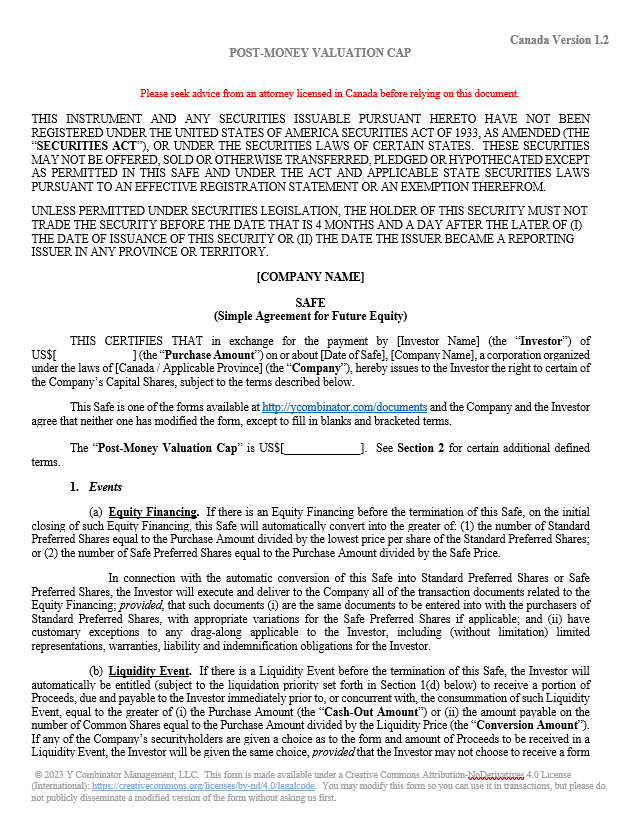
Next, the investment instrument. Not all founders would want this. Some are looking for a lead investor to set the terms, choose the instrument and structure the round. But for many founders, especially those with some negotiation power, it is perfectly welcome for you to set the terms and choose the investment instrument. Usually easier in the earlier stages, most founders would opt for a capped SAFE note, a standard convertible loan agreement or maybe a standard debt structure.
As long as you are using “industry standard”, most early-stage investors are ok with it. Worst case, if you meet a strong lead investor candidate, you can both agree to replace your investment instrument with their choice (e.g. going from a capped SAFE to a priced round or a convertible), but for many angels and early-stage investors, they will appreciate you having an investment ready document to sign.
6. Five decks, financial mode, investor FAQ, instrument, VC Investment memo
Going into level 6, you should now have most decks ready (Pitch deck, Investment Teaser and Executive Summary and Short Deck B, First Meeting deck), as well as model, FAQ and instrument. Next, you want to dig into those midnight hours and develop your Long Deck. The Long Deck, or Complete Investment Proposal, easily counts 20-100+ slides. We frequently see them at 45-50 slides. This deck is supposed to give your investors the opportunity to review in piece, read through every slide in detail – without having any founders present in the room. This is your full package, and should be packed with numbers, stats, KPIs and financial data. You might want to put this inside a data room, but in practice, a password protected DocSend is the way to to go.
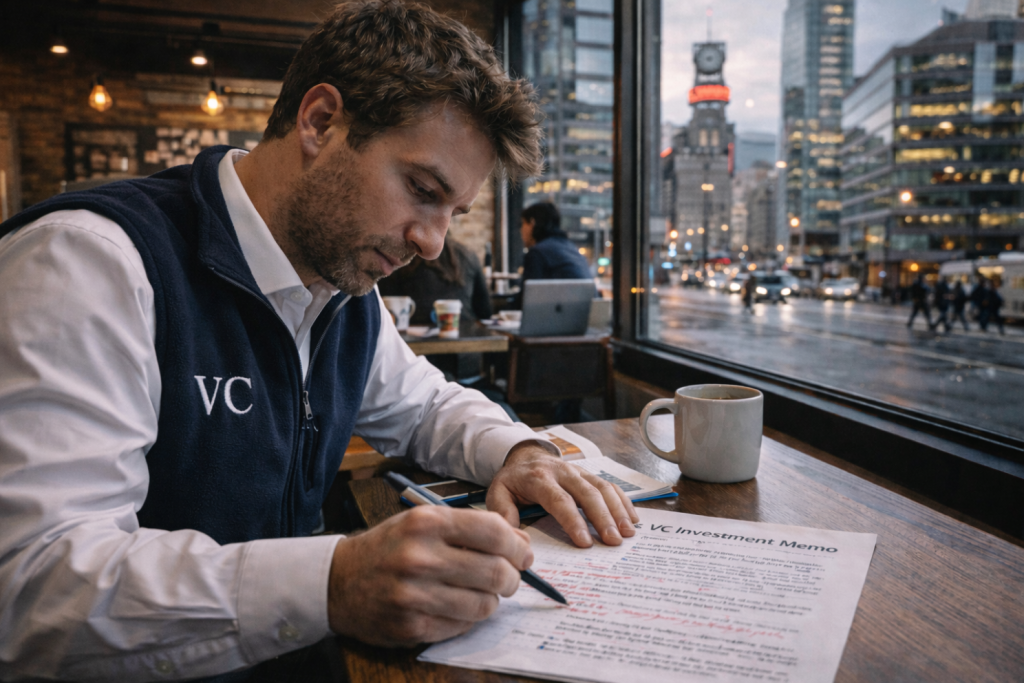
At this stage, you also want to develop your VC investment memo. To many founders – and some investors – this might seem like a strange deliverable. After all, why should the founders spend time to write up a 20-30 page VC investment memo?
Well, we propose two main reasons for why this makes a lot of sense. First of all, for the founders to putting in the work and truly structure their work, strategy, go-to-market, long-term capital strategy, team bios, investor returns and deal outcomes, it provides the founders with structured depth and insights on their own company.
Second, one of the real-life bottle necks your VCs have is time, often more than capital. “We’d love to engage, but we just don’t have the bandwidth”, is a common phrase. Well, if you can provide them with a strong VC investment memo, you can easily save them 15-20 hours of time, and maybe, just maybe, be able to tip them over to looking closer on your deal.
Again, not sure where to start?
Try out this Claude Prompt:
“Please write up a world-class venture capital investment memo on our startup. Make sure to include: Executive summary, clear investment rationale, market overview, problem, solution, business model, traction, team, competitive landscape, KPIs and traction to date, long-term capital strategy, cap table analysis, deal analysis, round structure, investor outcome analysis, exit strategy and exit scenarios. Feel free to add or highlight other things you believe is key to developing a world-class VC memo.
Name: (insert), URL: (insert). All pitch decks and key financials attached.
7. Six decks, model, FAQ, instrument, memo, shareholder agreement, cap table
OK, going to level 7, you are now truly maturing your investor materials. At this stage, you develop all six decks (Executive summary, Teaser deck, Pitch deck, Meeting deck, Introduction deck (investment teaser) and Long deck (Investment proposal). You got a solid financial model, FAQ, investment instrument. You got the VC memo.
Now you are adding the legal documents, namely Shareholder agreement and cap table (make sure to track this fully diluted) Granted, this should also have been included in the decks above and definitely the VC memo, but often, it is left out.
8. Six decks, model, FAQ, instrument, memo, SHA, cap & full data room
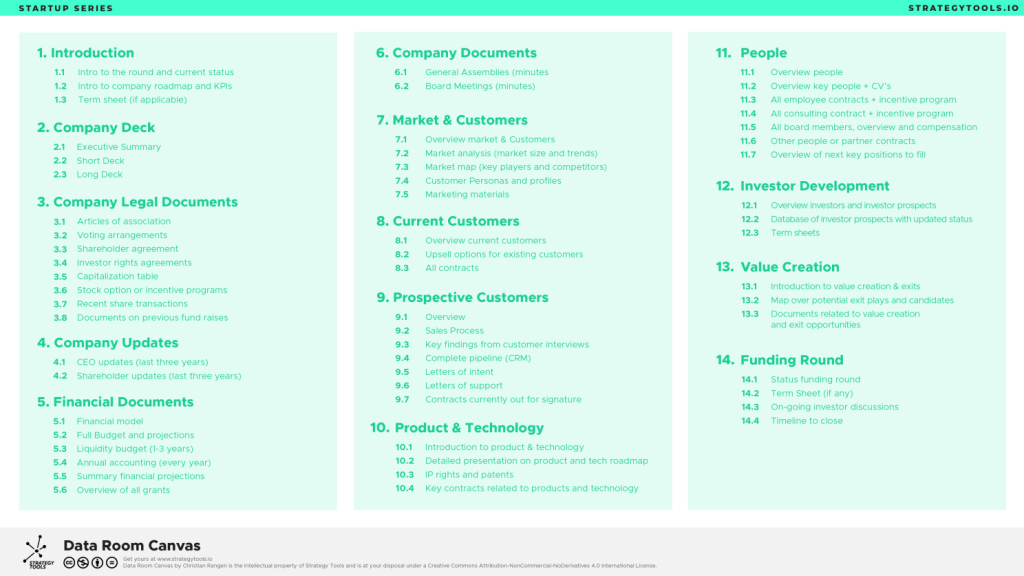
Finally, our last level, level eight. Now, you got all decks, financials, FAQ, instrument, VC memo, SHA and cap table. The only thing remaining; your data room, or VDR, Virtual Data Room. Many founders think about this as a data dump, a file repository. Smart founders understand differently. Smart founders design the data room through the lens of a world-class investor (customer) journey. “How can we make this a top-notch experience?”, “How can we use the data room to delight and impress investors”.
Here are three tips:
- Make the structure easy to understand and navigate
- Use guiding text to intro each main chapter or folder “In this folder you will find X, Y, Z. Make note of folder YY and ZZ”
- Shoot introduction videos (Loom recordings) for each key part, always with the user’s journey in mind
Closing out: from deck to investor ready materials
As I’m writing this, we are working hands on with 200+ founders across North America, MENA and Europe on different programs on Investor Readiness. This post if for you.
We hope this can serve both as an inspiration and checklist for the work you are all doing.
Next, we invite you to dig into the Funding Journey, where you can study the five phases and 43. Steps to close your next funding round.