


35 million people. 85+ unicorns. The world’s highest unicorn density outside Silicon Valley. And yet — the New Nordics is still leaving enormous value on the table. Here’s why that’s about to change.
What is the New Nordics?
The New Nordics isn’t just a geography. It’s a mindset. Traditionally, “the Nordics” meant Sweden, Denmark, Norway, Finland, and Iceland — a prosperous, high-trust, sustainability-driven corner of the world known more for ABBA and flat-pack furniture than for billion-dollar tech companies. With recent AI winners like Lovable, Legora and deeptech companies like Oura Health, that story is changing.
The New Nordics extends the frame. It brings Estonia, Latvia, and Lithuania into the picture — creating a combined region of 35 million people, world-class technical talent, battle-tested digital government, and a startup density that outpaces virtually every other region on earth. Think of it this way: Sweden gave the world Spotify and Klarna. Estonia gave us Skype and Wise. Lithuania gave us Revolut’s first e-money license. Finland is home to Supercell and 15 unicorns. This is not a collection of small countries.
This is one of the world’s most formidable innovation corridors — when and if it acts like one.
Why the New Nordics is Punching Above Its Weight
Let’s look at the numbers. The Nordic startup ecosystem is now valued at $552 billion — 16 times its value just a decade ago. In 2024 alone, Nordic startups attracted $8.2 billion in VC funding, with international investors contributing two thirds of the capital. The region produced 82 unicorns by 2024, up from just 9 in 2014. For a region with 4% of Europe’s population, it accounts for 17% of all European unicorns. Per capita, the New Nordic countries are second only to Silicon Valley in unicorn production.
What’s driving this? Three unfair advantages that most regions dream about.
First, a culture of building for the world from day one. Nordic and Baltic domestic markets are simply too small to sustain a scale-up. This isn’t a disadvantage — it’s a trigger function. Founders here think globally from the first pitch deck. They have to in order to scale. Second, extraordinary digital infrastructure. Estonia runs the world’s most advanced digital government. Finland treats broadband as a legal right. Sweden has fibre optic networks reaching 96% of households. This isn’t a backdrop — it’s a competitive weapon. Third, a deeply rooted engineering culture combined with a pragmatic attitude toward risk. Strong social safety nets reduce the downside of failure. Technical universities produce founders, not just employees. And the culture of trust — among founders, investors, and public institutions — keeps transaction costs low and collaboration high.
Early Success Stories from the New Nordics
The success stories are no longer just from the last generation. They’re happening right now. Lovable, the Swedish AI startup, scaled to $200 million in annual recurring revenue within its first year — a trajectory that would turn heads in Palo Alto. Legora closed a $550M series D, with a who’s who on the cap table. Stendr raised a $5.4M pre-seed to build AI-powered drone defence systems in Norway, in an industry few investors would have touched just 24 months ago. Stegra, the Swedish green steel company, raised $1,6BN for industrial sovereignty. Kelluu secured Nato Innovation Fund’s first deal, a $15M series A, in Finland.
On the fund side, Voima Ventures closed a €100M+ Fund III focused on deep tech across the Nordic-Baltic region. Final Frontier is leading a new pack of defense funds. Norrsken VC committed €300 million to “AI for Good.” Maki.vc launched its third €100M fund for deep tech and brand-driven startups. Capital is no longer the bottleneck it once was.
On the ecosystem side, the launch of the Nordic Deep Tech Valley initiative in May 2023 — led by Startup Estonia alongside partners in Finland and Sweden — represents perhaps the most important strategic bet the region has made. The premise is simple but powerful: in the global competition for deep tech talent and capital, it is regions, not countries, that win. Estonia, Finland, and Sweden are pooling resources, aligning policies, and presenting themselves as a unified deep tech hub to the world.
The first Nordic-Singapore Innovation Days in 2025 took joint Nordic delegations to Asian markets — a tangible sign of what coordinated regional strategy looks like in practice.
Barriers That Are Holding the New Nordics Back
So why isn’t the New Nordics already Europe’s answer to our entrepreneurship ecosystem challenges? Because four stubborn barriers remain.
The European Paradox — alive and well in the north. The gap between world-class scientific research and commercial success is a genuine, region-wide problem. I see this very clearly in my work across Sweden and Finland. The Nordics produce exceptional researchers. They do not always produce exceptional deep tech companies. Labs and universities are full of breakthroughs that never find their way to market. Despite $2.4 billion in deep tech funding in 2024, early-stage ventures remain underserved.
Fragmentation. Walk into a startup event in Tallinn and ask who the key players are in Gothenburg. You’ll get blank stares. In Bergen, ask who the key angels in Copenhagen are, same thing. Cross-border cooperation happens, but far below its potential. There is no coherent big picture. Ecosystems compete for talent and capital that could flow across borders freely if the infrastructure existed.
The capital gap at the growth stage. Pre-seed and seed funding has improved dramatically. But the Series A, B and C gap — the so-called “valley of death” for scale-ups — remains. European investors tend to be more conservative and metrics-focused than their US counterparts. In our work at Link Capital, we see this across our portfolio as founders prepare to scale. Rounds are smaller, valuations lower, timelines longer. A company that raises $5 million in Oslo might raise $25 million for the same business in San Francisco.
Liquidity & exits – or lack thereof. We see this clear as day. Across Scale Up! Masterclasses, founder programs, angel workshops and venture fund discussions. We are not generating the liquidity that the ecosystem deserves. It is a systemic challenge. Founders are not prepared for it (we see this crystal clear in Scale Up!), angels and VCs don’t structure for it, and the secondaries funds are still too few and far between. Fix the liquidity, and more (pension) capital will flow. But it starts with the founders at day one.
How to Solve Them The region needs to make four big moves — and it needs to make them together.
Move 1: Industrialize research-to-company pipelines. Estonia has set a target of 500 deep tech companies by 2030. Singapore — a city the size of a small Estonian island — already has 1,300. The gap is not in the research. It is in the infrastructure that converts research into startups. Entrepreneur-in-residence programs, IP frameworks, research accelerators, and cross-border mentorship need to become standard features of every university and science park in the region. Initiatives like the Nordic Deep Tech Valley’s Research Accelerator for HealthTech are the template.
Move 2: Build the common narrative — and stick to it. International capital is not interested in Norway or Finland or Sweden. It is interested in the region. The New Nordics needs a single, compelling story told consistently at every global stage — from Slush to TechArena to Singapore Innovation Days. This is what the ecosystem needs. Nordic Deep Tech Valley initiative is already building it, and it matters enormously. When the region acts as one, it carries weight on the other side of the globe. In my work with innovation clusters and ecosystems, we can do so much more to integrate our region far better.
Move 3: Fix the growth-stage funding gap. More regional fund-of-funds. More pension capital. More collaboration between Nordic institutional investors and international growth-stage capital. More angel networks — particularly those focused on deep tech — operating across borders. The Baltic and Nordic angel communities need more connective tissue. Structured syndication, shared deal flow, and regional SPV frameworks are not glamorous. They are the plumbing that turns a good ecosystem into a great one. We need to enable more of it.
Move 4: Boost liquidity across the investment landscape. Look to Sweden, study how Sweden has become an investment powerhouse. Study Nasdaq First North Growth Market in Stockholm, now Europe’s Leading Marketplace for growth companies. Set up more secondaries funds. Make partial liquidity at A and B a real, accepted option for early-stage investors to cash out. Train and prepare founders for how to think ‘value’ and ‘liquidity’ at every step of the journey.
The Moment Is Now
Here is the thing about building ecosystems: windows open and close. Right now, the window is open. Silicon Valley is expensive, politically turbulent, and increasingly unattractive to international founders. Europe is hungry for an innovation identity. Genuine deep tech is having its moment — quantum, AI, climate, defence, biotech — and the New Nordics is positioned at the intersection of all of them. The foundations are extraordinary. What has been missing is the will to act as one region, not separate countries competing for the same scarce resources and founders.
This is the challenge that inspired our work on Scale Up Nordics!
With over 7.000 participants; from startups, scale ups, angel networks, VCs, FoF’s, innovation agencies and ecosystem developers, it was time to do our part to support the New Nordics. It was time for Scale Up Nordics!
A new growth initiative, to support the startup- and scale up ecosystem across the New Nordics. We’ve developed the tools, the simulation, the academic foundation and the experience to support a generation of New Nordics founders, investors and ecosystem developers.
It’s time for the New Nordics to live up to its potential. It’s time to Scale Up!
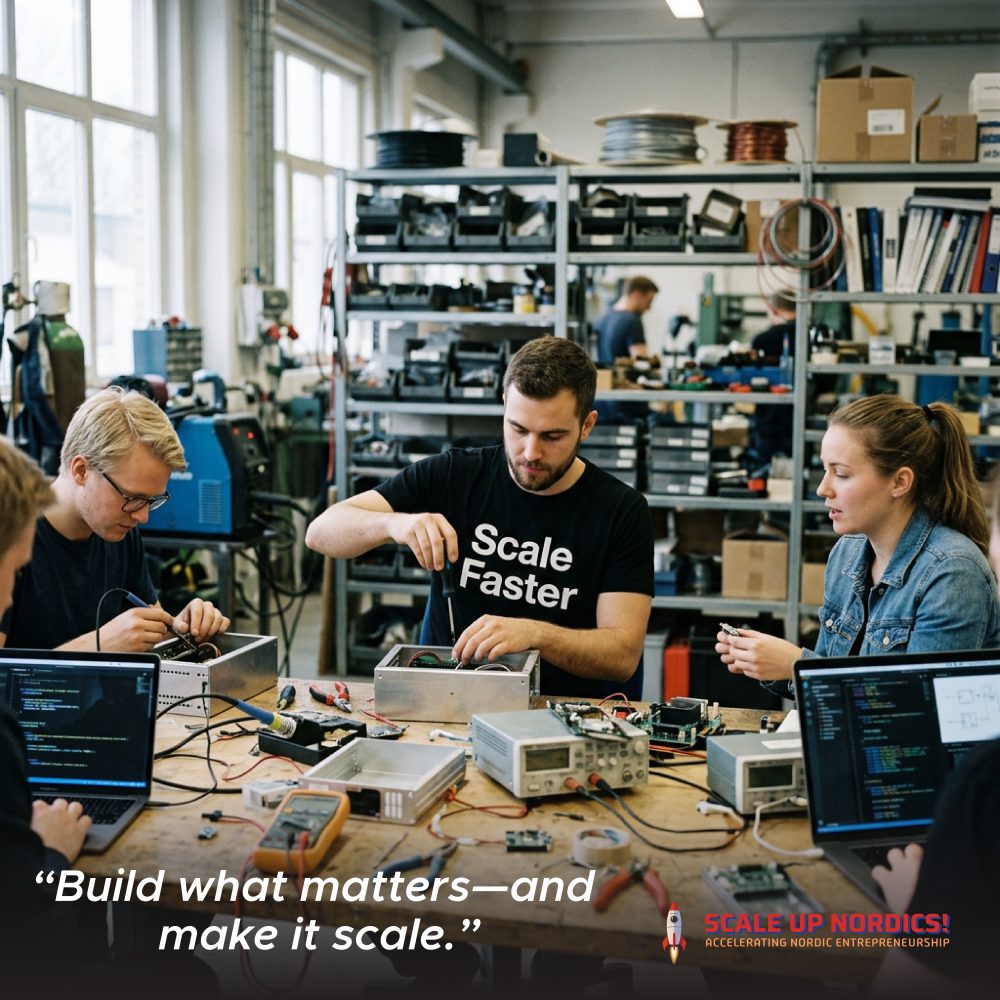
Want to explore how your ecosystem or organization can be part of Scale Up Nordics? Get in touch.