


Fewer than 6% of emerging venture managers make it to Fund III. The ones who do share a habit: they were building a firm, not just a fund, from day one.
Part of the Strategy Tools Venture Capital Series.
Twice a year, teaching at the Venture Asset Management Program at IMD, I open with a story, a quiz, a journey.
It starts with an idea: a thesis, a network, a conviction that a market is underserved. It moves to Fund I, usually small, usually hard, usually raised from people who believe in you more than in your track record. And, if things go well, it reaches Fund III: the point at which a manager stops being a promising experiment and becomes an institution.
Here is the uncomfortable part. Less than 6% of managers make that journey.
Most never get past the first fund. Some raise a second on momentum, then stall. A very small group crosses the line into Fund III and beyond, and an even smaller group goes on to build something that lasts for decades.
What separates them? In my experience, it is rarely deal luck alone. It is a mindset. The managers who make it think about the firm, not just the fund.
In this article we look at how eight venture firms across Europe, the Middle East, Africa and the US grew from first-time managers into the institutions they are today. Some did it in four years. Some took fifteen. All of them started with a single fund.
1. The journey to Fund III and beyond
A venture fund is a product. It has a size, a strategy, a vintage and a ten-year life. A venture firm is a company. It has a brand, a team, a set of long-term LP relationships and a portfolio of products that overlap in time.
The distinction sounds academic. It is not. It changes almost every decision a manager makes.
Three funds, three different proofs
Each fund asks LPs to believe something different about you.
- Fund I: prove you can invest. Your LPs are backing you, your thesis and your access. They know you have no track record. They are betting on your judgment and your network. Often, they are friends, family, angels, founders you have worked with, and perhaps one brave anchor.
- Fund II: prove you can pick, and keep picking. Fund II is usually raised before Fund I has returned any money. LPs look at early markups, the quality of follow-on investors in your portfolio, and whether you stuck to your thesis. Many managers stall here, because the story is promising but unproven.
- Fund III: prove you are a firm. By now LPs want evidence: realised exits, distributions, a team that will still be there in ten years, and an organisation that can manage more than one fund at once. This is where institutional LPs start to pay real attention.
Fund III matters because it is where the economics and the institution finally start to work. Overlapping management fees can fund a real team rather than a founding partner working nights. Institutional LPs who would never touch a first-time fund come into scope. And the firm can begin to offer founders something a single fund cannot: support from the first cheque to the growth round.

The right-hand column is not something you add after Fund III. It is what gets you to Fund III. The managers who make the journey design for it early: they plan the next fund before the current one is deployed, they upgrade their LP base deliberately, and they build a team and brand that can outlive any single vehicle.
A fund is a product. A firm is a company. LPs back funds, but they commit to firms.
2. How great managers build firms, not funds: a global view
To make this concrete, we mapped the fund history of eight managers across four regions, from their first fund to today. The sizes differ by orders of magnitude. The pattern does not.

Three things stand out. First, every firm started small relative to where it is today, sometimes very small. Second, most moved from a single fund to a family of vehicles: opportunity funds, growth funds, sector funds or regional funds. Third, the pace varies enormously. Plural went from Fund I to a €1bn Fund III in four years. MEVP took fifteen years to reach Fund IV. Both are firms.
Let us look at each.
Europe: Plural

Plural is the fastest journey in our sample. The London firm was set up in 2022 by former founders, including Wise co-founder Taavet Hinrikus. Its debut fund closed at €250m, well above its initial €150m target. Fund II followed in 2024 at €500m. In November 2026, Plural announced €1bn for Fund III: almost four times its first fund, and double its second.
Note the structure of Fund III. About two-thirds goes into the core early-stage fund, and about one-third into a new opportunities fund for follow-on rounds in its best companies, such as Helsing and Proxima Fusion. That is firm thinking. Plural is not just raising a bigger fund; it is adding a product so it can stay with its winners.
The lesson: when the thesis, network and early portfolio are clear, momentum compounds. Speed is a strategy.
Europe: Speedinvest

Speedinvest started in Vienna in 2011 with a micro-fund of around €10m. Fund II followed at about €90m in 2015, Fund III at about €190m in 2020, and the Fund 4 generation reached more than €600m: a €350m core fund, closed in January 2024, plus €250m for follow-on investments in existing portfolio companies.
What makes Speedinvest interesting is not only the size of the flagship funds. It is the platform built around them: specialist funds for marketplaces (Speedinvest x), an €80m Climate & Industry Opportunity fund, and in 2026 a first fund for the Middle East and Africa, backed by Mubadala, QIA and EIB Global. Speedinvest today reports around €1.2bn in assets under management.
The lesson: a firm can add specialist teams and new geographies under one brand, without losing the core.
MENA: BECO Capital
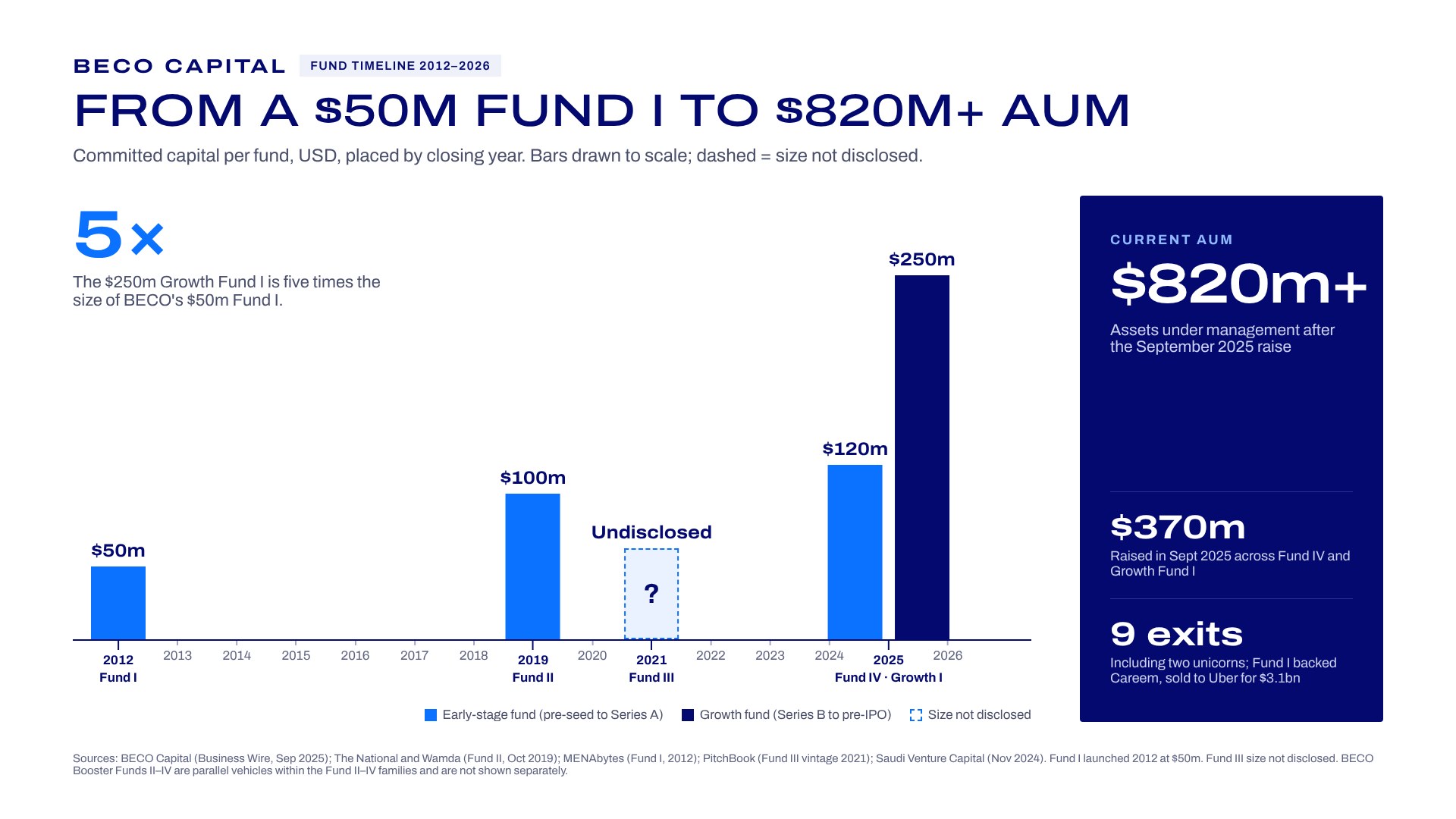
BECO Capital launched in Dubai in 2012 with a $50m inaugural fund, backed in part by the IFC. Its first fund backed Careem, later acquired by Uber for $3.1bn, which became one of the region’s defining venture outcomes. Fund II closed at $100m in 2019, above its $80m target. Fund III followed in 2021.
Then, in September 2025, BECO closed $370m across two funds: a $120m Fund IV for early-stage investing and a $250m Growth Fund for Series B to pre-IPO. That took the firm to more than $820m in assets under management, with nine exits including two unicorns.
The lesson: once you have proven early-stage judgment, adding a growth fund lets you keep backing your best founders, and fill a capital gap in your own market.
MENA: MEVP
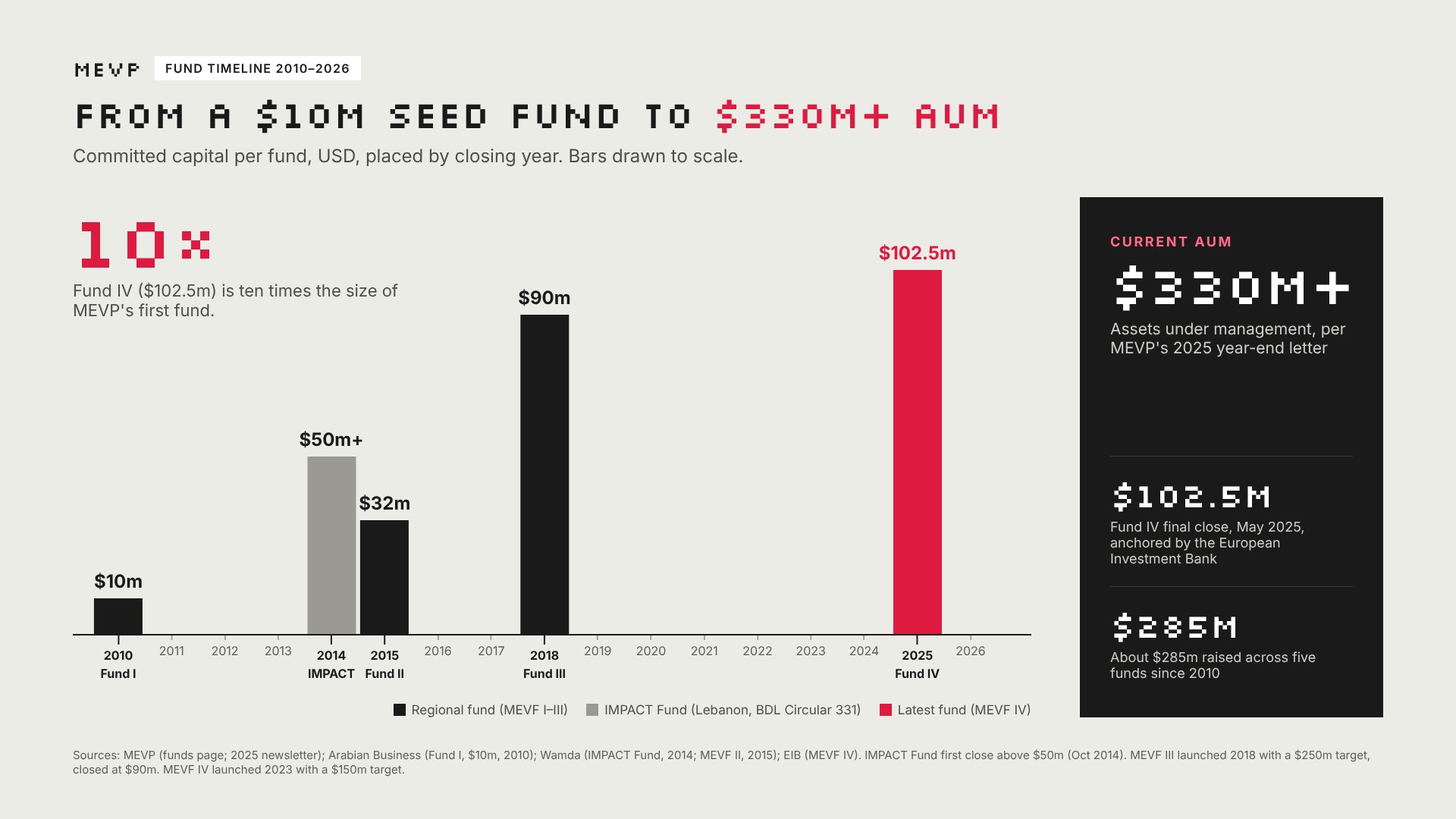
MEVP is the persistence story. Walid Hanna founded the firm in 2010 with a $10m first fund. In 2014 it raised the IMPACT Fund, the first venture fund to comply with Lebanon’s central bank Circular 331, with more than $50m in commitments at first close. MEVF II followed at $32m in 2015.
In 2018 MEVP launched Fund III with a $250m target. It closed at $90m. Many managers would have stopped there. MEVP did not. It rebuilt around the Gulf, and in May 2025 closed MEVF IV at $102.5m, anchored by the European Investment Bank. The firm today reports more than $330m in assets under management.
The lesson: missing a target is not the end of the journey. Firms survive setbacks that would end a single fund.
Africa: Launch Africa Ventures

Launch Africa raised its first fund at the height of the pandemic. Fund I was a Q4 2020 vintage, reached final close in Q2 2022 at $36.3m, and backed well over a hundred startups across the continent.
Fund II had its first close in January 2024, targeting $50m. It has raised $30m to date, with a final close expected at the end of Q1 2027. In the meantime, the firm has grown to more than 180 portfolio companies across 25 African countries, built a network of over 400 limited partners, and in June 2026 made its first distribution to Fund I LPs after a series of cash exits. It also advises the new Botswana Tech Fund.
The lesson: in emerging venture markets, the path to Fund III runs through distributions and a deep LP network. Returning cash to Fund I LPs is the strongest argument for Fund II and Fund III.
Africa: Knife Capital
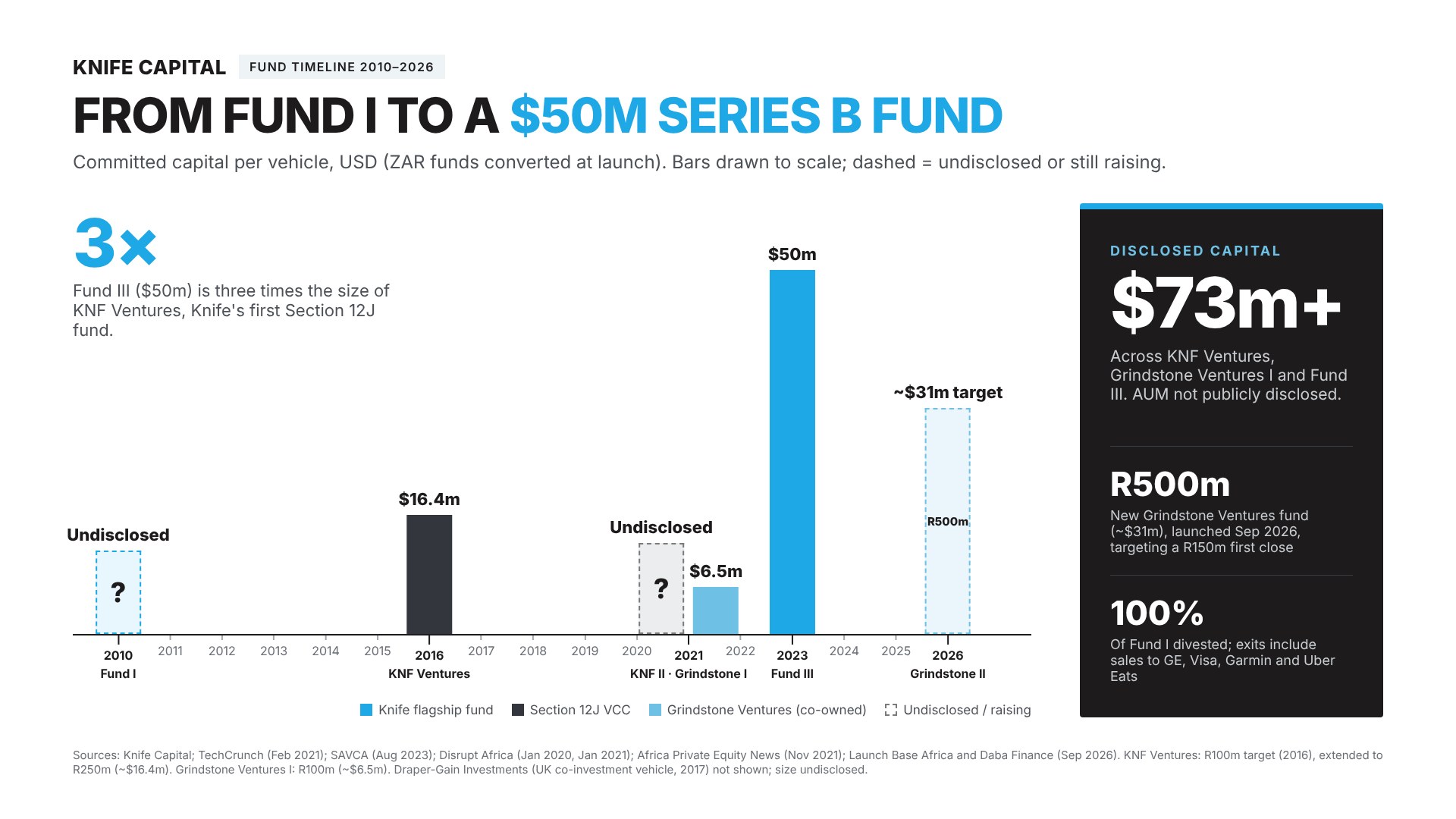
Knife Capital was established in Cape Town in 2010, taking over seven portfolio companies from Mark Shuttleworth’s Here Be Dragons to form its first fund. That fund has been fully divested, with exits to strategic buyers including GE, Visa, Garmin and Uber Eats: a rare achievement in African venture.
From there, Knife used the tools available in its market. In 2016 it launched KNF Ventures under South Africa’s Section 12J tax incentive, growing it to about R250m (around $16m), followed by KNF Ventures II. It co-owns the Grindstone accelerator, which launched Grindstone Ventures I in 2021 and a new R500m fund in 2026 under a new managing partner. And in August 2023, Knife closed Fund III at $50m, a dedicated Series B fund backed by the IFC, the SA SME Fund, Standard Bank and others.
The lesson: a firm can build a pipeline of vehicles, from accelerator to seed to Series B, and even incubate the next generation of fund managers.
US: Thrive Capital
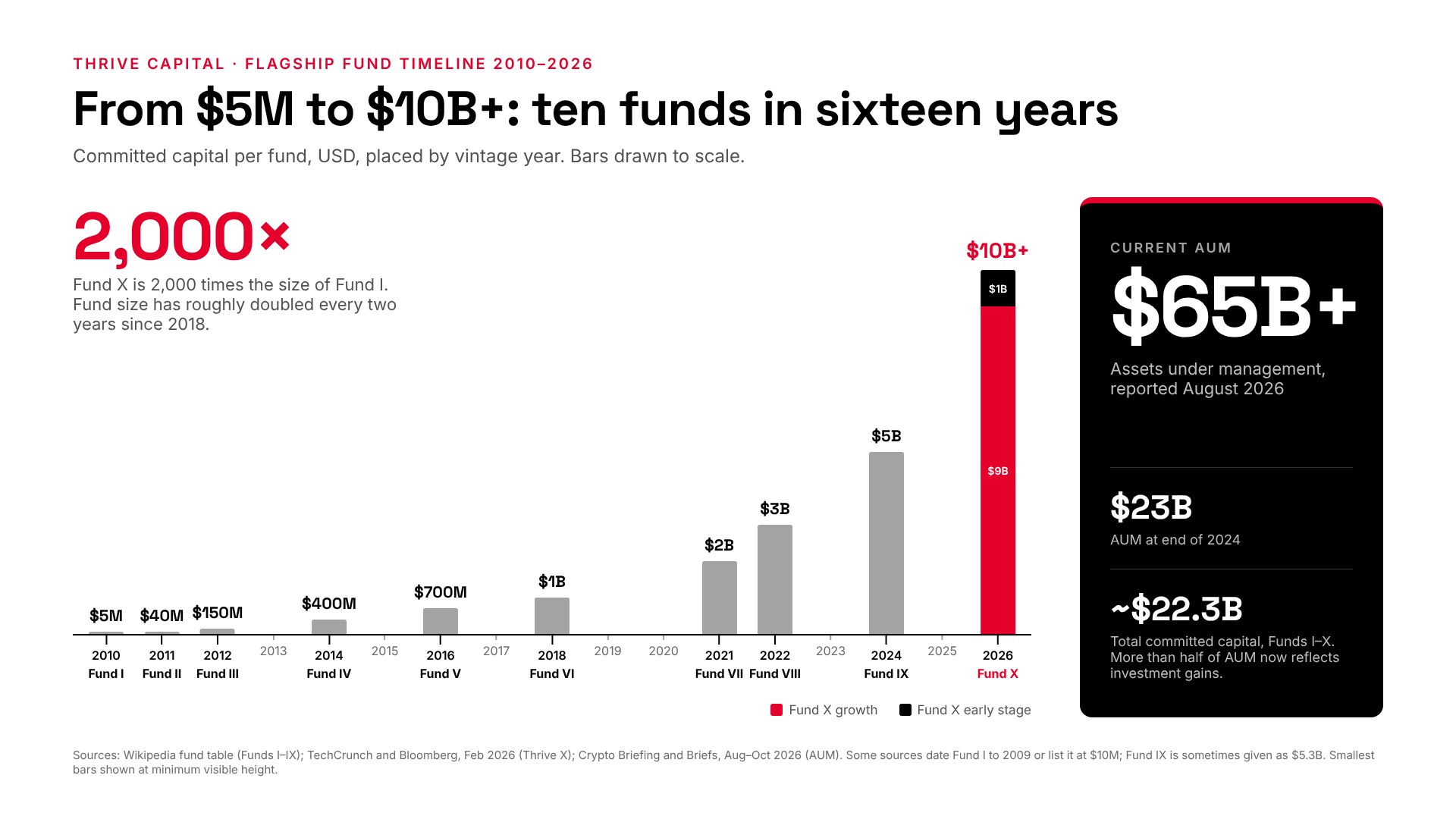
Thrive Capital’s first fund, in 2010, was about $5m. Ten funds later, Thrive closed Thrive X in February 2026 at more than $10bn: $1bn for early-stage and $9bn for growth. That is roughly 2,000 times the size of Fund I. Since 2018, fund size has roughly doubled every two years. Thrive now reports more than $65bn in assets under management.
The lesson: concentration and conviction compound. Each fund was a step, not a leap, and each one earned the next.
US: Andreessen Horowitz
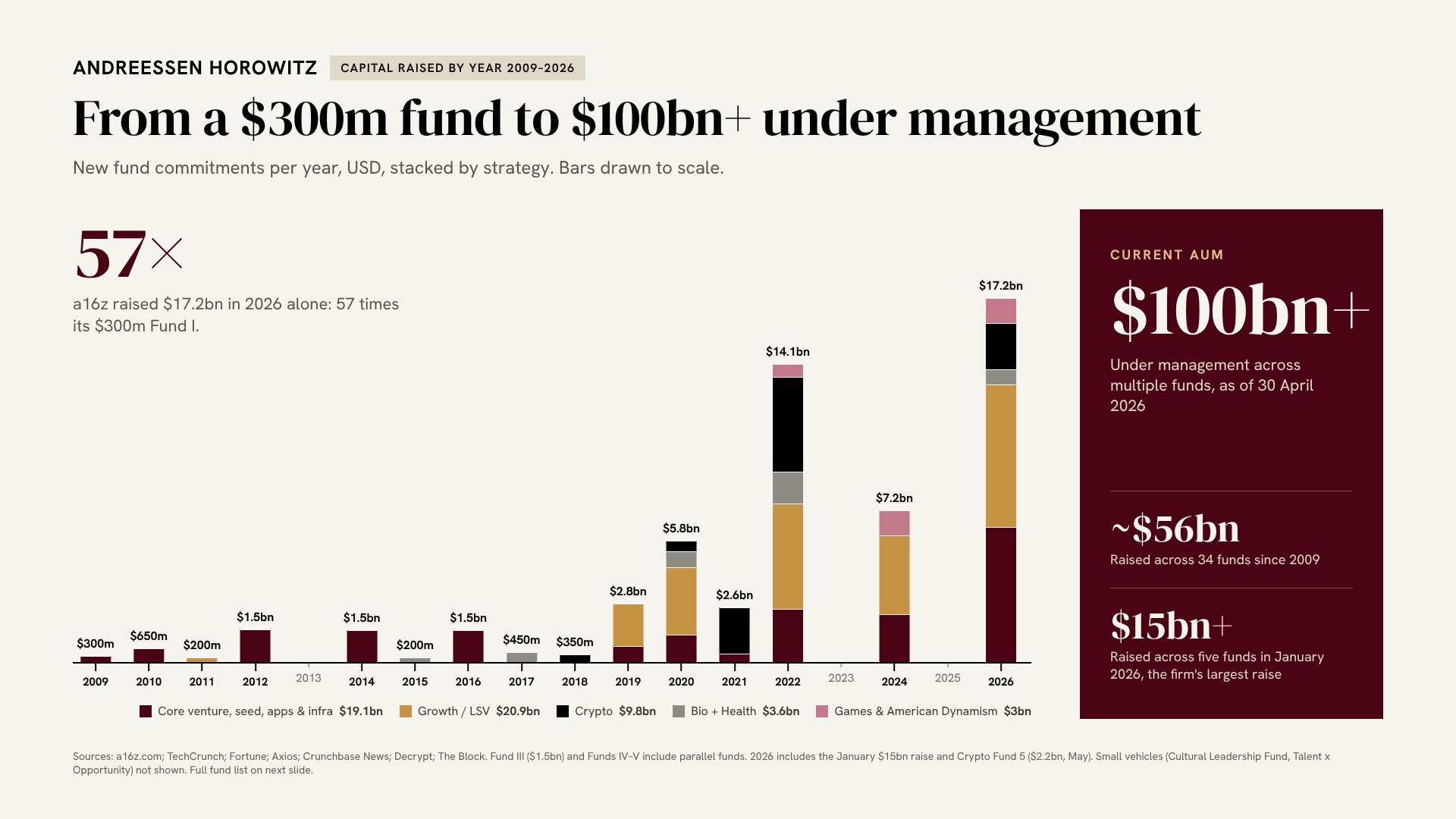
Andreessen Horowitz raised a $300m Fund I in 2009. By 2026 it had raised around $56bn across 34 funds and five strategies: core venture, growth, crypto, bio and health, and games and American Dynamism. In January 2026 alone it announced more than $15bn across five funds. The firm reports more than $100bn under management.
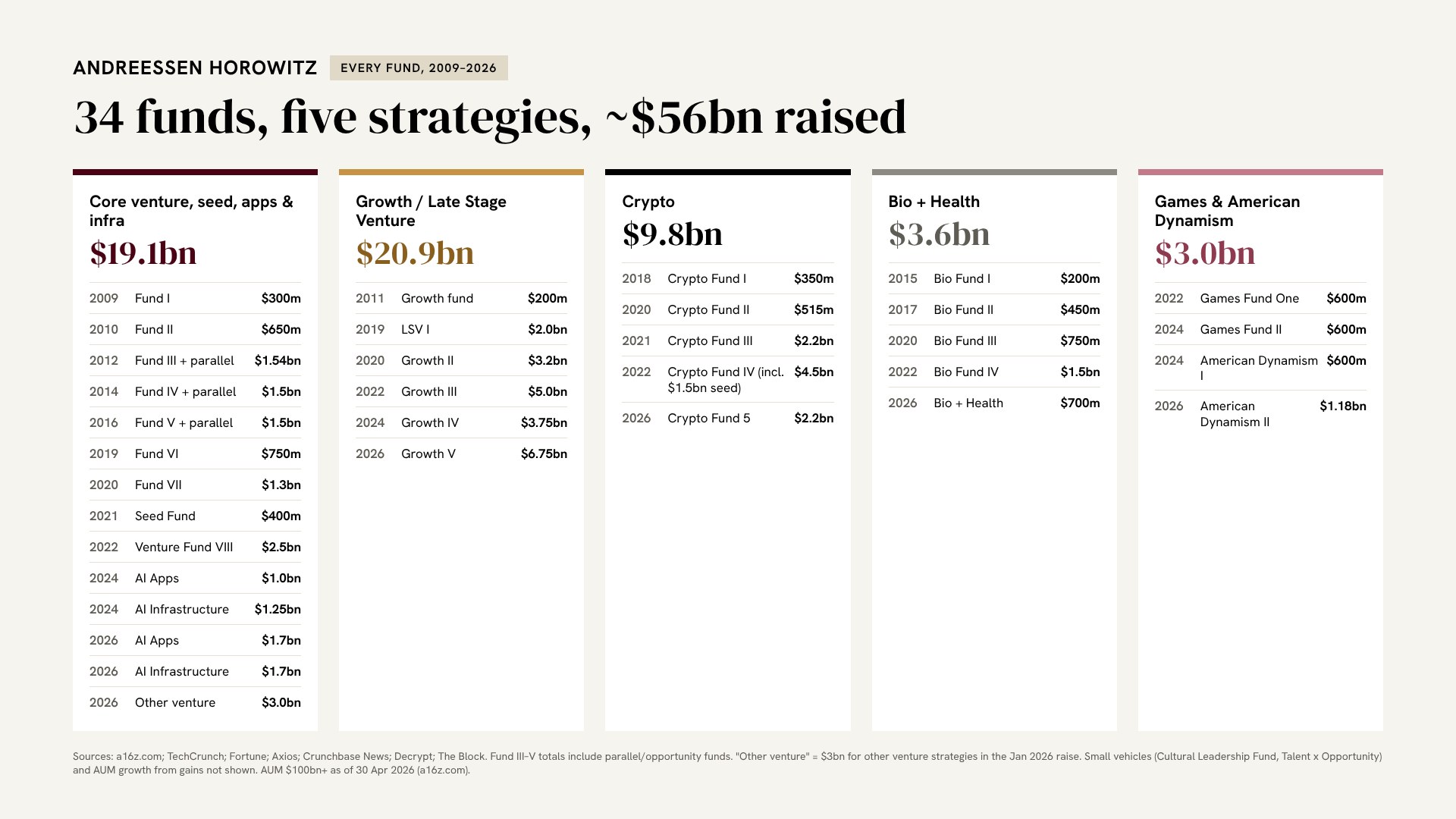
a16z is the clearest example of a firm designed as a platform from day one: an operating team, a media engine and dedicated strategy teams, each with its own fund family.
The lesson: the firm, not the fund, is the unit of strategy.
3. Your turn: map your journey to Fund III and beyond
Looking at other firms is useful. Mapping your own journey is more useful. That is why we built the Three Funds Canvas.
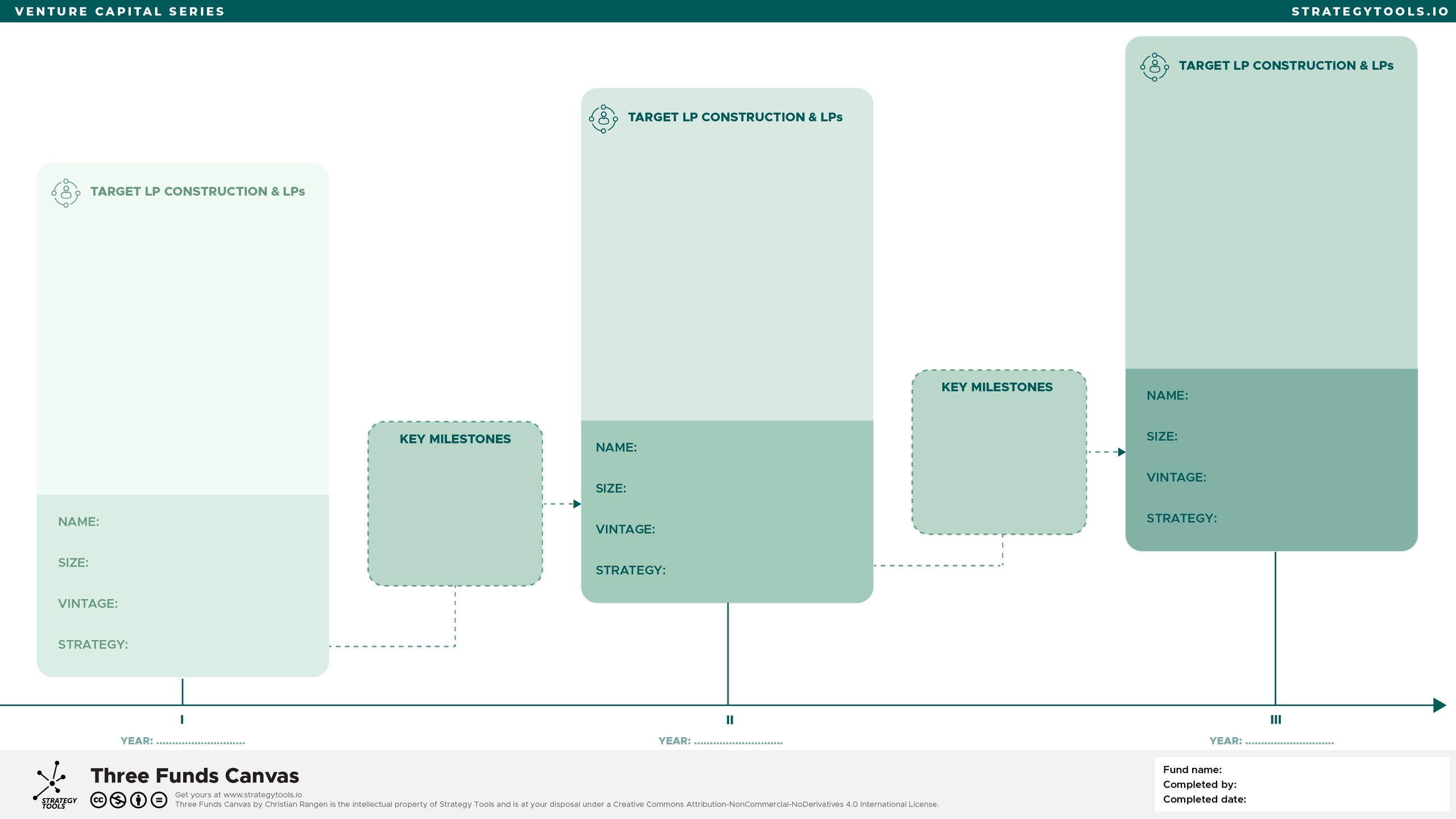
The canvas has three columns, one for each fund. For each fund you define:
- Name, size, vintage and strategy. What is this fund, how big is it, when does it close, and what does it invest in?
- Target LP construction and LPs. Who backs this fund? Fund I may be angels, founders, family offices and a development finance anchor. Fund III should increasingly include fund-of-funds and institutions. Name them.
- Key milestones. Between each fund, what has to be true for the next one to close? Think exits, distributions, team hires, follow-on rounds in your portfolio, and new LP relationships.
Three tips for using it:
- Start with Fund III. Describe the firm you want to be in ten years, then work backwards. Most managers do the opposite and get stuck at Fund I.
- Be honest about the milestones. They are the proof points LPs will look for. If you cannot write them down, you cannot deliver them.
- Plan the LP upgrade. The LP base that gets you to Fund I rarely gets you to Fund III. Map who you need to meet, and when.
Remember: fewer than 6% make this journey. The canvas will not raise your funds for you. But it will force you to think like a firm.
4. Key insights for emerging managers
Across eight firms, four regions and more than seventy funds and vehicles, seven insights stand out.
- Design Fund III before you close Fund I. The firm you want to become shapes the fund you raise first: its size, its LPs, its team.
- Momentum is a strategy. Plural went from €250m to €1bn in four years. Thrive has roughly doubled every two years since 2018. Raising the next fund while the story is strong is a skill.
- Persistence is also a strategy. MEVP missed a $250m target and still reached Fund IV. The firm outlived the setback.
- Add products, not just size. Opportunity funds (Plural), growth funds (BECO, Thrive), follow-on capital (Speedinvest) and sector funds (a16z) let you stay with your winners and serve founders end to end.
- Upgrade your LP base deliberately. Development finance institutions such as the IFC and EIB anchored funds for BECO, Knife and MEVP. They are often the bridge from friends-and-family capital to institutions.
- Distributions unlock the next fund. Knife’s fully divested Fund I, BECO’s Careem, Launch Africa’s first distribution: cash back to LPs is the strongest fundraising argument there is.
- Build the institution. Team, platform, brand and succession. Knife is now helping a new managing partner raise a fund under the Grindstone banner. That is a firm creating its own future.
The fund is the product. The firm is the company. LPs may commit to one fund at a time, but the managers who reach Fund III and beyond were building something bigger all along.
So, here is my question for you: are you raising a fund, or building a firm?
Want to map your own journey? Download the Three Funds Canvas at strategytools.io, or join one of our venture capital programmes.
Sources and notes: fund sizes are committed capital in each fund’s currency, from firm announcements and press coverage between 2009 and 2026, including TechCrunch, Fortune, Bloomberg, Business Wire, Wamda, The National, Disrupt Africa, SAVCA, the EIB and the firms’ own websites. Launch Africa Fund II figures were confirmed by the firm. Where sizes were not disclosed, we show them as undisclosed. The “fewer than 6%” figure comes from the author’s teaching and research on emerging managers.
About the author
Chris Rangen is a trusted advisor to investment organizations globally. He works closely with GPs, LPs, ecosystem organizations, national fund-of-funds and governments to build out VC ecosystems around the world. He has worked with 250+ emerging managers and taken 2.000+ people through the unique Fund Manager! Masterclass. He teaches venture capital at IMD, Oxford and Newton Venture Program at LBS.