
Zero. That’s how many €1 trillion companies Europe has ever produced. The US has seven. China has two. Europe’s largest public company, ASML, sits at roughly €520 billion — a magnificent business, but just halfway to the €1T mark. To close this gap, Europe has to do something it has never done at scale before: build a company from idea to trillion.
Here’s why that’s possible — and what it will take.
The Gap is Bigger Than Most Realise
Let’s look at the numbers. NVIDIA alone is worth more than €4 trillion. Alphabet sits around €3.5T. Apple, Microsoft and Amazon — each north of €2T. The combined market cap of the top five US tech companies exceeds the GDP of Germany, France and Italy combined.
Europe has world-class companies. ASML makes the machines that make the chips that power the AI revolution. Novo Nordisk rewrote GLP-1 therapies. LVMH redefined global luxury. SAP runs the world’s back office, Spotify put the Nordics firmly on the map. Magnificent companies — but none has crossed €1T, and none is close.
This isn’t because Europe lacks talent. Europe produces more STEM graduates per capita than the US. This isn’t because Europe lacks science. Europe leads in roughly a third of the world’s deep tech research output. This isn’t because Europe lacks capital. European pension funds alone sit on more than €6 trillion in assets.
What Europe lacks is the system that turns talent, science and capital into trillion-euro outcomes.
Why the €1T Barrier Exists
Four structural barriers are holding Europe back. I see them in our work across startups, scale-ups, fund managers, innovation agencies and governments — and they keep showing up in the same order.
Barrier 1: A fragmented Single Market. In theory, the EU has 450 million consumers. In practice, a founder in Berlin still faces 27 tax regimes, 27 labour codes, and 27 versions of “almost harmonised” regulation. A US founder addresses 340 million consumers from one Delaware entity on day one. A European founder fights border by border. This is not a rounding error. This is a structural handicap holding Europe back.
Barrier 2: The capital stack collapses at growth stage. Pre-seed and seed? Healthy in most of Europe today. Series A? Manageable. Series B, C, D, E — the rounds that actually build trillion-euro companies? That’s where European founders quietly book the one-way ticket to San Francisco. Mario Draghi put a number on this in his 2024 report: around 30% of Europe’s most successful scale-ups relocate to the US. Capital follows them.
Barrier 3: The European Paradox. Brilliant science. Mediocre commercialisation. Europe spends around €430 billion per year on R&D. The US spends roughly €900 billion. But the gap in trillion-euro outcomes is 7 to 0 — vastly bigger than the research gap suggests. The infrastructure that converts research into companies — spinout frameworks, entrepreneur-in-residence programs, IP-friendly universities, research accelerators — is still not industrialised across Europe. The challenge runs across academia, corporates and startups alike.
Barrier 4: No real exit market. When a US company hits scale, it has NASDAQ, a liquid secondaries market, and a deep M&A ecosystem with trillion-euro acquirers. When a European company hits scale, it has a fragmented patchwork of national exchanges, few trillion-euro buyers, and a current allergy to partial liquidity. Founders can’t cash out smartly. Investors can’t recycle. Pension funds won’t allocate. The whole system seizes up.
Fix these four, and a €1 trillion European company becomes more of a likelihood.
5 Moves to Build Europe’s First €1 Trillion Company
Move 1: Make EU Inc. a reality. Now.
The 28th Regime — a single, pan-European legal entity for startups and scale-ups — is the single highest-leverage reform on the table. One company structure. One tax treatment. One stock option regime. One employment framework. Available from day one across all 27 member states.
Europe has debated this for 15 years. It’s time to ship it. By 2027. Not 2035. Every month of delay is another cohort of founders who set up in Delaware instead of Dublin, Berlin or Tallinn.
Move 2: Unlock €500 billion of European growth capital.
European pension funds allocate roughly 0.01% of their assets to venture capital. Canadian pension funds allocate 5–10%. Do the math: if EU pension funds moved just 1% of their €6T AUM into European scale-ups, that would release around €60 billion of patient growth capital every single year. Enough to fund every serious European growth-stage company — several times over.
We need regulatory reform. We need a continent-wide equivalent of France’s Tibi Initiative. We need fund-of-funds platforms — an EIF, but 10x larger, and with growth-stage, not just seed-stage, ambition. And we need institutional investors to treat European scale-ups as a strategic asset class, not an exotic allocation.
Move 3: Use public procurement as an industrial weapon.
The EU and its member states spend more than €2 trillion per year on public procurement. That is not a budget line. That is the largest, most underused industrial policy instrument on earth. Every euro of that spend should, by default, be tested against one question: Could a European scale-up deliver this?
We need pre-commercial procurement at scale. We need anchor customer programs for European deep tech. We need defence, energy, health and digital sovereignty contracts routed deliberately toward European challengers — not default-bought from American incumbents. This is exactly how Silicon Valley was built — with the US Department of Defense as first customer to a generation of companies. Europe has not learned that lesson. It is well past time to learn it.
Move 4: Bet hard on the sectors where a €1T company can actually be built.
Consumer internet is over. The trillion-euro giants there are already built — and they are American. But the trillion-euro companies of the next decade will be built in:
- Applied AI and AI infrastructure — Mistral, Aleph Alpha, Lovable, and the next generation
- Defence tech and dual-use — Helsing, Quantum Systems, Tekever, ICEYE, Stark
- Green industry and climate tech — Stegra, 1Komma5
- Space and new mobility — Isar Aerospace, The Exploration Company, Kelluu
- Biotech and longevity — BioNTech, CureVac, Oxford Nanopore
- Quantum and deep compute — IQM, Pasqal, Alice & Bob
Europe does not need to win in every sector. Europe needs to pick 5–7 strategic arenas and go all-in. National innovation agencies, EU programs, public procurement, and pension capital should align behind those priorities. Not spread thinly across 400 simultaneous priorities, as is the default today.
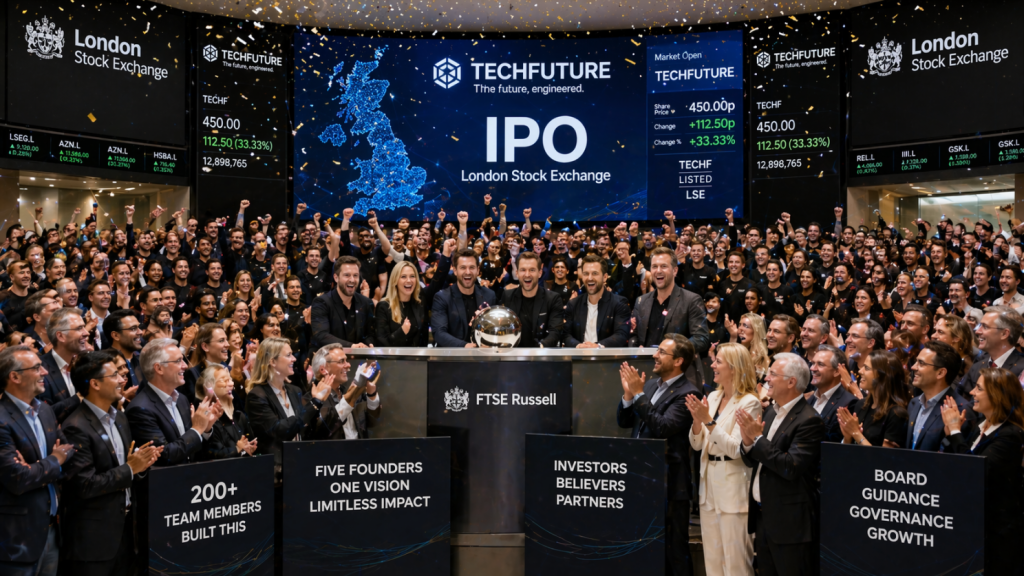
Move 5: Build a real European IPO and exit engine.
A €1 trillion company needs a €1 trillion-capable market to list on. Today, that effectively means NASDAQ. It should mean Euronext, London, Frankfurt, Stockholm — or better, a genuinely integrated pan-European exchange with the depth to host a trillion-euro listing.
This means consolidating Europe’s patchwork of national exchanges into a continental venue with real liquidity. It means secondaries markets that let founders and early investors take partial liquidity at Series C and D — rather than driving the whole company across the Atlantic to solve liquidity. It means pension and insurance capital flowing into European public tech — the buy-side that turns a strong IPO into a sustained run.
Sweden’s Nasdaq First North Growth Market is already Europe’s best model for growth-stage listings. The question is whether Europe has the ambition to build a continental version — or continue hoping that 22 small exchanges can compete with one NASDAQ.
Europe’s opportunity
Here’s the thing about trillion-euro companies: they don’t get built by accident. Apple, Microsoft, NVIDIA, Alphabet, Amazon — each is the product of decades of success, setbacks and progress. Ambitious leadership. Deep capital pools. Anchor customers. A single market. A tolerance for scale. A culture that celebrates building huge companies, not just elegant small ones.
Europe has an opening. The US is politically turbulent and increasingly inward-looking. China is closing. Global capital is searching for a third pole. Europe has the talent, the science, the institutions — and, for the first time in a generatio – we hope – the political will.
Draghi spelled out the stakes: “slow agony” if Europe fails to act. A year on, only around 11% of his 170 recommendations have been implemented. That pace has to change. The next Commission priorities, the next German coalition, the next French reform cycle — these are the vehicles that decide whether Europe’s first €1T company gets built here, or gets built in Palo Alto by European founders who gave up waiting.
What This Means for Each of Us
For governments and innovation agencies: Stop funding hundreds of small programs. Fund a dozen that matter. Align public procurement behind European scale-ups. Industrialise the research-to-company pipeline.
For pension funds and institutional investors: 1% of your AUM into European venture and growth is not risk. It is strategic capital allocation for your own continent.
For founders: Build for €1 trillion, not €10 million. Operate as a global company from day one. Don’t accept “European-sized” ambitions — that framing is part of the problem.
For investors: Stop shying away from €500M+ rounds. If you don’t write them, Sequoia, a16z and Tiger will — and the company will move.
For Europe’s ecosystem builders: This is the work. Across our Scale Up Europe!, Fund Manager! and Scale Up Angel! programs, and our engagements with innovation clusters, accelerators, fund-of-funds and national agencies, we see the pieces Europe needs to put together — and we see the talent and ambition ready to deliver.
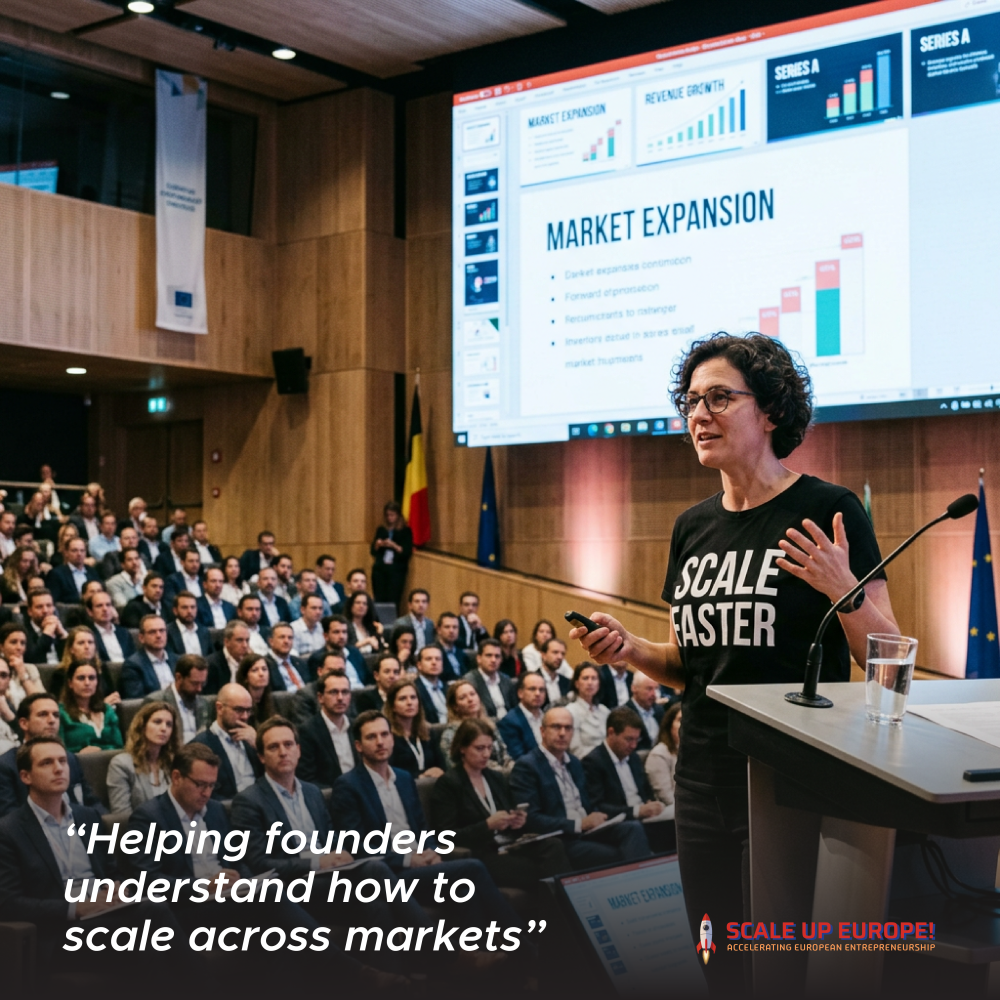
What we see in our Scale Up Europe! Masterclasses
We designed the Scale Up! Masterclass to equip founders, investors and board with the tools to ‘scale up’, to shift from building local to global companies.
To shift from simply managing a cap table to using the cap table as a strategic tool. To shift from ‘we need money’ to ‘this is how we will return your fund’.
We have spent 1000’s of hours working with global founders, global accelerators, global entrepreneurship programs with one mission: Equip more founders to not just start up, but to scale up.
Today, that means, you are on a path to build a €1 Trillion outcome. We have seen it happen, in the programs, from London to Zurich, founders achieving a €1 Trillion outcome. It can happen. It can happen again.
As a foundation for Europe’s scale up ambition we need founders who speak ‘entrepreneurial finance’, who understand the linkages from ‘lab to listing’, who can develop fund returning pitch decks and scale to DPI faster than peers.
All happening in Scale Up Europe! (coming soon)
Europe, It’s time to Scale Up.