

Two ecosystems. One label. A decade of confusion.
Walk into almost any innovation conference, policy roundtable, or national strategy briefing, and you will hear someone talk about “the ecosystem.” Founders, investors, policymakers and advisors all nod along as if they are talking about the same thing.
Unfortunately, they often are not.
In our ongoing research into Startup and Venture Capital ecosystems — and across the past years of workshops, ecosystem engagements and conversations with 150+ global experts — one pattern keeps repeating: the Startup Ecosystem and the VC Ecosystem are two distinct systems, with different players, different incentives, different metrics, and heroes. Treating them as one is one of the most profound mistakes a country, region, ministry or innovation agency can make.
From Startup Genome webinars, Ministry meetings in Canada and classrooms in London we’ve talked about the difference and how to best manage both.
This article breaks down that difference — and why it matters for anyone working to build, fund or grow a modern powered-innovation economy.
Mapping the two ecosystems
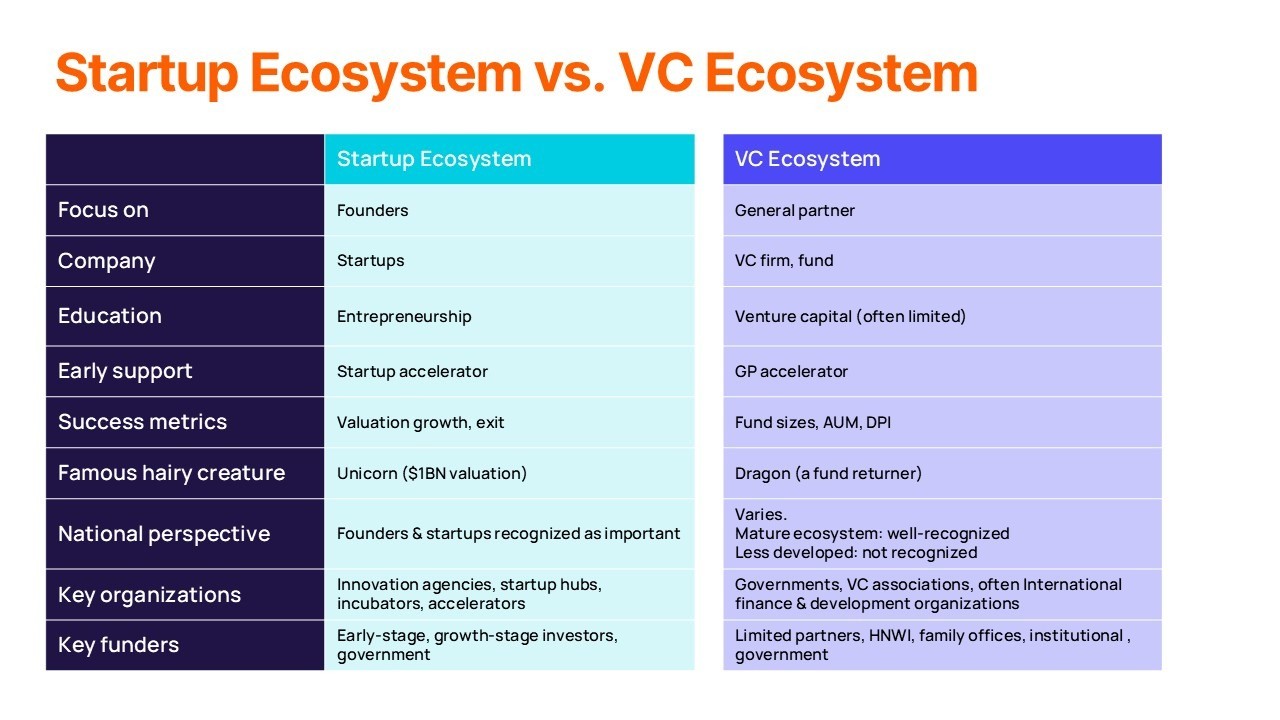
In our upcoming report, Scale Venture Capital Ecosystems, one of the key insights is this single page.
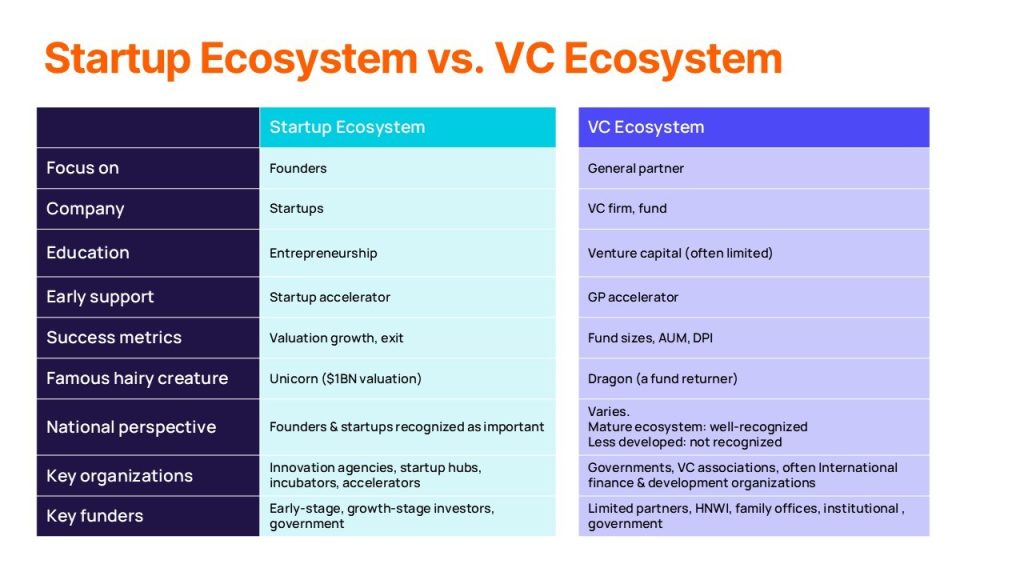
While most ecosystem conversations naturally center around the left side, the ‘Startup Ecosystem’, the most advanced, the most well-developed, the most mature ecosystem have realized a harsh truth; you can’t succeed with one, without also developing the other.
Understanding the two ecosystem perspectives
The Startup Ecosystem is built around the founder. The central company unit is the startup. The educational infrastructure is entrepreneurship, taught in classrooms everywhere. The early support is most often an startup accelerator, maybe a local incubator. The mythical creature everyone think they are chasing is the unicorn. Almost every country has a minister, an agency, a hub or a program or ten dedicated to building it.
The VC Ecosystem is built around the General Partner. The central unit is the VC firm and the underlying funds. The educational infrastructure around venture capital is, in most countries, thin to non-existent. In the New Nordics is pretty much absent. The early support is a GP accelerator, a concept most policymakers or innovation agencies have never heard of, a regrettable fact that will need to change. The mythical creature is the dragon — a single investment that returns the entire fund. And at the national level, whether it is recognized at all depends entirely on how mature the ecosystem has become.
Did you know…. it’s about 4x – 5x as hard to raise a venture capital fund, than it is to raise a regular startup funding round.
Why the confusion matters
In our work with governments, national fund-of-funds and innovation agencies, we see the same pattern in market after market: policy, capital and attention flow almost entirely to the Startup Ecosystem, while the VC Ecosystem is assumed to emerge on its own, or, in many cases, it is just entirely ignored.
When a country invests heavily in startup programs but ignores VC ecosystem development, the predictable outcome is:
- A startup pipeline that stall and flame out. Plenty of startups, too few fundable rounds, too little capital to deploy. Outcome: people complain about too little capital. Most companies never achieve breakout velocity
- Thin fund manager talent. Without GP accelerators, without structured fund manager education and development, without strong networks between GPs and LPs, the country produces founders faster than it produces investors, ultimately leading to founders and startups leaving, to secure capital elsewhere.
- LP capital sitting on the sidelines. Pension funds, sovereign wealth funds, family offices and DFIs may want to allocate — but find limited institutional-grade GPs to back, leading to more capital flowing to other alternative assets or get placed into US-based funds.
- Wonky metrics Governments measure unicorns. LPs measure DPI. Founders measure valuations. GPs chase dragons. Everyone is optimizing for a different number. Over time, most ecosystems struggle to clearly define what ecosystem success metrics look like.
- Underdeveloped infrastructure. The organizations, roles and networks that hold a VC ecosystem together — association bodies, LP education, GP onboarding, fund-of-fund vehicles, exit advisory networks — simply do not get built and scaled.
In many places, the Startup Ecosystem gets a minister post. The VC Ecosystem, barely a footnote.
Did you know….In our experience, every country or region should set themselves a benchmark. For every 4-5 startup accelerators, run 1 GP accelerator. So, a country with 20 startup accelerators, should aim to run 4-5 GP accelerators. Few do.
What we have learned across global ecosystems
Over the past three years, we have had the privilege of sharing this work with a remarkable range of institutions and audiences, including:
- Global audience at Startup Genome Webinars
- ISED – Innovation, Science and Economic Development Canada
- DFDF – Dubai Future District Fund, Dubai
- InnovateBC and InBC British Columbia, Canada
- EBRD – European Bank for Reconstruction and Development, London
- Newton Venture Program, London Business School
- Mauritius ecosystem and National Fund-of-Fund initiative
…and many more engagements with VC associations, innovation agencies, emerging managers and LP programs across MENA, Africa, Europe, North America and Asia.

Across these discussions, we have seen a few observations that travel well across regions:
1. Mature ecosystems built both — but rarely by design. In the US, UK, Israel and a handful of others, the VC ecosystem grew alongside (sometimes ahead of) the startup ecosystem over decades. Few of today’s policymakers can point to a deliberate VC ecosystem playbook. The conditions happened to be right.
2. Emerging ecosystems are learning to build both — on purpose. In Canada, the GCC, parts of Africa, South East Asia, and increasingly Central and Eastern Europee, governments, national fund-of-funds, international finance organizations are explicitly designing VC ecosystem interventions. Fund-of-funds, GP accelerators, LP education and co-investment programs are moving from “groundbreaking” to “minimum expected.”
3. The language is still catching up. Ask ten people in any market what a “VC ecosystem” is, and you will get ten different answers. This is not a language problem — it is an ecosystem problem. We cannot build what we cannot describe. With over 150 interviews completed and 100+ hours of workshops, this is a genuine challenge for us to solve for.
4. The VC ecosystem is a system, not a line item. Capital alone does not build a VC ecosystem. Neither does a single fund-of-fund. The functioning systems we study have GPs, LPs, educators, advisors, secondary players, exit specialists, legal infrastructure, cross-border networks and a shared language — all working together.
Why this matters for different stakeholders
For governments and policymakers. If your national strategy only names founders and startups, you are building half an engine. Ask the harder question: what is our VC ecosystem strategy? Who is responsible for it? Who measures it? Where does it sit in government circles?
For innovation agencies. Your mandate has likely grown beyond startups without anyone writing it down. The agencies doing the best work right now are quietly adding VC ecosystem tools — GP accelerators, LP education, fund-of-fund design — to their portfolio. Slowly, you might already have been building out the pieces, but without an overarching strategy.
For LPs, fund-of-funds and DFIs. You are not just allocating capital. You are shaping an ecosystem. The quality of GPs in your market in 10 years is being decided by the selection, coaching, governance and pacing decisions you make now. Notably, for FoF’s, there is a more strategic role to take for you.
For GPs and emerging managers. The ecosystem you operate in is as strategic as the portfolio you build. Where are the gaps? Where are the associations, the educational tracks, the peer networks? If they do not exist, there is an opportunity — and an obligation — to help build them.
For founders. Understanding the VC ecosystem is key. The capital you raise, the terms you accept, and the partners you choose are all shaped by forces that sit outside the startup ecosystem. Find your partners and know their definition of success.
Two ecosystems, one strategy
The most effective national innovation strategies we study treat the Startup Ecosystem and the VC Ecosystem as two parallel, interdependent systems, each with its own architecture, its own playbook and its own measurable outcomes.
They build founders and General Partners. They chase unicorns and dragons. They fund early-stage startups and emerging fund managers. They measure exits and DPI. They build entrepreneurship education and venture capital education – side by side.
That is the tale of two ecosystems. One without the other is, at best, a half-built engine — with lots of sparks and very little capital.
Continuing the research
This article is part of our broader, ongoing research into how Startup and Venture Capital ecosystems form, grow and mature — and how countries and regions can develop both deliberately.
Pre-register for the full research report, Scaling VC Ecosystems – forthcoming – here.
The report draws on:
- An extensive literature review of VC industry and ecosystem development
- A review of national and international VC development roadmaps, policies and strategies
- 150+ interviews with GPs, LPs, FoFs, policymakers, faculty, innovation agencies, and VC associations
- Key findings from ecosystem engagement workshops across multiple regions
If you are working on VC ecosystem development at a national, regional or institutional level — we would love to hear from you.
About the Author Christian Rangen is a strategy advisor and business school faculty member. He works with VC/PE firms, fund-of-funds, DFIs, innovation agencies and governments on venture capital ecosystem development. He delivers VC Masterclasses and mentors fund managers globally. Learn more at www.strategytools.io.