


Startup founder, raising pre-seed, seed, seed+, Series A or B? Spent the last six weeks obsessing over your deck? Good. Now let’s talk about the other 95% of the job.
By: Christian Rangen
Most founders we meet show up to their first investor readiness session with one thing in mind: “I need to improve my deck.”
And yes, you do. You almost certainly do.
But here is the uncomfortable truth we see play out, over and over, in programs across North America, MENA, Europe and APAC: your deck is the smallest piece of the puzzle.
Raising capital is not a deck-delivery exercise. It is a process. A long, multi-phase, team-based, full-contact process. One that — if you get it right — compresses into a tight, well-run, momentum-driven few months. One that — if you get it wrong — drags out over 18 months, burns your runway, exhausts your team and ends with a mediocre term sheet from an investor you didn’t want in the first place.
This article is for the founder who has realised the deck is not the job.
The job is running the fundraising process.
The three circles of fundraising
Before we get into the process itself, let’s zoom out.
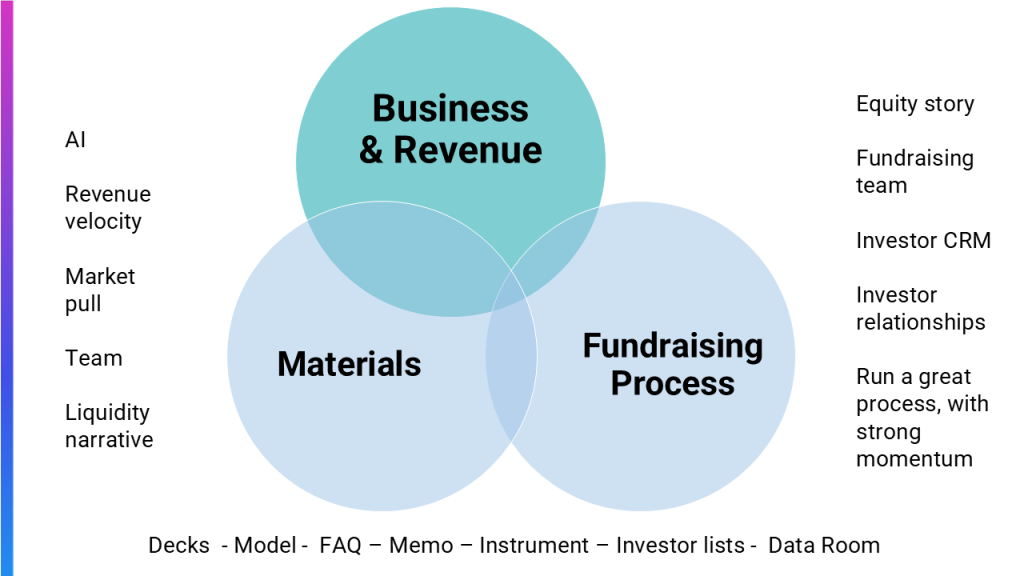
In our Scale Up Masterclasses, we always open with this. Every successful fundraising round rests on three things:
- Business & Revenue — the underlying company. AI story, revenue velocity, market pull, team, liquidity narrative. This is your equity story.
- Materials — decks, model, FAQ, memo, instrument, investor lists, data room. This is what the outside world sees.
- Fundraising Process — the actual running of the round. Team, CRM, relationships, momentum.
Most founders over-invest in circle two (materials, specifically the deck) and under-invest in circles one and three.
Fix that.
This article is about circle three.
Meet the Funding Journey Canvas
A few years ago, we started mapping out what a well-run fundraising process actually looks like. Not the theory. The practice. Pulled from our work on 400+ equity rounds, advising 1000’s of founders, and watching world-class fundraisers — and complete disasters — up close.
We studied the best founders in our portfolio. We interviewed founders across our programs. We analyzed work flows, timelines and success stories.
The result is the Funding Journey Canvas.
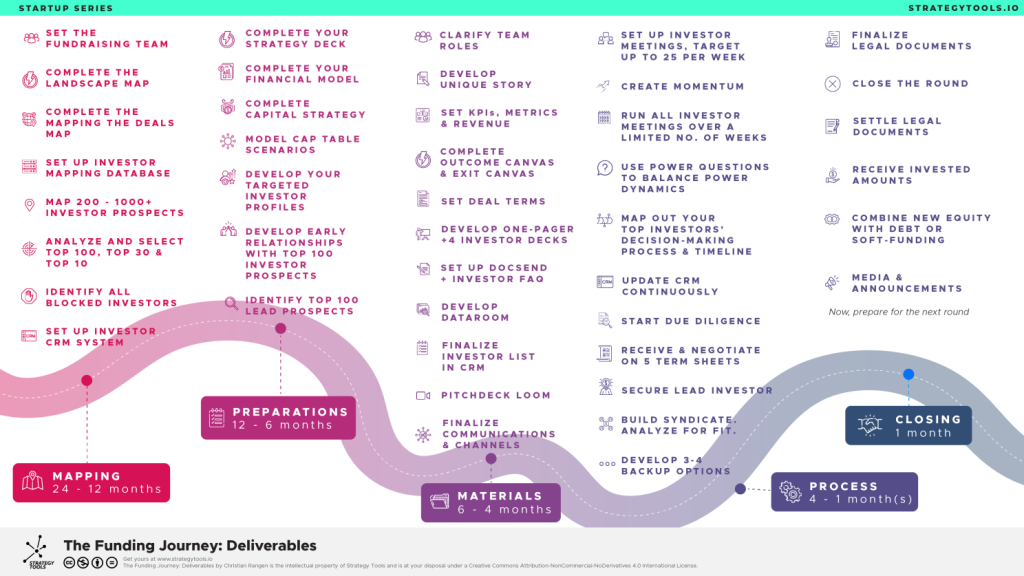
Five phases. Forty-three steps. From the moment you start thinking about your next round, all the way to the cash transfer hitting your company bank account and the announcement going live on LinkedIn.
The five phases:
- MAPPING — 24 to 12 months before the round
- PREPARATIONS — 12 to 6 months before the round
- MATERIALS — 6 to 4 months before the round
- PROCESS — 4 to 1 month(s)
- CLOSING — 1 month
Yes. Read that again. 24 months. The best fundraisers we have studied started two years before they raise.
Most founders start a few months before. And then wonder why it’s so hard.
Let’s walk through all five phases and all 43 steps.
(Download the full Funding Journey Canvas — the one-page visual — at the end of this article.)
Phase 1 — MAPPING (24 to 12 months out)

This is the phase nobody talks about. It is also the phase that separates the founders who close quickly from the founders who grind for 18 months.
8 steps in this phase:
1. Set the Fundraising Team. You are not raising alone. Decide, now, who is on the team. CEO, CFO, a project member, board support, advisors. (More on roles below.)
2. Complete the Landscape Map. Who is actually funding companies like yours, right now, at your stage? Map the landscape — sector by sector, stage by stage, geography by geography.
3. Complete the Deals Map. Study the deals. Who led? Who followed? Ticket sizes? Valuations? Terms? This is public information. Crunchbase, PitchBook, MagnitT, Dealroom, Carta data, LinkedIn announcements. Do the work.
4. Set up Investor Mapping Database. This can be a Google Sheet, a Notion, an excel. This is where you dump a lot of data, before you start analyzing and cleaning it up.
5. Map 200 – 1000+ Investor Prospects. Yes, really. A thousand names. In 2026, with AI tools, any serious founder can build a 1000-name investor list in a day. If you can’t, that’s a skill gap you need to close — fast.
6. Analyze and Select Top 100, Top 30, and Top 10. Not every name is a fit. Narrow down. Your Top 10 are the investors you truly want. Your Top 30 are your core pursuit list. Your Top 100 is your full active pipeline.
7. Identify All Blocked Investors. Investors who already backed a competitor. Investors who have a policy against your sector. Investors whose fund cycle is wrong. Strike them off. Don’t waste a cycle on a dead lead.
8. Set up Investor CRM System. Notion, HubSpot, Attio, Affinity, Airtable — pick one. Use it. This CRM becomes the single source of truth for your entire process.
Pro tip: Most founders skip Phase 1 entirely and then try to do all of it in week one of their fundraise. That’s a big reason why they fail.
Phase 2 — PREPARATIONS (12 to 6 months out)

Now you start preparing to raise. Not raising. Preparing.
7 steps in this phase:
9. Complete your Strategy Deck. Your internal strategy deck. What are you actually building? Where are you going? This is the document behind the pitch deck.
10. Complete your Financial Model. A real model. Not a spreadsheet your intern built in 45 minutes. Base, bull, bear cases. Unit economics. CAC, LTV, churn, gross margin, NRR, burn multiple. Know your numbers cold.
11. Complete Capital Strategy. How much capital do you need over the next 5-10 years? Across how many rounds? At what valuations? With what dilution targets? This is the long game. Read our MENA 101 piece on this — most founders don’t have a capital strategy, and it costs them dearly.
12. Model Cap Table Scenarios. 3-5 rounds forward. Fully diluted. With ESOP, SAFE conversions, priced rounds, warrants. Model the dilution. Understand where you end up.
13. Develop your Targeted Investor Profiles. Not a generic “VC.” A specific profile. Fund size, check size, stage, geography, sector thesis, decision-making pattern, known partners.
14. Develop Early Relationships with Top 100 Investor Prospects. This is the one most founders miss. Start meeting investors 6-12 months before you need to raise. Not pitching. Relationship-building. Sharing updates. Asking for feedback. By the time you officially raise, they already know you. That’s the goal.
15. Identify Top 100 Lead Prospects. Of your list, who are the lead investor candidates? Leads are rare. They set the terms. You want 20, 50 even a 100 realistic lead candidates at the top of your pipeline. That’s tough.
Phase 3 — MATERIALS (6 to 4 months out)

Now we talk about the deck, the decks and model.
11 steps in this phase:
16. Clarify Team Roles. Who is doing what during the process? (See the roles section below.)
17. Develop Unique Story. Your narrative. Not a generic “we do AI for X.” A specific, memorable, differentiated story that a VC can repeat, word for word, to their partners on Monday morning.
18. Set KPIs, Metrics & Revenue. Lock in the 3-5 metrics that define your business. Know them. Own them. Report them consistently.
19. Complete Outcome Canvas & Exit Canvas. Most founders avoid the exit conversation. Wrong move. Your investors need a credible liquidity path. Map out the outcome scenarios and the exit landscape. Get comfortable structuring creative liquidity solutions and don’t shy away from talking about exit strategies, even if it’s early.
20. Set Deal Terms. What round size are you raising? What valuation cap? What discount? What instrument? What minimum check? What allocation for strategic angels? Set your own terms before someone else sets them for you.
21. Develop the Six Investor Decks. The one-pager. The teaser. The pitch deck. The meeting deck. The long deck. (We wrote a whole piece on the six decks you need).
22. Set up DocSend + Investor FAQ. DocSend or similar. Password-protected. Tracked views. Plus a proper 25-50 question Investor FAQ so you never answer the same question in 80 different first calls.
23. Develop Dataroom. Structured. Folder-organized. With guiding text. Ideally with Loom intro videos for each section. A dataroom designed through the lens of the investor experience, not your internal filing convenience.
24. Finalize Investor List in CRM. All key target names loaded, tagged, ranked, and sequenced.
25. Pitchdeck Loom. A 10-15 minute Loom of you walking through the deck. This is a game-changer. Many investors will watch the Loom before they take the meeting. It’s still amazing how view founders do this.
26. Finalize Communications & Channels. LinkedIn, email, warm intros, events. How are you reaching each investor tier? Write down the plan.
Phase 4 — PROCESS (4 to 1 month(s))
Now the round is live. And this is where the best founders separate from the rest.

11 steps in this phase:
27. Set up Investor Meetings — target up to 25 per week. Yes, 25. Per week. For 4-6 weeks. This is what running an actual process looks like. Not three meetings per month.
28. Create Momentum. Momentum is everything. Investors don’t want to be the first. They want to join something that’s moving. Signal movement. “Closing $X of $Y. Two soft commits. Lead conversations active. Targeting close in 6 weeks.”
29. Run all Investor Meetings over a Limited No. of Weeks. Compress. A 4-week process beats a 16-week process every time. Get them all in parallel. Create real intensity.
30. Use Power Questions to Balance Power Dynamics. Fundraising is a power negotiation dressed up as a friendly conversation. Ask questions that shift dynamics: “What would you need to see to move to term sheet?” “How does your partnership make decisions?” “Where do we fit in your current portfolio thesis?”
31. Map out your Top Investors’ Decision-making Process & Timeline. Every fund has a process. Partner meetings on Mondays. IC on Thursdays. Six weeks from first meeting to term sheet. Map it. Work it backward.
One of our portfolio companies tried to raise from a Danish utility. Turned out they had 18 people involved in the decision-making process, including the full board. Our founders assumed it was just two….
32. Update CRM Continuously. Every call. Every email. Every soft signal. Into the CRM. Your future self will thank you.
Trust us on this. Three years and two CFOs later, you will be really glad you had the discipline to do this.
33. Receive & Negotiate on 5 Term Sheets. Five. That’s the target. Why five? Because one term sheet is not a negotiation. Five term sheets is optionality. Leverage. Power. “Run a great fundraising process” means ending up with multiple competitive offers. This is what we call the ‘double Olympic Gold Medal of Entrepreneurship”. Aim for five. Work backwards on how to get there.
34. Start Due Diligence. DD is not something that happens after the handshake. It starts early. Be ready. Data room open. Legal files organized. References warmed up. Use your board or financial advisor to run DD prep sessions.
35. Secure Lead Investor. The lead is the one who sets price, terms, and timing — and signals validity to everyone else. Get the right lead. Not the fastest. The right one.
36. Build Syndicate. Analyze for Fit. With your lead in place, build the syndicate. Strategic angels. Follow-on funds. Operator investors. Corporate VC, if it helps. Don’t just fill the round — be strategic about it.
37. Develop 3-4 Backup Options. Because things fall apart. A lead might ghost in week 3 of DD. Always have backup options warm and ready, even if it is internal loans at 18% or selling off a part of your team to fund the next 9 months.
Phase 5 — CLOSING (1 month)

You’ve run a great process. Now close it. One of our clean tech portfolio companies made it this far. They did everything right. Last second, the lead investor came back “we think it makes sense to have a commercial milestone based tranched disbursement plan, wouldn’t that make a lot of sense?” Well, safe to say, we never actually saw the last tranche hitting our bank account. Truly, a round is not over until its paid in.
6 steps in this phase:
38. Finalize Legal Documents. SHA, SAFE conversions, share classes, warrants, side letters, board resolutions. This takes longer than you think. Start early.
39. Close the Round. Signatures. Transfers. Confirmations.
40. Settle Legal Documents. File everything. Update the cap table. Store everything in the data room.
41. Receive Invested Amounts. Make sure every payment arrives. Chase down stragglers. This is where the project member earns their keep and the CFO sweat.
42. Combine New Equity with Debt or Soft-funding. Smart founders don’t just raise equity. Grants. Revenue-based financing. Venture debt. Soft-funding. Stack the capital stack intelligently to extend runway and reduce dilution.
43. Media & Announcements. Announce well. Thoughtful LinkedIn posts. A strong press release if relevant. Great customer communications. A round announcement is also a recruitment tool, a sales tool, and a signal to the next round of investors.
Now, prepare for the next round.
The founders who win
Here is what we have learned, over 15 years, 400+ equity rounds, 100’s of Scale Up! Masterclasses and Investor Readiness Programs globally:
The founders who raise well are not the ones with the best decks.
They are the ones who run the best process.
They start early. They build the team. They map 1000+ investors. They build real relationships 12 months before they raise. They run a compressed, competitive process. They end up with five term sheets on the table. They close in six weeks, not six months. And they get back to building.
The 43 steps in the Funding Journey Canvas are not a wishlist. They are the operating manual.
Use them.
Download the Funding Journey Canvas
Download the full Funding Journey Canvas — the one-page canvas covering all 5 phases and 43 steps
Want to read more?
- Ready to raise capital? Here’s your materials checklist
- Founder? These are the six decks you need
- Startup Founder? 15 Steps to Upgrade Your Deck
- Fundraising in MENA 101 — Your first funding round
- Entrepreneurial Finance Readiness Level
About the author
Christian Rangen is a global advisor on entrepreneurship, venture capital, and ecosystem building.
- 150 personal investments across startups, funds, and ecosystem initiatives
- Inside 400+ equity rounds — pre-seed to post-IPO, as founder, investor, advisor, and board member
- Advised 1000’s of founders on startup and scale-up financing globally
- Works with accelerators, ecosystems, innovation agencies and governments on building better investor readiness programs
- Visiting faculty at several business schools. Chairman of three venture capital funds.
Christian developed the Funding Journey Canvas, the EFRL framework, leads Scale Up! Masterclasses & programs delivered globally to founders, accelerators, angels, and ecosystem builders.
See how Strategy Tools‘ global team can partner to strengthen your ecosystem and next investor readiness program.