


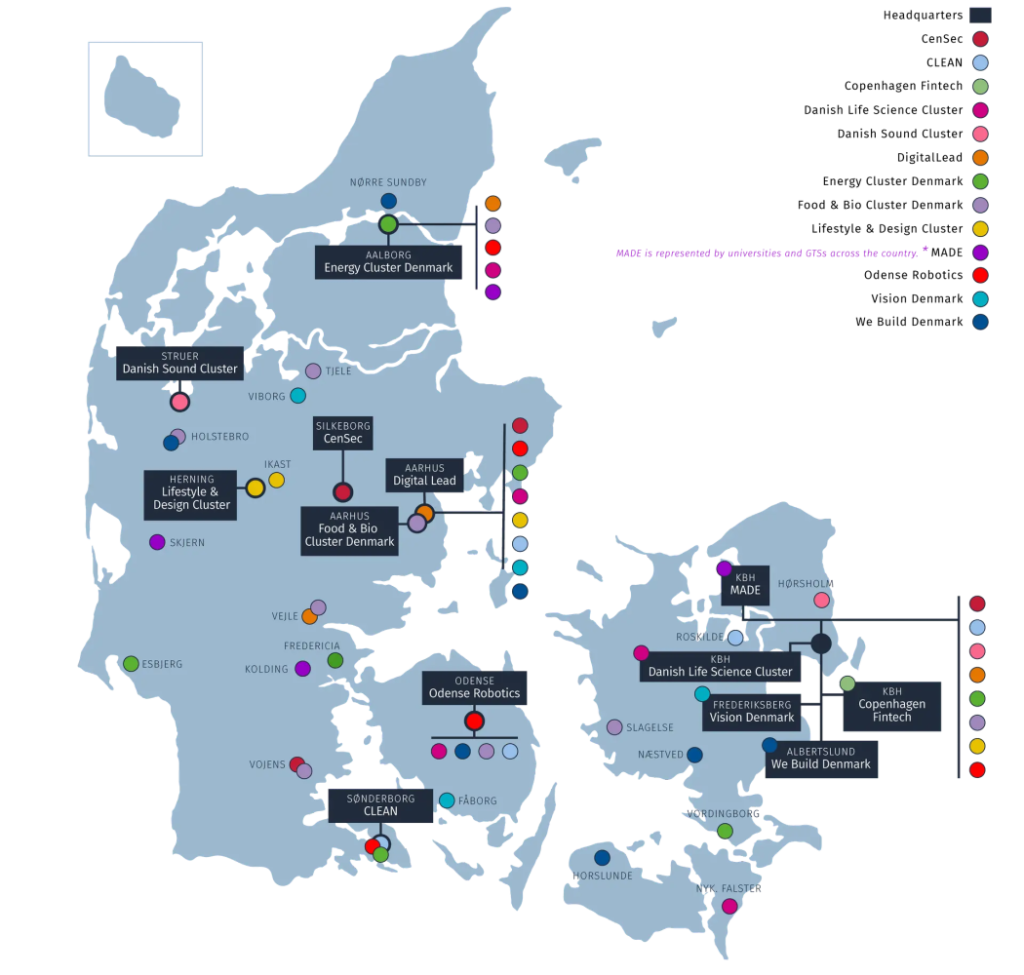
Globally, there are more than 7.000 innovation clusters. From AI & tech in Saudi Arabia to life sciences in Denmark, from seafood in Norway to deep tech in China, clusters make up a core part of national or regional innovation infrastructure, in many places being the #1 engine of innovation in that system.
But how does a cluster get started? How can a small and engaged team get a cluster off the ground?
Well, in light of the ongoing (2026) call for Excellence Cluster in Sweden, I wrote up a short piece.
This article is based on my personal insight, experience and learnings from working with 400+ clusters over 15+ years. Hopefully, it can serve as a guide to new clusters being formed, both in Sweden and beyond.
Not official advice
This text is mine alone. It does not represent official Vinnova or VR (Research Council) advice or policy. I have spent significant time reading up on the program, but in certain areas, Vinnova or VR might have differing opinions. In those cases, Vinnova and VR will be right. Not me. Having said that, I’ve been working with clusters for 15+ years, so I have high confidence in the validity of these suggestions.
18. steps to launch
We identify three stages, each with six key steps to complete. We also brought this together in this ‘super-simple-to-use’ checklist format.
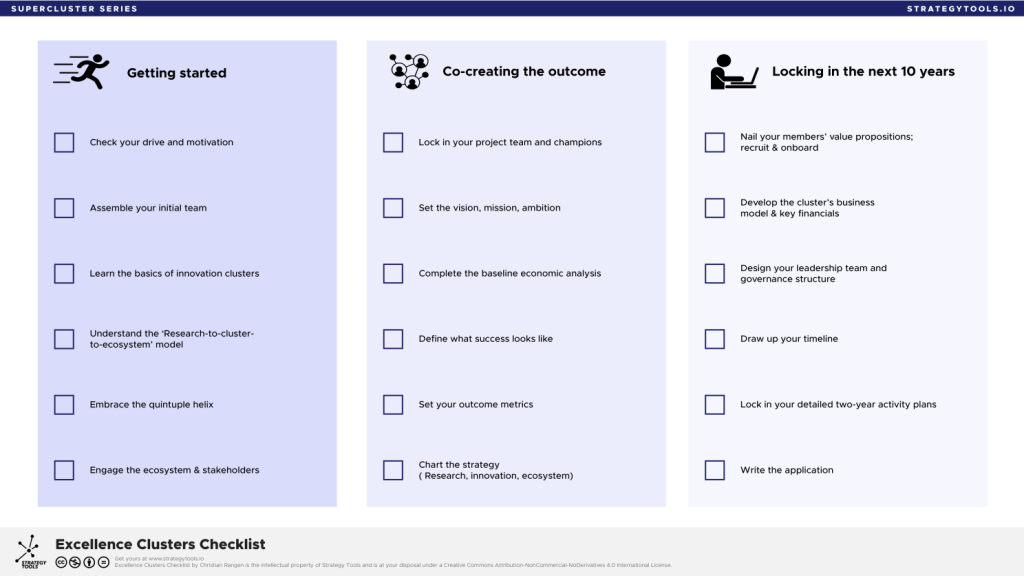
Stage I: Getting started
These are your initial, sounding steps. In this phase, you are exploring, testing, learning and evaluating. At this stage, any time, you might decide to not pursue this any further. Maybe.
1. Check your drive and motivation
Much like building a venture capital firm or launching a startup, building a cluster takes real commitment over years, possibly decades. If you are the engine, the champion, ‘the lone hero’, make sure you have the drive and motivation, the engine and the fuel to carry this through. If you – and your team – is successful, you will be responsible for launch an innovation cluster that could operate, innovate and scale over 10-20 years. That’s pretty rockstar!
But check, do you have the drive for this? There will be setbacks. There will be delays. The probability of landing the national funding (most common model globally) is small, in some cases less than 5% – 10% .
Always, check your energy and motivation for doing this.
2. Assemble your initial team
Even a rockstar like you can do it all alone. You need a team. But, you need a team of like-minded people, coming from across the ecosystem. This is key. Do not gather five like-minded, similar looking people with the same background.
You need, ideally, the former CEO, now retired, that says ‘I know some people I can call’. You need, someone, representing the capital side. Maybe a banker, maybe an investment banker. Often, a successful founder-now-operating-his-own-family-office. You need academics. You need young energy. You need older networks and wisdom. You need diversity.
Get your initial team in place and secure their commitment. Initially, mostly time and work.
3. Learn the basics of innovation clusters
In my experience, enthusiasm only get you so far. At some point, you need to know what you are talking about too. Turns out, most people do not, truly, understand an innovation cluster until we get into year 3; and we don’t have time for that.
Spend time to read up on the basic elements of clusters. Catch a report. Map out clusters in your part of the world (Norway, Denmark has plenty information online). Read the strategy documents, annual reports and impact reports from other clusters. Sign up for cluster newsletter.
Heck, get in the car and go visit a few. In my experience, most are more than happy to share their learning to date. There are books. The classics. Like Porter’s classic. There are reports. Easier. Blog posts. TCI Webinars.
It’s out there. Go get it.
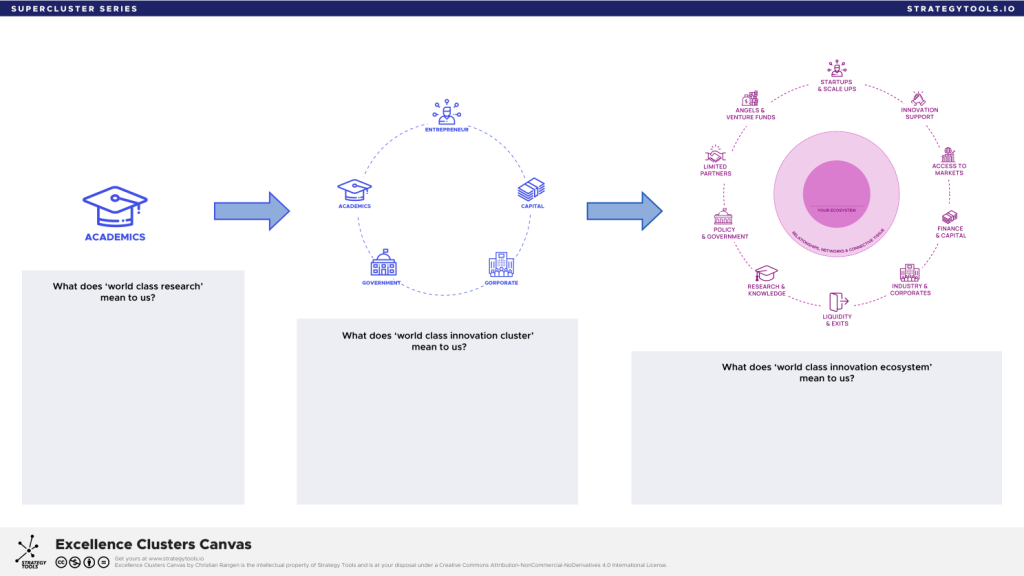
4. Understand the ‘Research-to-cluster-to-ecosystem’ model
Uniquely to Sweden, the program is heavily structured for ‘world class research’ and also ‘world class innovation’.
In my interpretation, we need to think – and connect the dots from ‘world-class research’ to ‘world-class innovation’ to ‘world-class market leadership’ to ‘world-class ecosystem’. This is a long value chain.
In some fields, like life sciences or advanced biotech, this chain can take 20 years or more. In others , it can take 24 months.
Make sure to discussion, reflect and digest: “what does the model mean to us?”
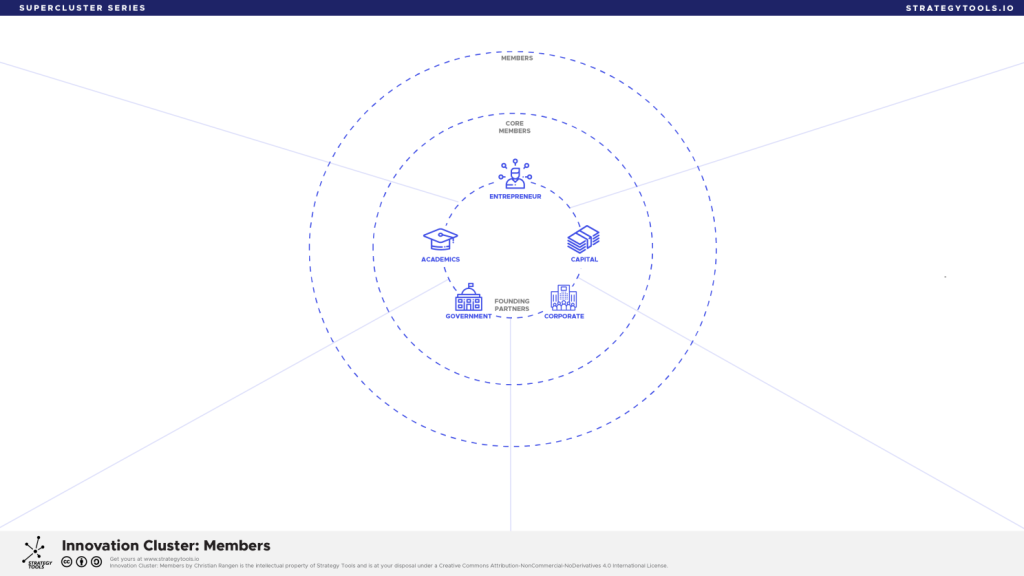
5. Embrace the quintuple helix
There is no way around this one. You don’t build a cluster, today, in 2026, without having the Pentagram at the core. Sure, in the 1990’s most clusters were firmly Triple Helix.
Not anymore. The Triple Helix has held back European innovations and economies long enough.
As the hero here, make sure you embrace, understand and truly work with the quintuple helix. It matters.
(Disclaimer: if you are a world class researcher, chances are you have firmly grown up in a triple helix universe. It’s not your fault. But the implications are that most researchers are not at all connected into the capital side or even the entrepreneurship and startup side. These are systemic challenges across the European society due to an overly reliance, heck, even a love affair with the Triple Helix. It’s time to kick that. But like any addiction, it may time some time. If you, the researcher, is not familiar with all the building blocks of the Pentagram, find team members that are.)
6. Engage the ecosystem & stakeholders
Do.Not.Skip.This.Step.
You need to get out of the building. Talk to key people across the ecosystem. Engage your stakeholders. The ones that do this point well? Gather 100’s of potential partners in a series of workshops with strategic discussions, often asking key questions like:
“What would a world-class life science cluster need to provide for your organization?”
“As Sweden’s largest investment firm, what would you hope to gain from being a Founding Partner in an advanced material sciences cluster?”
“As a former VD(CEO) at SAAB, and now board member, business angel and author on management practices, what do you see are the barriers holding Sweden back from bringing world class research to market?”
“As the former Dean at Chalmers, now board member at Nasdaq North, how can we better link the bridges and strengthen the ties between our research communities and our public markets?” (Sweden is already a world-leader, but it is an never-ending competition)
“As a business school, how might we combine your interests and programs, with the world class research planned for the defense tech cluster?”
“As a city council, actively involved in the energy & climate research cluster, what would you need to see to invest your time – and annual membership fees?
Ask. Listen. Engage. These strategic discussions are key. They set the foundation for what comes next, the actual work.
Stage II: Co-creating the outcome
Ok, we’ve had the meetings. Now, it’s time to get serious. It’s time to do the work. It’s time, to engage your partners, team, members in co-creating the outcome.
7. Lock in your project team and champions
Look back at all the conversations you’ve had over the past few weeks and months. Who impressed you? Who were the champions? Who brought energy, network, access? Who can connect the weak links we have between world class research and our ability to scale to big companies? Lock in the team. Cancel other commitments. Get your key nodes, your champions onboard. Get their commitment.
This, this is now your Project Team and your extended Project Team.
8. Set the vision, mission, ambition
With the project team onboard, lock yourself in a room and complete the following:
Problem statement: why are we here?
Solutions: What do we need?
Based on that, you should emerge unscathed with:
Vision: Mission: Ambition: Sounds easy. Can be done in an afternoon.
Usually takes months.
9. Complete your baseline economic assessment
This used to be months of outsourced consulting work, expensive economic analysis. Not any more. Today, most can complete this using a series of AI tools, and some extra verification of data and sources. It is not a research paper. It is just your shared understanding of the current economic footprint of your proposed cluster.
Answer these six questions: For our proposed cluster, how would we assess these:
A) Number of companies in this sector (define the sector)
B) Number of jobs
C) Number of researchers, academic
D) Contribution to GDP
E) Total value creation (often measured in GPD-level $)
F) Revenue / headcount in the industry
Example: In our industry space, we assess:
A) 954 companies, of which 9 are more than 6.000 people, 45 are 1.000 – 6.000, 500 are 100-1.000 and the rest below 100 people
B) In total, the sector employees 21.000 people
C) In total, we count 495 researchers, per Q2 2026
D) The industry contributes 3,1% to GDP (2025)
E) In total, the industry delivers SEK400BN, of which SEK380BN is exports
F) The revenue / headcount is SEK 3.2M
(ok, these are random numbers, but I think you get the point)
10. Define what success looks like
Now that you have the problem statement, the vision, the economic baseline. You have the world-class research, the world-class innovation ambitions; what does success look like to you and the cluster?
Remember, you probably got started from a ‘research lens’, and gradually came to learn that clusters are highly dynamic, collaborative platforms with multiple categories of members and stakeholders. How do you pull this together, so everyone wins?
How do we connect all the dots needed to build, truly, a future competitiveness platform for AB Sweden?
Research matters. Innovation matters. Ecosystem success matters. What does success here look like?
11. Set your outcome metrics
Following that, the metrics to define your success. In Canada, the focus has been mostly on net new job creation (target: 50.000/10 years) in high-value, high-productivity sectors.
In the Seafood Innovation Cluster in Bergen, the metrics was 3X the value of the aquaculture industry by 2030; connecting research, fish health, biomass, operating licenses, new technologies, new markets, with a rapidly increasing demand for Norwegian salmon (all, eat more fish).
What would be one, two or five (never more) outcome metrics that in 2037 shows you have achieved your ambitions?
12. Chart the strategy (Research, innovation, ecosystem)
Now, you got the ‘why’ and the ‘what’. Next is how.
This is where the strategy come in.
Supercluster strategy Maps, Supercluster intro or the Excellence Clusters Strategy Map are all designed to help you here.
From our work with clusters around the world, we find this to be a surprisingly simple exercise (but, again, it just takes some time..). There are commonly 20 key strategic focus areas for most clusters. Select amongst these 20, trim it down to 5, and you should be ok. F
or Sweden, make sure to structure the work to cover both the world class research, world class innovation and world class ecosystem development; all tied together.
Ideally, by now, you have engaged 100’s of people in strategic discussions. You have onboarded a world class project team.
Time is running, but you are working fast. You have aligned on the strategy (it might even have been easier than you first thought).
Next, bringing it all together and then some.
Did you know, most clusters draw up a ten-year strategy roadmap, with three distinct stages.
- Stage I: 0-2 years (learning to walk)
- Foundation phase. Stage II: 2-5 years (Learning to work)
- Project growth phase Stage III: 5-10 years (Learning to fly) – Cluster impact phase
These three stages also align well with the evolution of the cluster business model, see below.
Part III: Locking in the next 10 years
Bring out your computer, it’s time to zoom in and write it up. It’s time to lock in the strategy, roadmap, business model and governance.
13. Nail your members’ value propositions
In your cluster, you are going to want to have members, many members. Strategic partners. Research partners. Go-to-market partners. Capital resources. Scale ups. (See, Cluster Members).
But this time, you also need to bring them onboard, properly. For this, you need a crystal clear value proposition. Why, after all, should they join? Why, should they care? Note, it’s not enough to have a generic value proposition. “We got a great cluster, you should join”.
You need to identify the unique value proposition for each of your target partners and members. You got the world-class research. What else?
What would Svenska Handelsbanken gain by joining the cluster, what’s in it for them?
What would you expect from them? What would Atlas Copco gain? Why should they join?
The Stockholm School of Economics, why would they be interested? What’s their value proposition?
Heidi Lindvall from Pale Blue Dot, Johan Brenner from Creandum or Klas Johansen at Redstone; why would they want to join the cluster? What’s in it for them?
Once you can nail these different, unique value propositions you are in excellent shape, truly, and you should be able to bring in 10’s or 100’s of members to get the cluster going. The world class research networks are key; building out the rest will bring the research to market and to scale.
14. Develop the cluster’s business model & key financials
At some point, you are going to want to dive into the numbers. That’s why we developed the powerful cluster business model, en äffarsmodell for clusters.
It’s based on PPP, Private (sector funding), Public (sector funding) and Project (based funding). Read more in our Cluster Business Model report, co-written with cluster leaders globally.
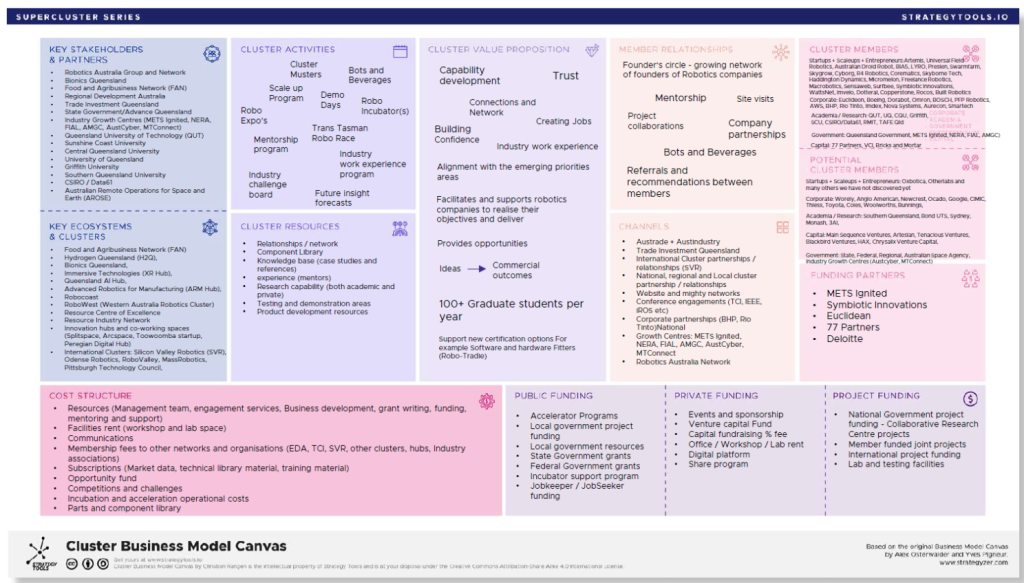
This makes for an excellent project team exercise, working visually together, backed up by some kick ass heavy excel spreadsheets modelling out a ten-year financial journey, with 100’s of million of cash flow coming in, flowing through to your key budget posts:
- Operating expenses
- Projects
- Research
- Innovation
- Ecosystem
- (+ the post that matters, but does not go into your books; ‘capital attracted to projects downstream, including research, project, debt, equity)
Expect a lot of assumptions, and also a lot of interesting insights as your research work meets operating budgets at cluster level.
The rule of thumb for global clusters is pretty straightforward. €1 public funding should be 1:1 with another €1 in private funding. Cash on cash. No funny accounting practices where time suddenly becomes money.
This is one of the moments when ‘show me the money’ actually means, show me. In Canada, the CAD$1 is now 1:1.4 private sector. That’s pretty impressive. Now, VR & Vinnova has decided to not require matching capital upfront (I kind of wish they had; but….), but clearly expect matching funding to come in over time.

Note the phrase, “several times greater capital attraction”. This will be interesting.
So, what does that all mean to you?
Let’s sketch out some rough back of the envelope math here.
- VR: SEK100M
- Vinnova: SEK75M
- Total: SEK175M * 10 = SEK1,75MRD
- Let’s assume 2,5X matching, that gives us a total of SEK 4,3BN.
- (ok, lots of assumptions, but)
Understanding how that SEK4,3BN flows through your operating budget, through your portfolio of activities and through your wider ecosystem, that, my fellow cluster friends, defines your cluster business model.
(Did you know, a cluster business model typically evolves three times over a 10-year journey, with significant evolution at each stage.
15. Design your leadership team and governance structure
Once you have made it so far, you have a pretty good idea who your key people and leaders are. That’s key. Because now you need to set up and formalize your governance structure.
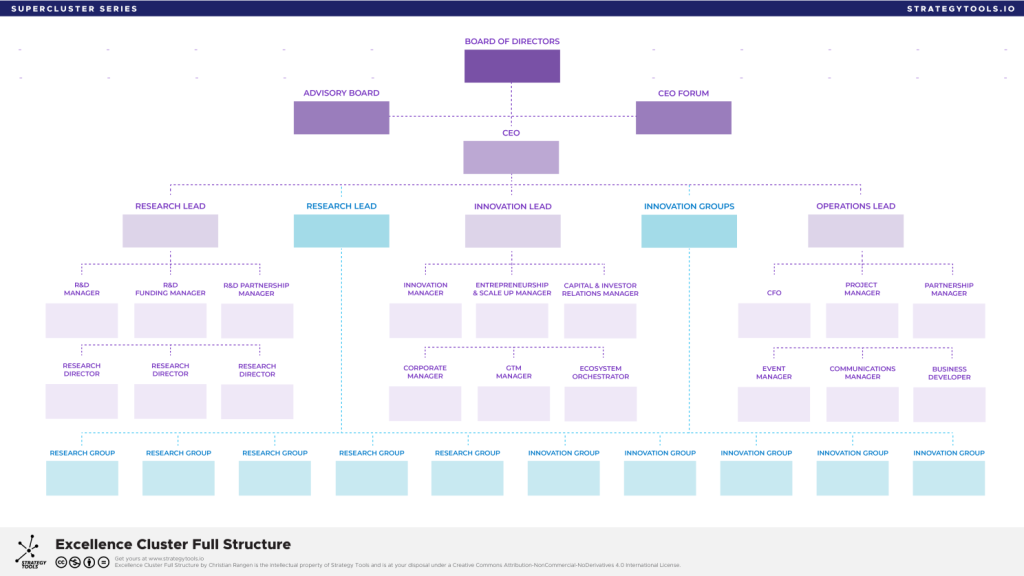
Board members: 8-12 people, balanced across the quintuple helix. Often, in the beginning the board might be 20-35 people, as everyone wants to have a seat at the table – literally, but after two years, a 8-12 people board works well.
The key here; get a well connected, well respected, recently retired industry CEO who can call anyone and secure funding in just a few calls. The wrong board chair; well, expect things to move very slowly, unfortunately. Advisory board: common across clusters, this advisory board can have a strong research focus, strong technical focus or strong cluster management focus. You select.
CEO Forum: It’s a great place to connect senior leadership and engage them in the cluster activity. Bring in some speakers, serve some good food, showcase world class research and make the most of this networking arena.
CEO (sometimes also called cluster manager, VD, Project manager, life coach and herder of cats), the CEO – along with the board chair, is the MVP of this thing. You, the initial hero, you got the cluster off the ground. Congratulations, but your CEO will be the one that becomes the face of the cluster to the world. CEOs, unfortunately, burn out. They crash. The work is far more complex than they were expecting. Don’t burn your CEO.
Operating structure
Team members: So for the case of Sweden, I’ve drawn up a possible organizational structure that might work well. I believe this would align with VR and Vinnova’s focus areas, as well as give the cluster the operating capacity needed. In this org.chart example below, I have included space for CEO + 18 people. These can be full-time, part-time, flex-time or even interns. You might also decide to staff this org.chart differently, but this is how I would think about it.
Research & innovation groups: Most of the work that matters in clusters, happens in the ‘groups’. These are well-defined, well-led operating groups, often in research or innovation, sometimes separate, sometimes combined. It typically takes a new cluster two to three years to figure out their optimal working process with these groups.
The Norwegian Offshore Wind cluster has found a great way to structure their projects. With 17 working (innovation) groups; they have found a solid way to work well with their 350+ members.
16. Draw up your timeline
You’ve now done an impressive amount of work. Congratulations. Getting closer to finalizing the application, make sure to draw up a timeline, a roadmap and define key milestones. This has already happened with the strategy work and business model development above, but now you can really get into the details.
Project management, GANTT charts, Monthly deliverables, all of that goes into the timeline work. You have a ten-year cluster, with primary focus on the first five years (that’s what you normally apply for funding for).
17. Lock in your detailed two-year activity plans
You’re almost done. Just a few more hours to zoom in on the next 24 months. You want to make sure you come out of the gates storming.
It’s June, your application is due. It’s a process. It will run into September, October, interviews, meetings, maybe in November we’ll know for sure. January first, you will be expected to kick off; these timelines are always, always to short. Yet, here we are. Move fast, execute well. Just make sure to plan out your detailed activities right here.
18. Write the application
Finally, last step. Write up (the final version) of your application. You likely already have the draft notes, the sketches. The strategy. Partial excel models.
What you need to do now is a couple of things.
1. Executive summary (we all know, how much this matters)
2. Full application (a small team will write it, one person will tie it all together)
3. CVs, you’ll need a lot of CVs. Ideally, you brought these in already back in April
4. Letters of commitment, letters of support. From industry leaders, top academics. From universities, from international partners. This piece always ends up taking things down to the wire. Don’t be that.
5. bring back the financial model and spreadsheets, review and check everything
Press “send”.
(what happens next is often described as a combination of waiting, not hearing anything, matched with sudden dashes of ‘can your entire board come to our ministry building next week Monday 8 am to present, thank you’. Probably, in Sweden things will be more organized than the average cluster application and evaluation process. I expect so).
Concluding reflections
From Seattle to Kuala Lumpur, from Førde (that’s Norway) to Guadalajara, Mexico, we have seen 1000s of stakeholders come together to shape regional and national future competitiveness through clusters.
We know clusters work.
The question is ‘can you make yours work’.
I have seen board chairs sit and write till 3am, project champions pulling all-weekend workshops, and cluster chairs fly into Oslo and Ottawa on a moment’s notice to present their clusters work.
Done right, innovation clusters are powerful levers of innovation, connecting world class research to world-class companies and markets. This is your opportunity.
Good luck.