
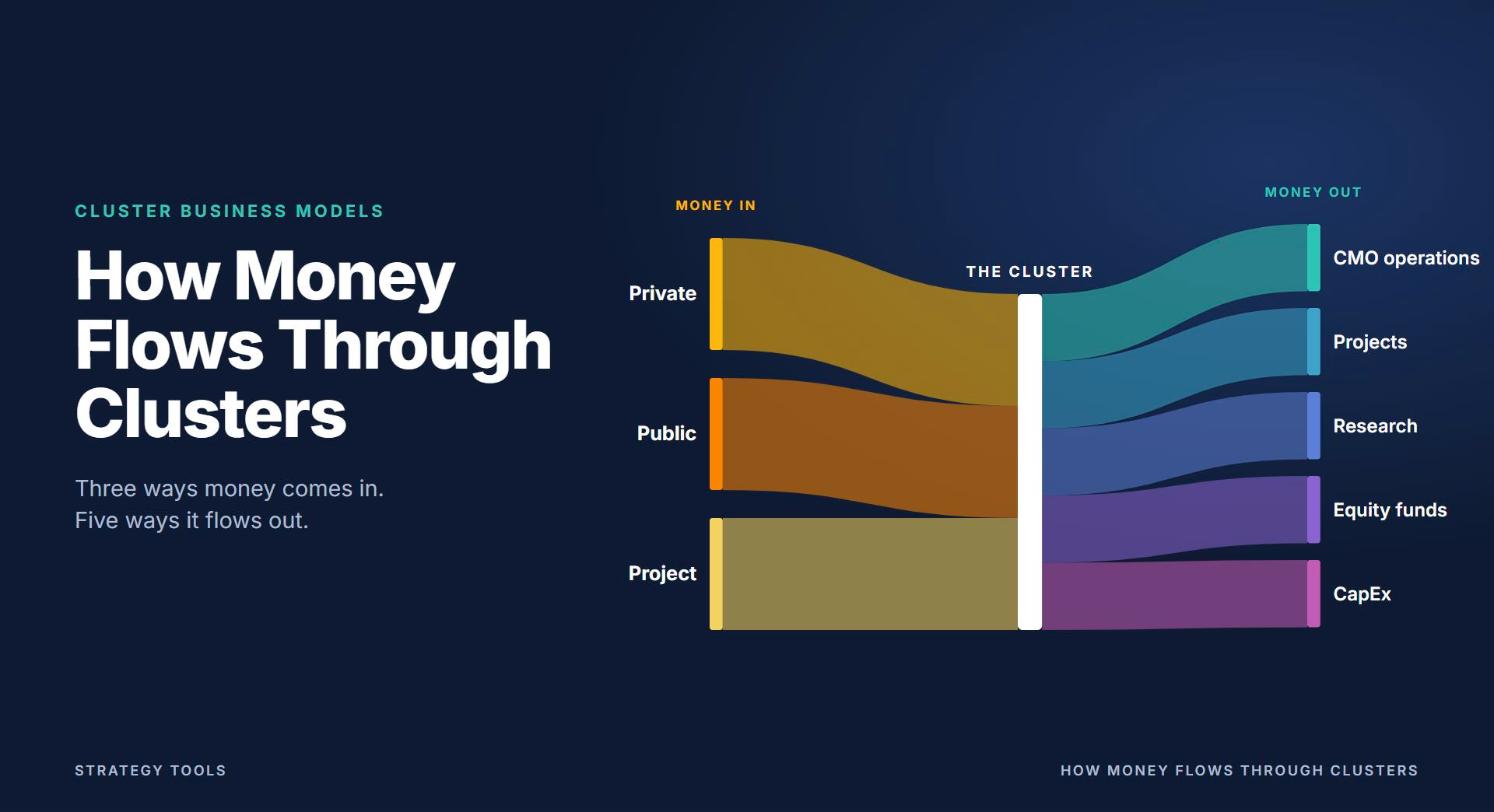

Since we published the Cluster Business Model report, we have run hundreds of hours of workshops, webinars, conferences, keynotes and client engagements around the world. The interest in how business models work in and for innovation clusters has been profound. Yet the general understanding is still shallow, and full of misconceptions about how money actually flows through a cluster. This article maps it.
The question is relevant to almost everyone in the cluster world:
- Existing clusters looking to grow and scale.
- Well-established clusters approaching the end of their public financing period.
- New innovation clusters that are just starting to form.
- National and regional cluster programmes that fund, design and steer them.
The audience that needs to understand cluster money flows is surprisingly large.
A cluster needs a business model, and a financial model
In the last few weeks alone, we have worked with national cluster programmes in the Nordics, emerging clusters in the UK, and on the European ecosystem in Brussels. Across all of them, we keep coming back to one statement:
Just like a business needs a business model and a financial model, a cluster needs a business model and a financial model.
For most people, this is a profound thought. Most clusters have never developed either. We propose they should.
From 3-year budgets to 600 million euro capital stacks
The range of financial ambition across clusters is enormous.
Just last week, I worked with clusters in the Nordics that are building a 10-year capital stack of potentially €600 million or more, modelling what it takes to build and scale a successful cluster at that size. In other parts of Europe, clusters are struggling to put together a 3-year budget. In North America, we have worked with clusters on 5- and 10-year plans that, once all the numbers are in, add up to hundreds of millions of dollars.
The direction of travel is clear. In the UK, we see the Catapult network growing and new innovation superclusters rising. In Europe, we see a trend towards larger clusters. Larger clusters need larger, and better, financial models.
In this article, we explore the basic concept of how money flows through a cluster. As we will see, it comes down to a handful of key building blocks.
First, a note on PPP
Before we start: most clusters around the world are financed on a PPP model — private, public and project financing. It is a core concept, so we put it in writing here and return to it when we turn to the income side.
The five building blocks of cluster money flows
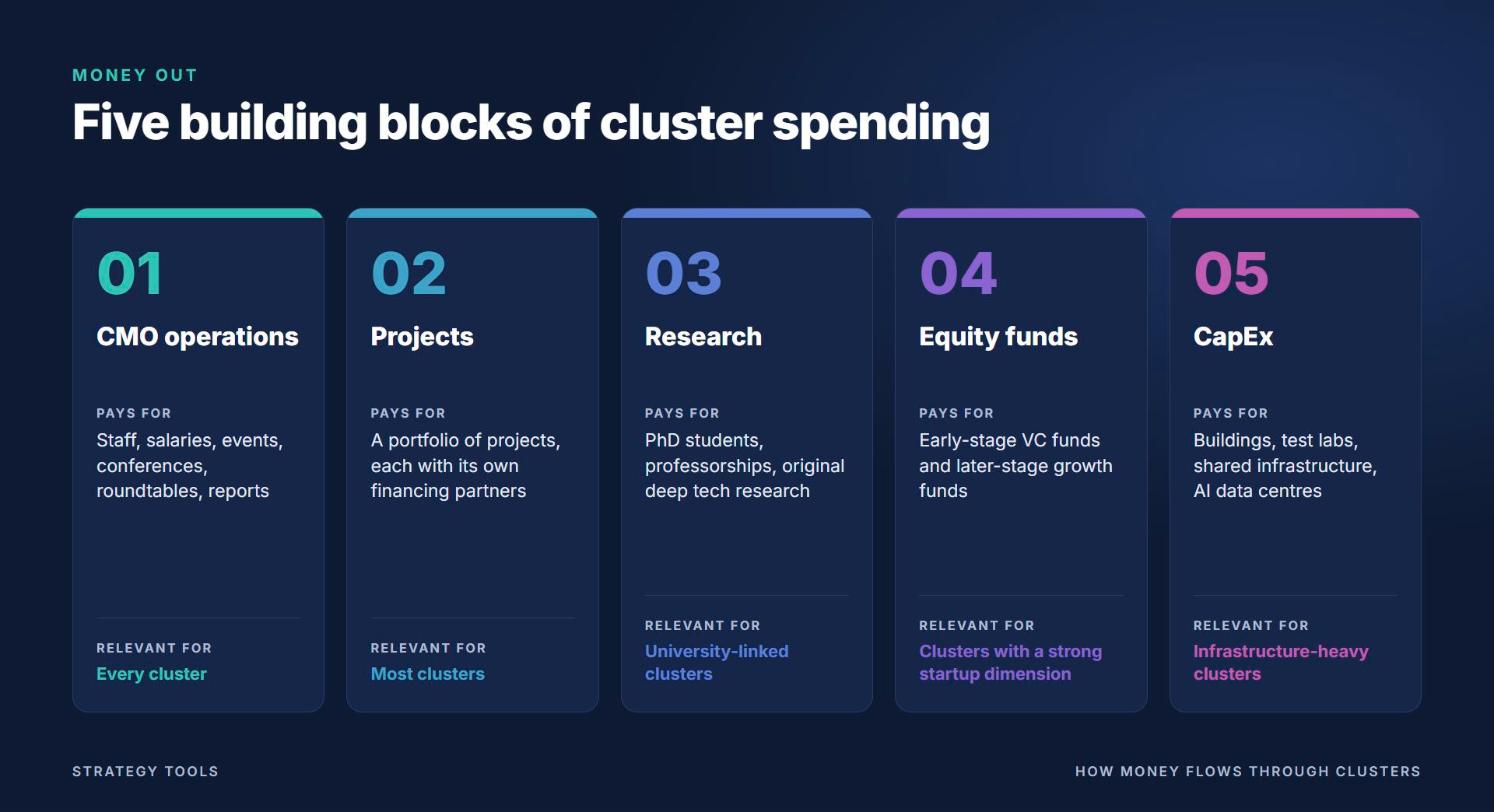
When you start mapping how money flows through a cluster, there are five building blocks to work with:
- Cluster management organisation operations
- Cluster projects
- Cluster research — only for some
- Equity investment funds — not for everyone
- CapEx: infrastructure, buildings and real estate
Let’s take a deeper look at each.
1. The cluster management organisation’s operating budget
This is where the day-to-day operating costs of the cluster go. It pays for staff and salaries, events and conferences, roundtables, activities and reports.
We will come to the income side shortly. But note this now: for many clusters, this is the most challenging cost area to finance.
2. Cluster projects
Projects are often linked to the day-to-day operations, but they are financed in a distinctly different way.
Take Energy Cluster Denmark. It runs an impressive portfolio of projects, and each project has a slightly different financing model and a slightly different set of financing partners. Some funding comes from the European Commission. Some comes from the EIC, the EIB or the EIF. Some comes from industry partners or national research institutes.
Cluster projects can be financed in incredibly diverse and flexible ways.
3. Cluster research
This is not relevant for every cluster. But clusters closely linked to universities, or hosted within them, may run dedicated research tracks. They might support PhD students, fund professorships, or run original deep tech research.
For these clusters, putting money into research is a core part of their DNA and identity.
4. Equity investment funds
This one is complicated for many clusters. At the same time, we see great examples of clusters approaching it in different ways.
Clusters with a strong entrepreneurial dimension understand the startup and scale-up landscape. They want to offer better support and better instruments to their young companies, and they may be able to bring in a significant share of investors. For these clusters, there can be a clear win-win in developing equity investment funds — typically early-stage VC funds, or later-stage growth funds.
We do not have many of these in Europe, but we do have some. We are currently working with several clusters outside Europe to build equity investment funds into their money flows.
5. CapEx: infrastructure, buildings and real estate
Again, this is not relevant for many clusters. For others, it is almost a core part of their identity.
The questions we now hear are concrete. Should we develop joint innovation infrastructure? Should we set up test labs, wet labs, dry labs? Should we build our own closed-model AI applications, or AI data centres that are proprietary to the cluster and its members?
In Seattle, Maritime Blue, led by Joshua Berger, runs Blue Hub innovation spaces in Seattle and Tacoma. It is also the primary tenant of the new Maritime Innovation Center at Fishermen’s Terminal, a building funded by the Port of Seattle. For clusters like this, buildings and infrastructure can be a significant part of the money flow, even when partners carry the capital cost.
These are the five areas where money flows through, gets invested and gets spent within a cluster. Now let’s turn to the income side — equally important.
The income side: private, public and project
As we said at the start, the income side rests on PPP: private, public and project financing. Practice differs by country and by cluster.
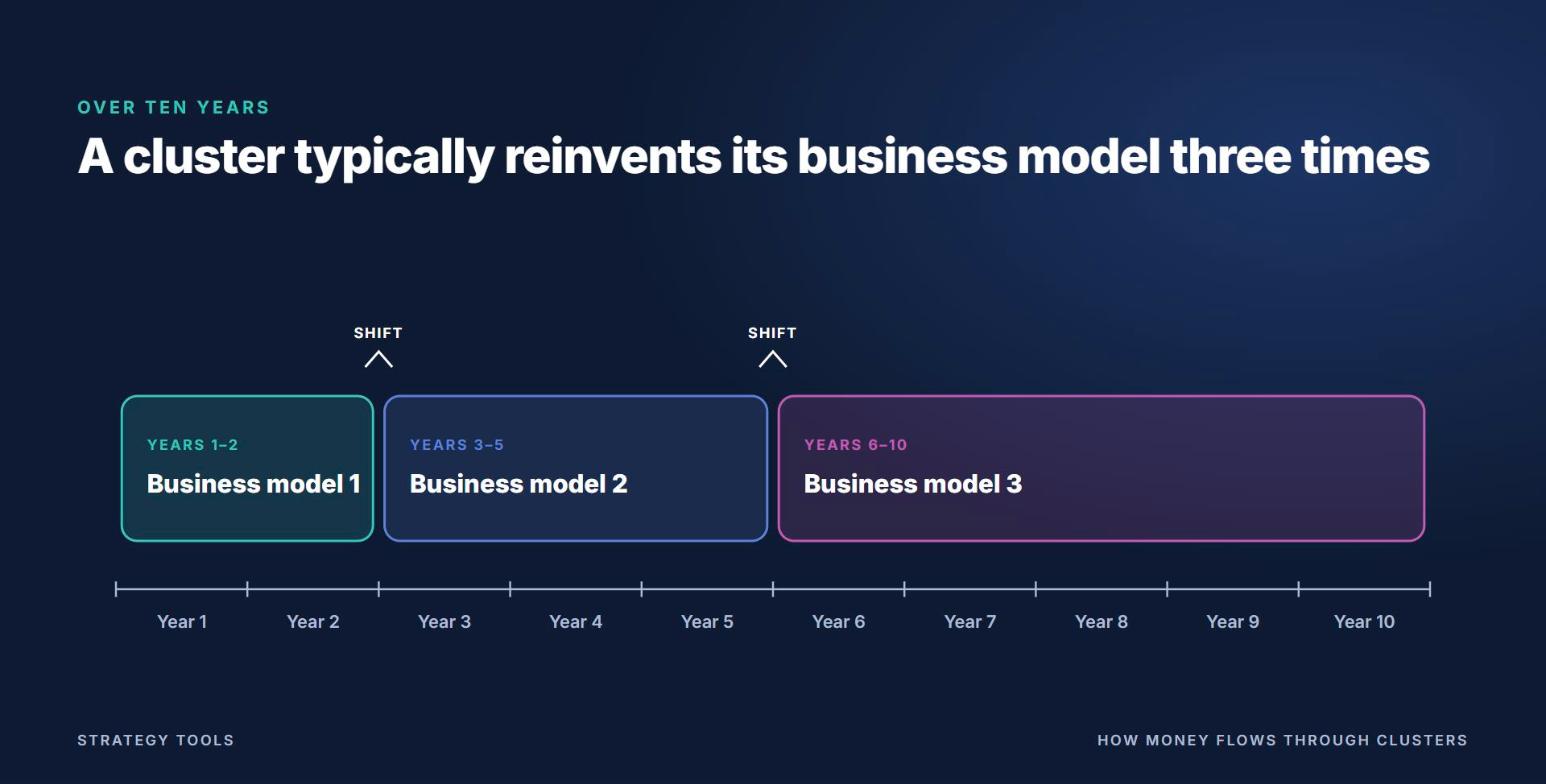
It also changes over time. In the Cluster Business Model report, Victor Haze and I wrote that clusters evolve their business model as they mature. Over a 10-year period, a cluster might significantly change its business model three times: in the first couple of years, again around years 3 to 5, and finally for years 5 to 10.
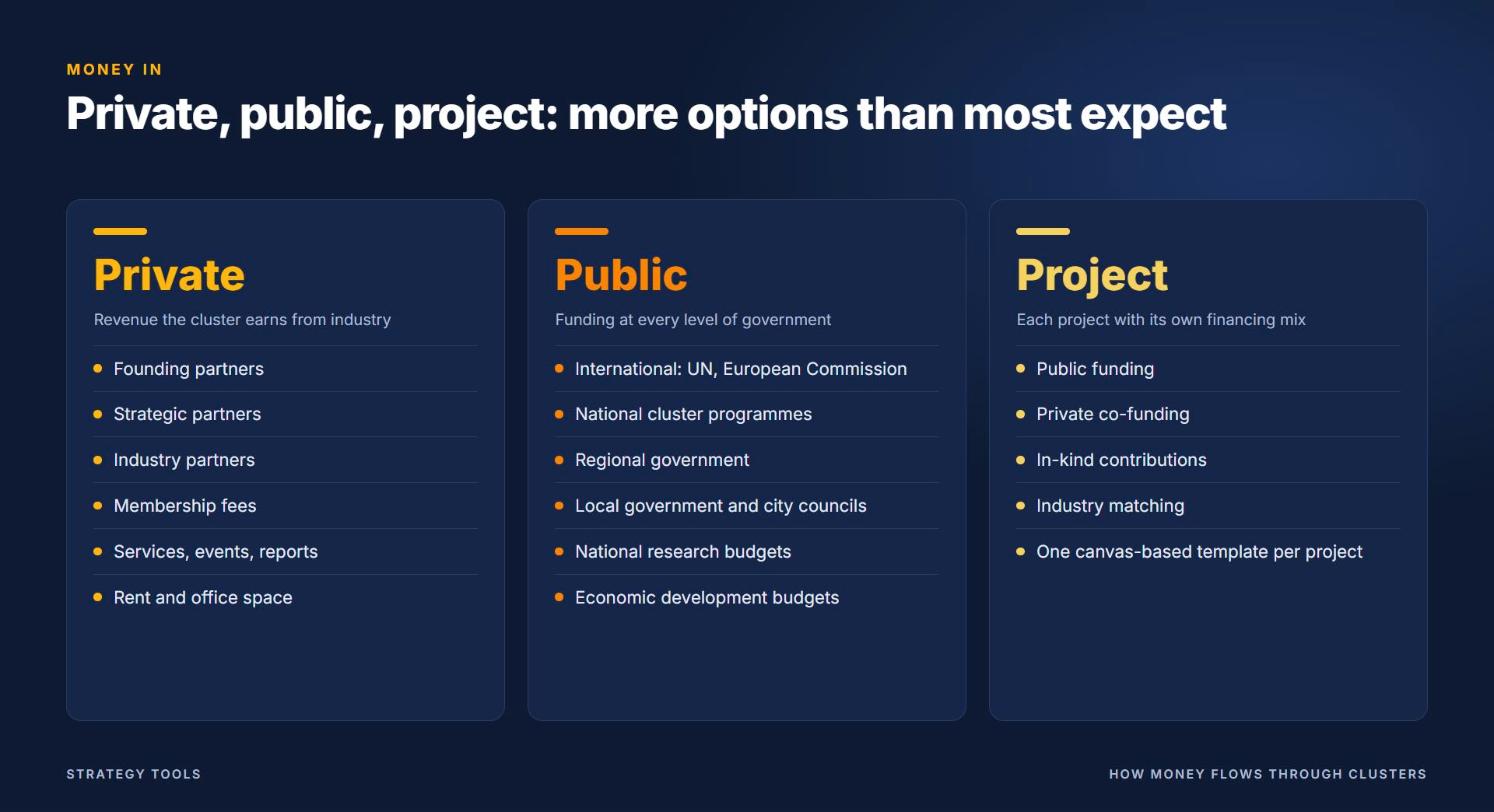
The good news is that there are surprisingly many funding options available to clusters. Here is how they break down.
Private
On the private side, the common revenue-generating building blocks are:
- Founding partners, strategic partners and industry partners
- Membership fees
- Services, events, reports and activities
- In some cases, rent and office space
Public
Public financing can come from many diverse sources, at every level of government:
- International: the United Nations or the European Commission.
- National: national cluster programmes and, occasionally, a direct line item in the national budget, although that is not common. Some countries run several programmes under different ministries. Germany, for example, has four national cluster programmes, each with its own mission, mandate and financing.
- Regional: regional government and public bodies.
- Local: municipalities, right down to the city council. In Stavanger, the city council financed a blue aquaculture accelerator programme to support early-stage companies in the region.
Clusters can also tap into budgets that are not aimed at clusters but still fit, such as national research budgets and national economic development budgets.
Projects
Projects are the most diverse income stream, often mixing public funding, private funding and in-kind contributions.
We recommend that clusters develop a strict framework for how each project is designed and structured — what we call a canvas-based project template. In Canada, for example, a significant share of federal funding goes into the project portfolio, but it requires matching contributions from industry in different forms.
Bringing it together
Money flows out through five building blocks: operations, projects, research, equity funds and CapEx. Money flows in through private, public and project financing, with far more diversity and more options than most clusters expect.
This is how we view how money flows through clusters. I hope it is useful in your work on developing your cluster’s financing. Good luck, and let’s stay in touch.
Further reading
- Cluster Business Models: Exploring Business Models in Global Innovation Clusters by Victor Haze and Christian Rangen. A toolkit for cluster managers, with expert insights and five case studies from clusters around the world. Download it from Strategy Tools.
- Building Innovation Superclusters by Christian Rangen. What innovation superclusters are, how they form, and how countries can start building them. Available on the Strategy Tools publications page.