
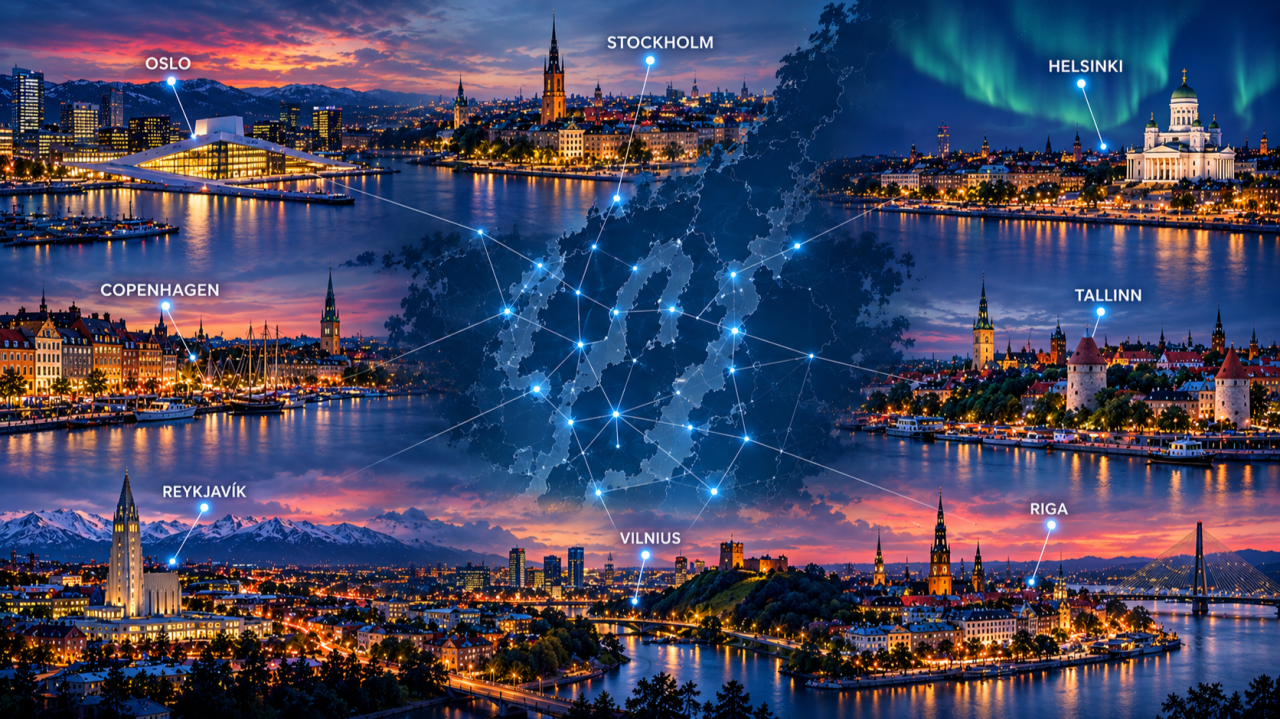

We know all about the ‘US vs. EU’ startup and scale up scene, how they differ and how they evolve. But what about the New Nordics? How is the New Nordics region developing and scaling tech companies into global winners?
This is part I in a three-part series where we explore scaling up, private and public markets for tech companies in the New Nordics. Part II, It starts at IPO, looks at how Nordic tech companies have performed after listing. Part III, Nordic Scale-Ups Summary, is coming next week.
In this article we explore the 78x gap between the US and EU, the pipeline of companies from the New Nordics and who actually funds them. A big thanks to people like Jonas Michanek, Stina Lantz, Kristianne Paasche, Torunn Totland Stangervåg, Scott Newton and the project team behind the Nordic Ecosystem Mobilization report for early inspiration for this piece. Thanks Andrew McAfee for the methodology.
It’s time for Europe to Scale Up
Over the past six years I have been involved in multiple initiatives to ‘help European startups scale up’. From workshops in Zurich to ecosystem programs in Oslo, from angel networks in Romania to investor conferences in London, the focus has been on getting more companies from ‘start to scaling’. We have run Masterclasses, Scale Up Programs, Investment Readiness programs, innovation cluster scale up programs, scale up ecosystem programs and delivered 1000’s of hours of work with founders, investors and ecosystem leaders.
As investors, we’ve invested in 150+ companies, worked on 400+ equity rounds, secured EIC funding, taken companies public, raised capital from pre-seed to post-IPO, closed M&A transactions and spent 100’s of hours in board meetings to ‘crack the code to scale’.
More recently we have also seen the EU Commission shine the light on ‘scale ups’. Increasingly, Europe has started recognizing that entrepreneurship is not about ‘starting a tiny company’, but scaling critical companies that can underpin entire, future tech industries.
Recent initiatives like the EU Startup and Scaleup Strategy propose a comprehensive set of 26 actions across 5 key areas ‘to make the EU the best place in the world to launch and grow technology-driven innovative companies’. The EQT-managed Scale Up Europe Fund is one of these actions.
Right now, writing this, I am in Sweden, working on one of several cluster initiatives across Europe. Most of them address the same question: ‘how do we get more companies to scale up, in order to build new high tech industries for the future?’
With this backdrop, we got inspired to do some digging into five questions:
- How has the US vs. EU scale up competitiveness evolved since 2024?
- How are the New Nordics doing?
- How is the New Nordics pipeline looking?
- Who are the investors funding the New Nordics?
- And finally, as an afterthought, what if we had not sold?
US vs. EU
In December 2024 MIT researcher Andrew McAfee published A Visualization of Europe’s Non-Bubbly Economy. Here, McAfee visualized the 70x gap between the EU and US, using the definition ‘Public From-Scratch US and EU Companies Less than 50 Years Old with $10B+ Market Cap’. He called these new companies arrivistes.
McAfee identified 241 US companies and 14 EU-based companies. Back then, McAfee wrote “The biggest American arrivistes are staggeringly big”. Well, since then they have just continued to grow bigger – and fast.
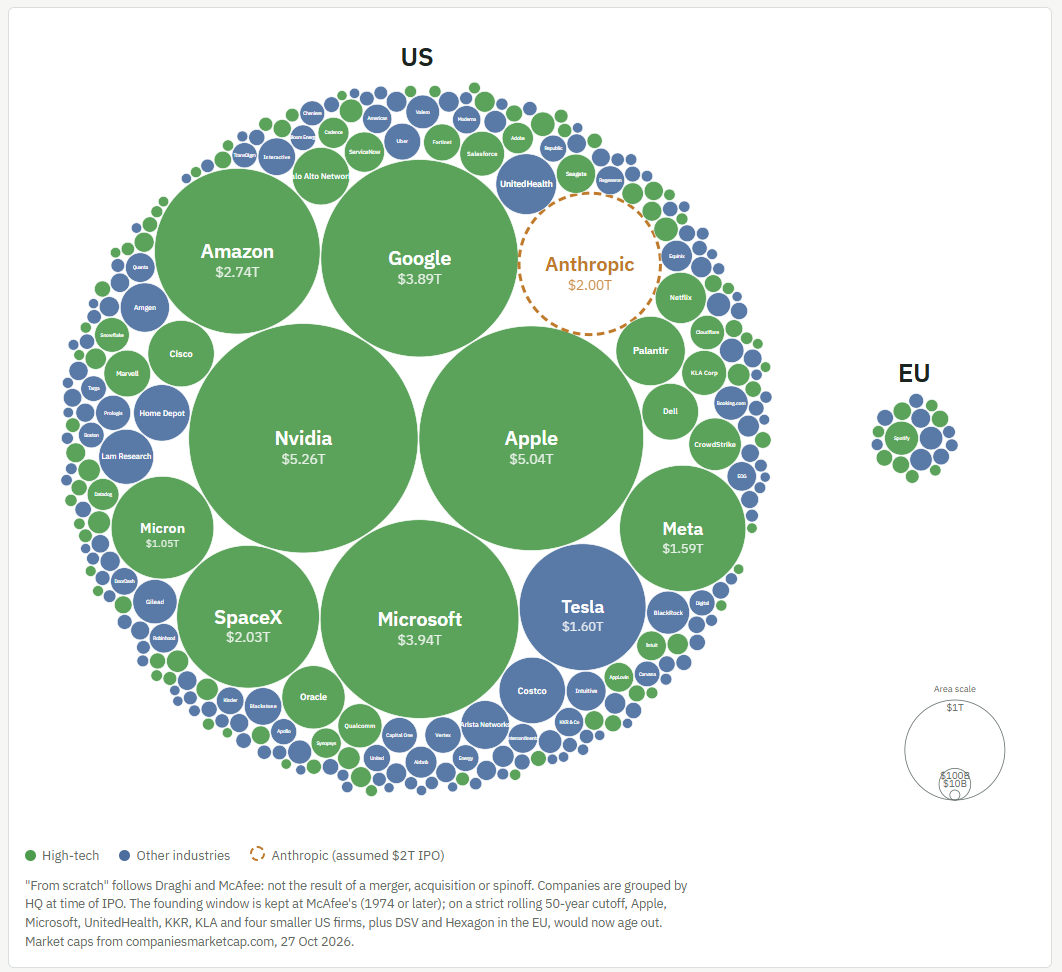
This month we decided to do an update. Using Claude, we developed an October 2026 update.
What we found:
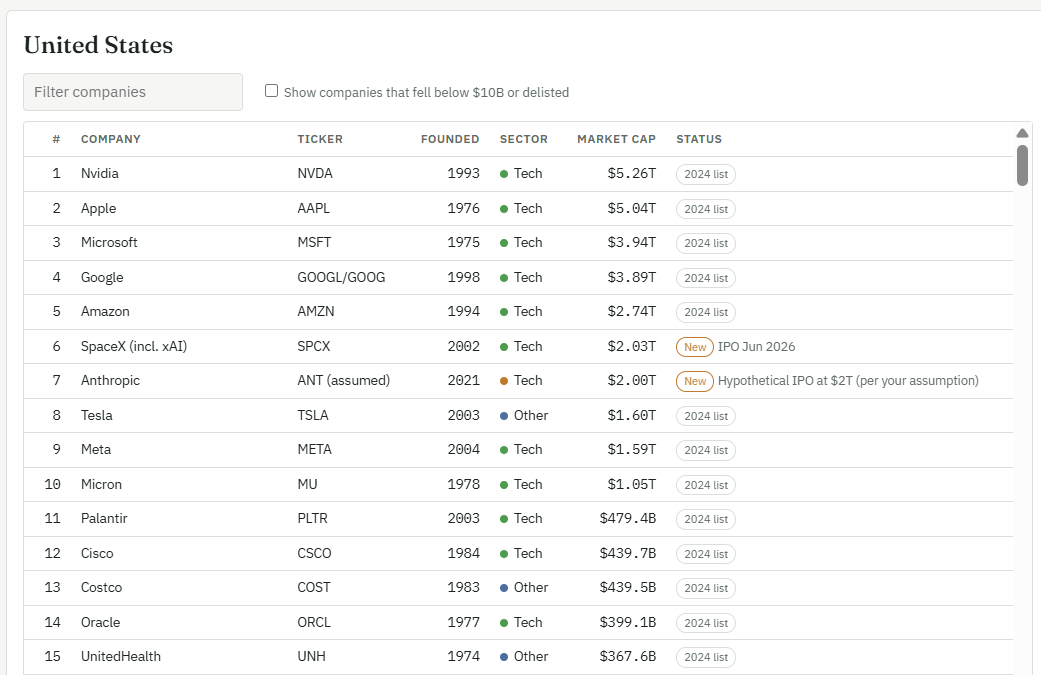
- US: 268 companies, $43.6T market cap (we included Anthropic with a $2T market cap)
- EU: 18 companies, $563.4BN
- In simple terms, all 18 European companies are worth one Palantir and Airbnb.
What the methodology is telling us
We are not comparing all companies. We are mapping the ability the two ecosystems have to ‘start, scale and take companies into public markets within a window of 50 years’. There are many great companies, both in the US and Europe, that fall outside this definition.
What we are mapping is the ability to start, ramp up and shift the company from private to public market ownership. It is, if you will, a strong indicator of scale up ecosystem capacity.
Below is an overview of our findings, ‘public from scratch US and EU companies’, per October 2026.


Full data set here.
The key findings
- The US pool is 78x larger than the EU (74x if we remove $ANT)
- The gap is widening
- The EU is largely missing software and tech companies
- The US has ten companies over $1T market cap
- Spotify is the only EU company on the list over $100BN market cap
- Bending Spoons (Italy), founded in 2013, shows that it is possible to go from zero to $30BN in a little over a decade
- Bending Spoons, if you will, shows the path for the next generation of fast-moving European startups ($BSP when public on NASDAQ, July 2026)
From EU to the Nordics
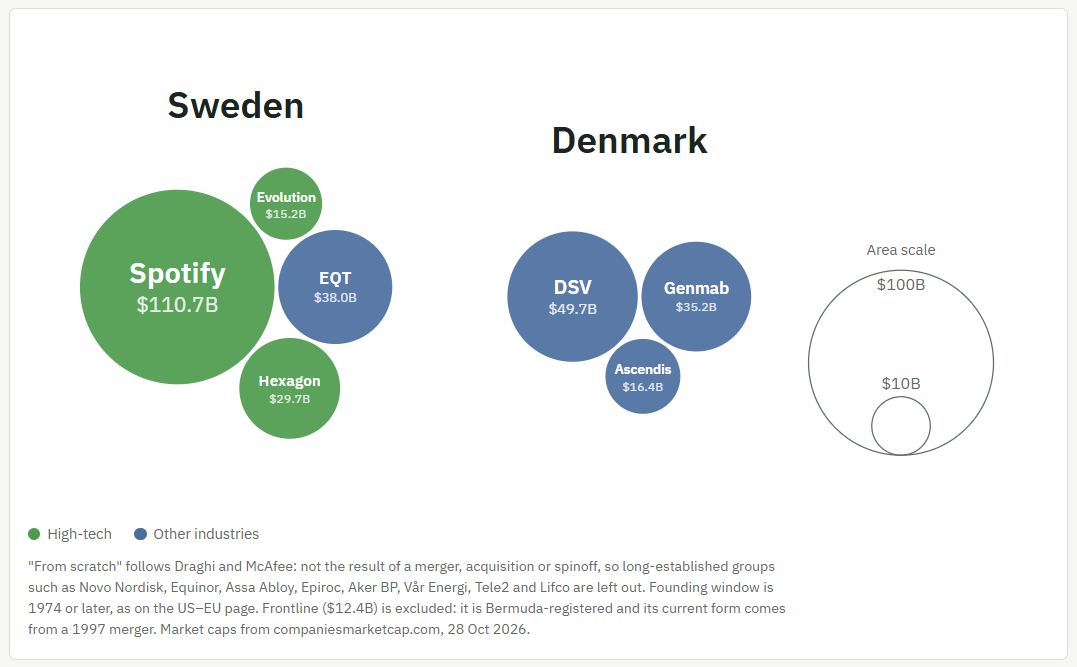
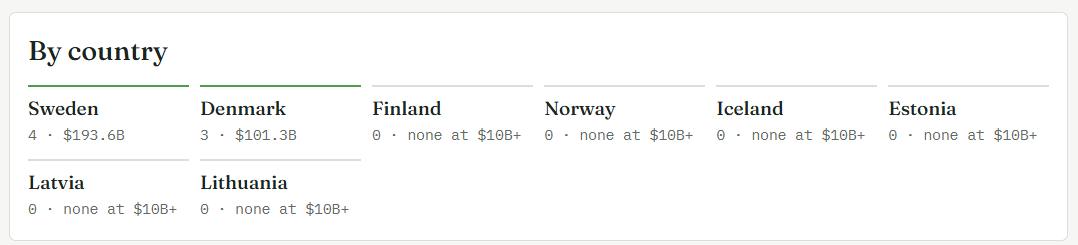
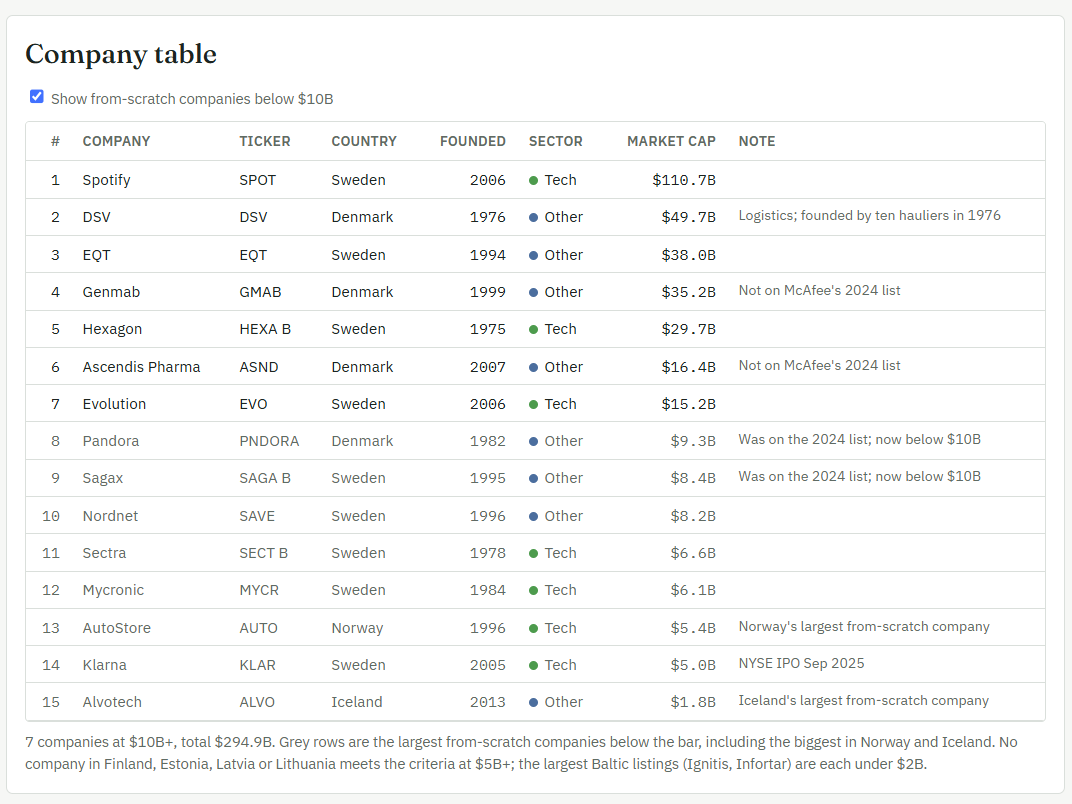
Zooming in on the Nordics, we find that on the EU list of 18 companies, seven are Nordic: Spotify ($114BN mcap), EQT and Hexagon from Sweden, and DSV, Genmab, Ascendis Pharma and Evolution from Denmark.
By this account, the Nordics are already punching well above their weight – but these seven companies combined are still only 5.6% of Nvidia’s market cap.

Full data set here.
Shifting to the future: the pipeline to turn public
Building on my conversations over the past few weeks, we asked ‘well, what’s in the pipeline?’
What does the landscape look like of Nordic companies that maybe are next in line to follow in Spotify’s footsteps? Who are the New Nordic companies today that could become the global arrivistes tomorrow?
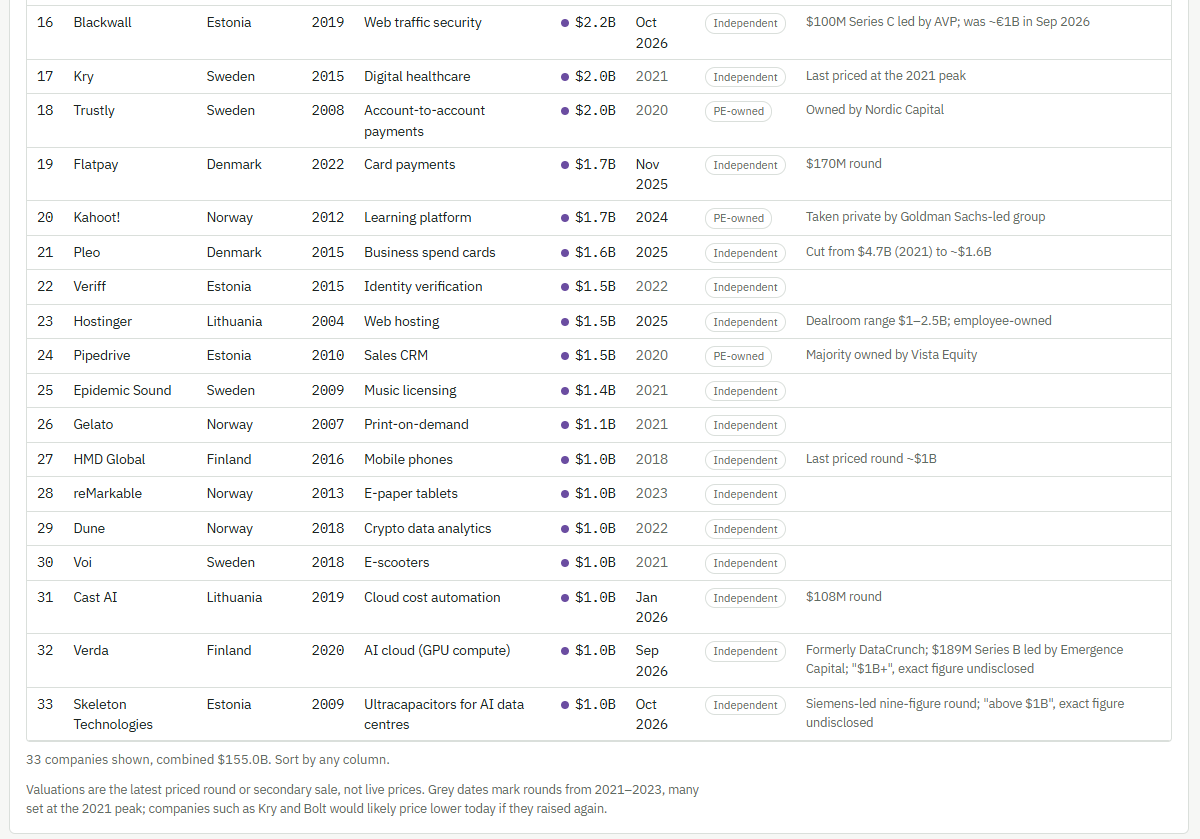
We found a total of 32 companies, including five decacorns ($10BN valuation). In our methodology we chose companies with a private market valuation above $1BN, including companies that have private equity ownership and might be in process to go public (at some point in time). Visma (NO), IFS (DK), Lovable (SW), Iceye and Oura (FI) all track above $10BN valuation, for a combined $73BN valuation.
Looking at the pipeline, it is clear that the Nordic and Baltic countries do have a pipeline, but probably nowhere near what we are going to need over the coming decade. If we want to see a strong and thriving technology economy in the New Nordics, we are going to have to find a path to scaling up many, many more tech companies – and take them into public markets when the time is right.





Full data set here.
Who funds the New Nordics?
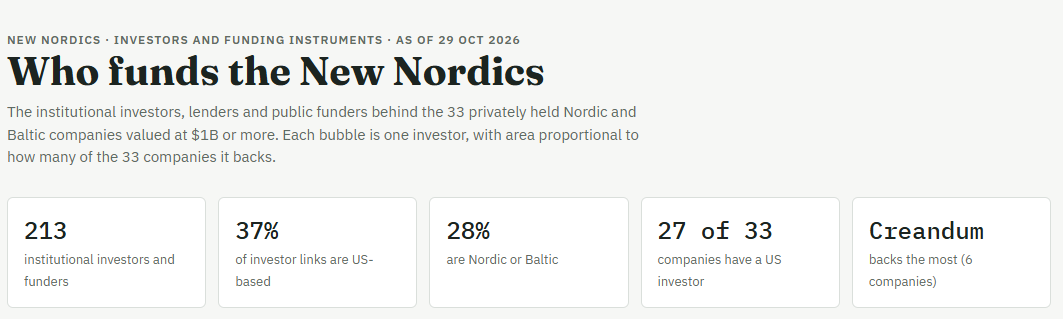
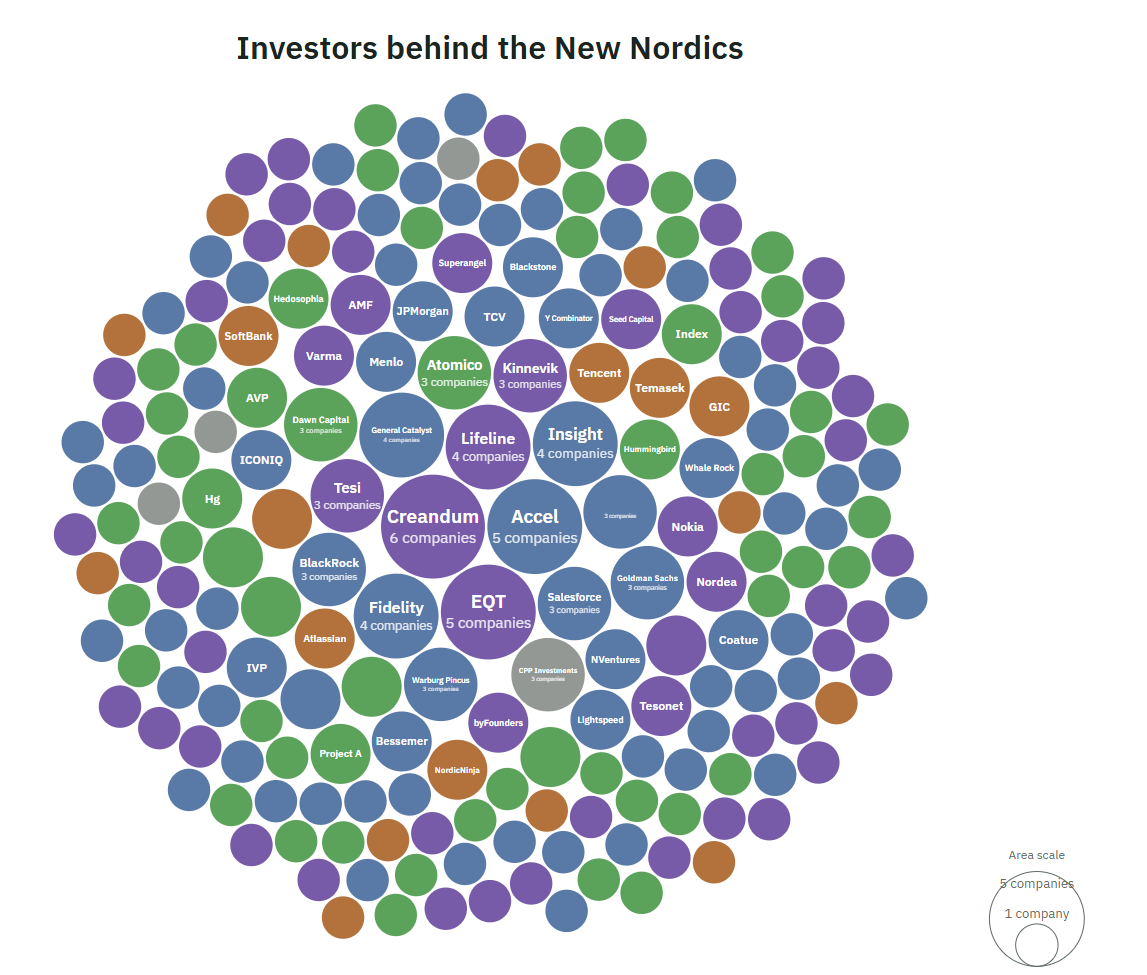
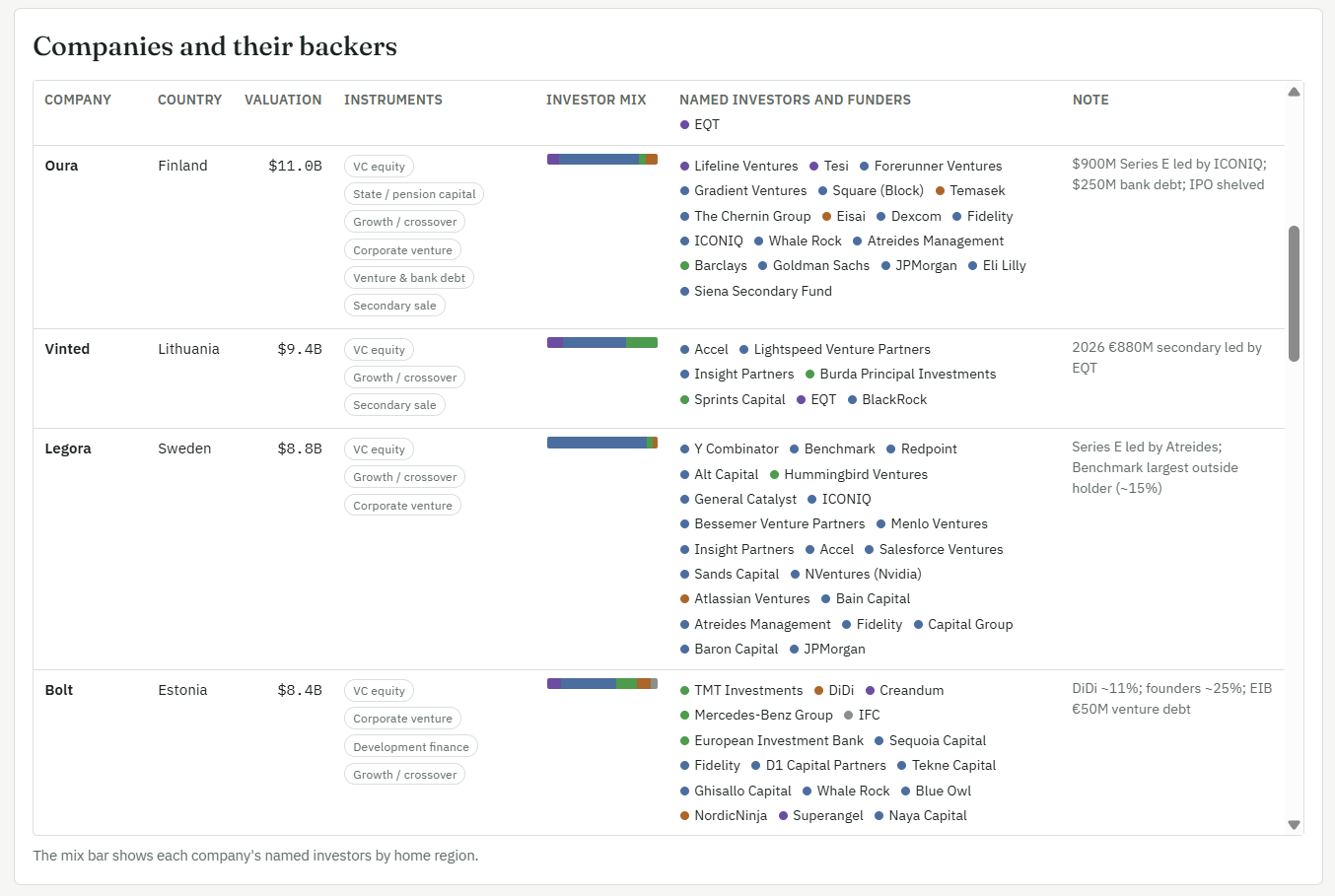
As we were looking through the data, we next asked ‘who and what funds these companies?’ With a focus on the 32 pipeline arrivistes, we dug into who had invested in them. (This dataset is aimed at later stage rounds, the scale up financing, and does not cover all early-stage financing in detail. A more complete dataset might give a slightly different picture.)
What we found:
- 213 institutional investors and funders (and many, many more if we count early friends, family, angels, HNWIs, incubators and accelerators)
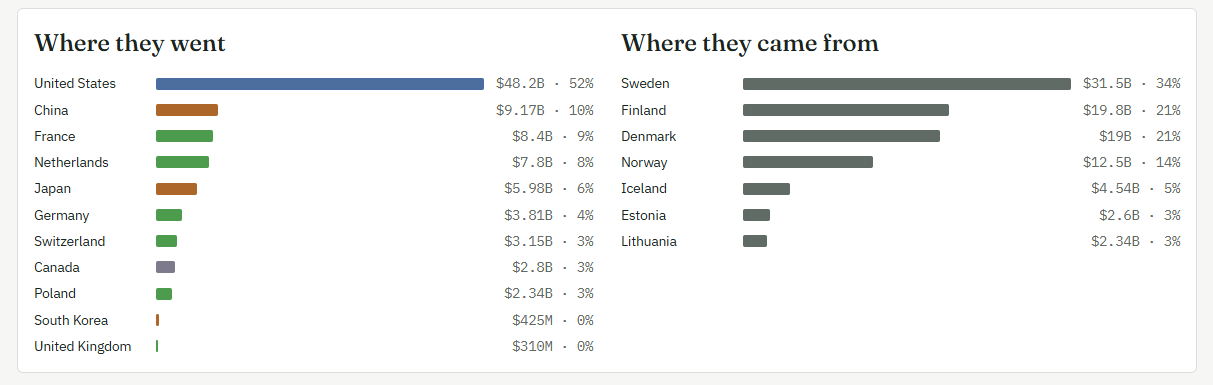
- The majority (37%) are US-based investors
- 28% are Nordic or Baltic investors
- 82% of all the companies have one or more US investors
- Creandum, EQT and Lifeline are the most active Nordic investors
- Accel, Insight Partners, Salesforce Ventures and Goldman Sachs are the most active US investors


Full data set here.
Unpacking the investor analysis
What we find in the dataset:
- The best New Nordic companies have no problem attracting international and global venture scale financing.
- Many of the best VCs in the world invest in and back New Nordic scale ups, including ICONIQ, Hummingbird Ventures, Lightspeed and Temasek.
- Corporate investors, including Mercedes, BAE Systems, Nokia and AP Moller, are active.
- Public funds, like EIB, TESI, British Business Bank and Bpifrance, are active, but less than expected.
- Pension funds are active, including AMF, CPP Investments, Folketrygdfondet and Ontario Teachers’ Pension Plan.

Full data set here.
What if we had not sold?
In a separate piece, Europe’s Alternate Tech Future, I wrote a fiction piece on how Europe might have looked very different if we had made other choices and successfully built and kept our tech companies over the past 20 years. (Sneak preview: €trillions in value and €10,000s in higher wages across Europe.)
That question lingered in the background as we were working on the dataset here too. Effectively, we are asking ourselves: what would have happened if we had kept Skype (vs. selling it to eBay and later Microsoft) and developed Skype into a global tech giant from the Baltics? What if we had kept Fast Search & Transfer ASA (FAST), including the consumer arm, and outcompeted Google in search? What if we had kept Cognite, not selling it to French Schneider? What if we could keep, scale and list these companies here?
Why this matters
When we look at much of the ecosystem today, most exits are widely celebrated, including the recent €3.1B Cognite x Schneider transaction (read, “Tuesday was a good day for Norway”). Across the New Nordics, the pattern is the same: ‘building and selling is to be celebrated’. But what if we are doing ourselves a massive strategic disservice? What if we have companies today, like Cognite, that could become anchors and leaders in the next industrial cycle, scaling to $100BN – $1T company valuation, and in the process support entirely new tech ecosystems, much like Nvidia is doing today?
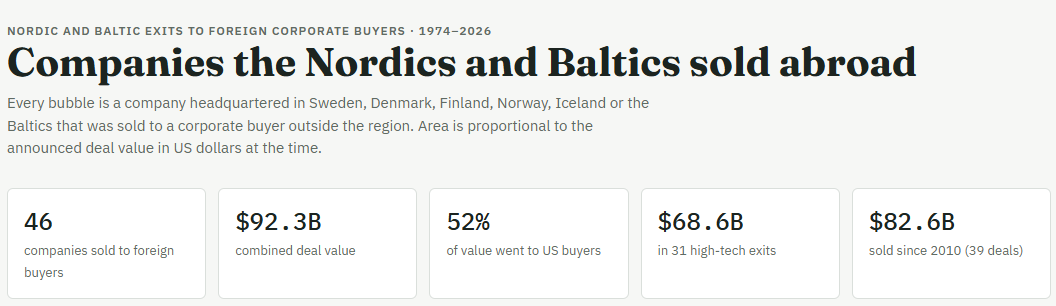
Applying the same method, we looked at companies that have been sold out of the region to non-Nordic buyers. We did not count Nordic deals and M&As, and we focused on the larger deals. In total, we identified 46 companies, or 31 tech deals, for a total transaction value of $68BN. Of these, 52% went to US buyers.
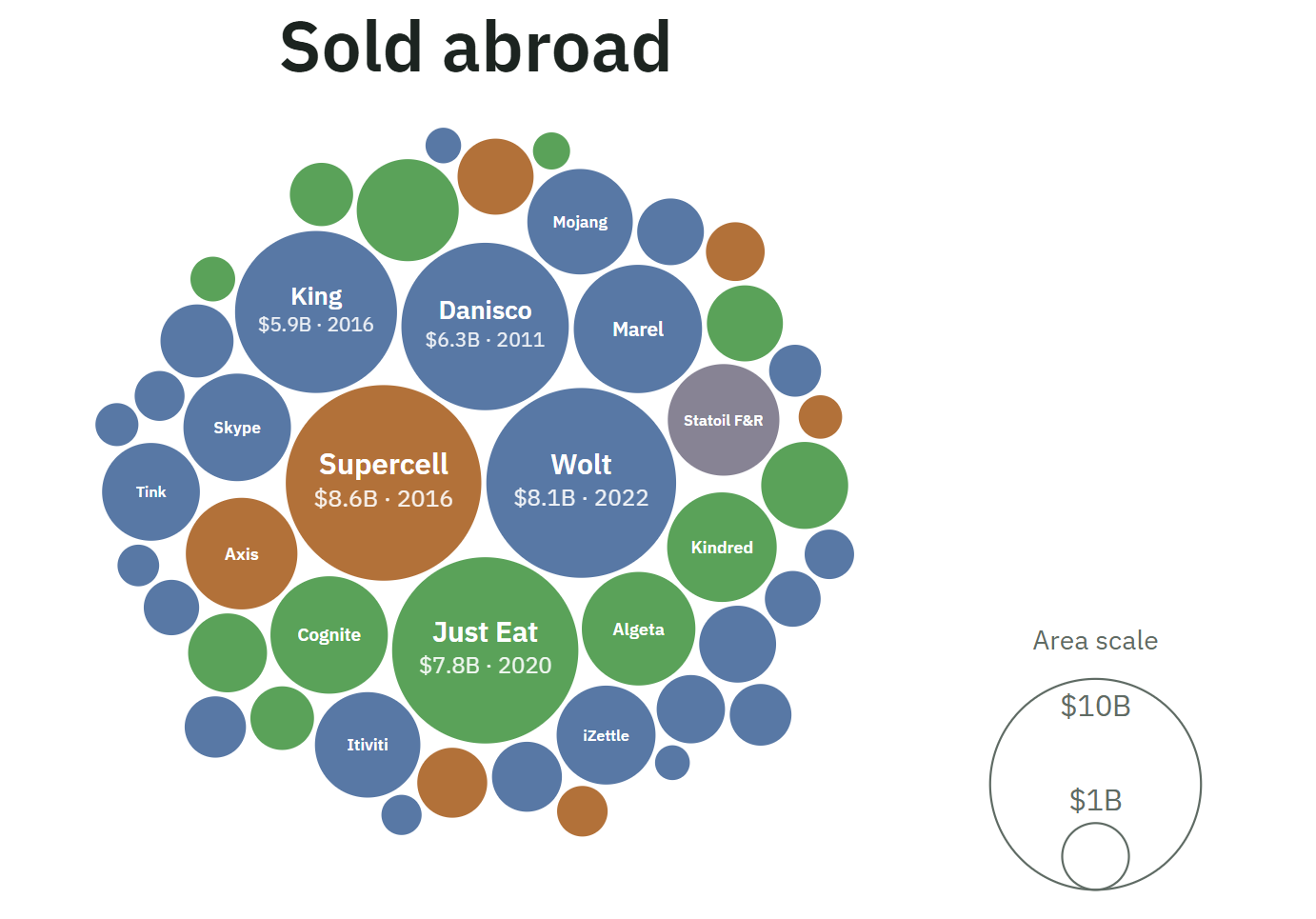

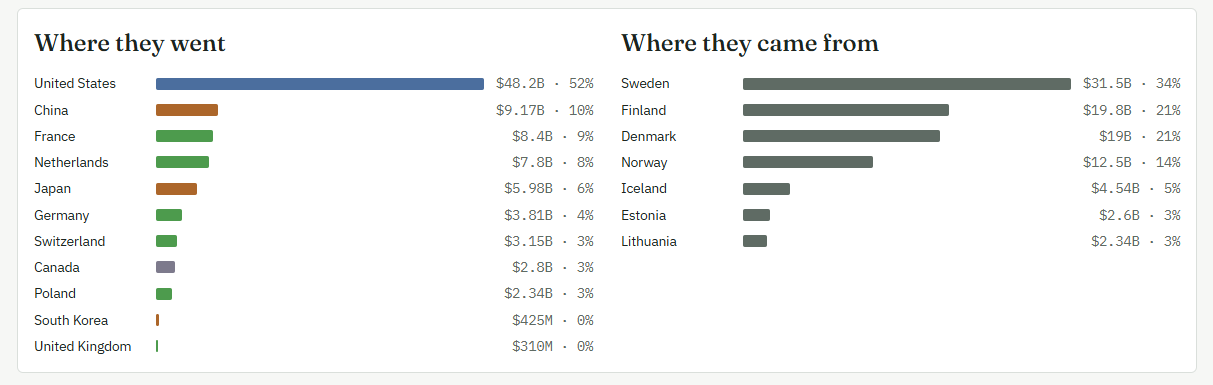
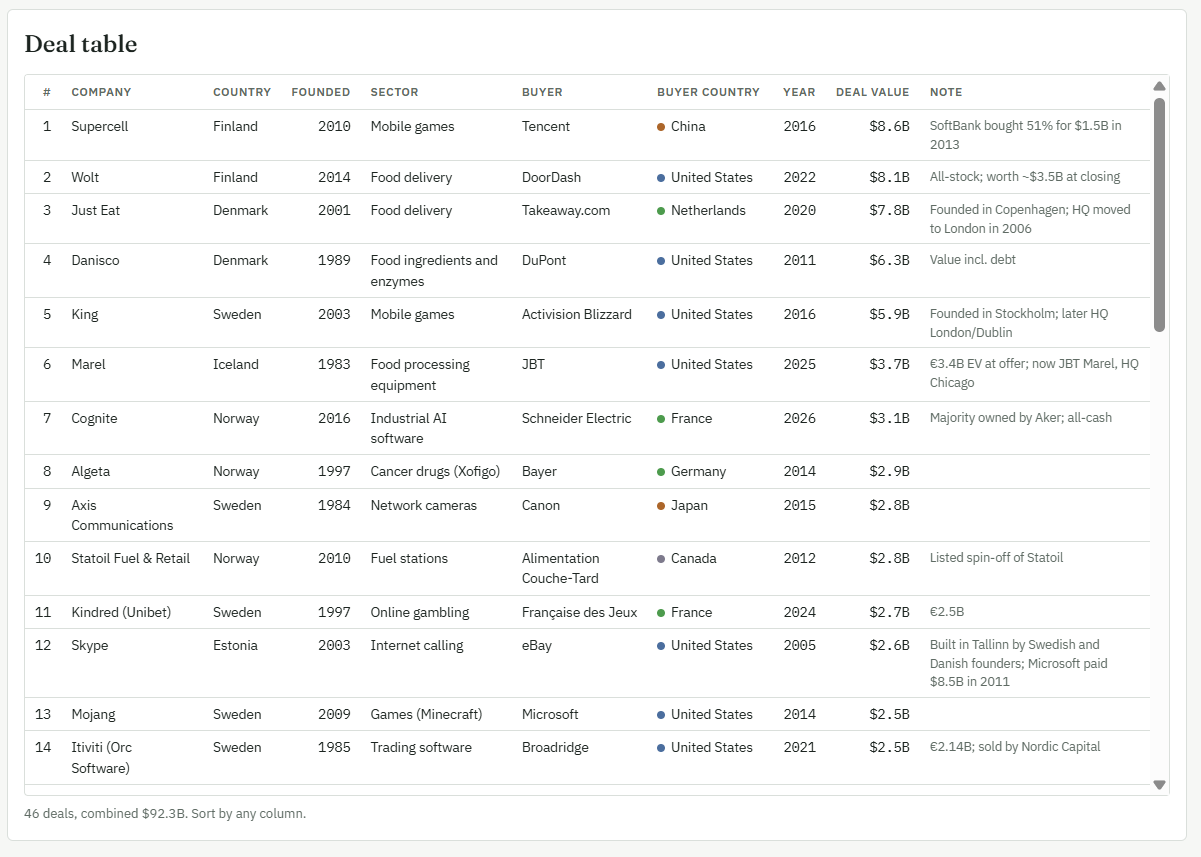
Full data set here.
Access to liquidity is a key pillar of any ecosystem, and M&A transactions are the most common route. For many investors, invest, scale and M&A exit is a proven playbook to deliver DPI to their LPs. But the question lingers. Are we selling tech companies too soon? And if so, what does this mean for the next cycle of New Nordic scale ups? (We dig into the companies that listed, then sold, in part II.)
What it all means for the New Nordic ecosystem
The message is clear.
Europe needs to radically change how we scale and list companies. For the Nordics, we have a strong foundation. Spotify proves the model. But we need ‘100 Spotifys’. We need 20x the size and value of Spotify.
For the New Nordic ecosystem, we need to step back and look at every step of the journey. How do we improve and amp up every step, from pre-seed to IPO – and then post-IPO?
We are not competing on the fundamentals of entrepreneurship.
We are competing on our ability to scale up – and fast – to move from $1BN valuation to $10BN (five private market companies today), $100BN (one company, in public markets: Spotify) and $1T valuation. We are competing on our ability to generate 100+ more Lovables, Legoras and Iceyes over the coming decade – and then scale them up quickly.
EQT has already said it out loud: the race is on. We just need to make sure it is a New Nordic company that gets there first.
The ecosystem foundation is already here. Now, we need to scale up.
This is part I in a three-part series where we explore scaling up, private and public markets for tech companies in the New Nordics. Part II, It starts at IPO, looks at how Nordic tech companies have performed after listing. Part III, Nordic Scale-Ups Summary, is coming next week.
Chris Rangen is a strategic advisor to governments, innovation agencies, innovation clusters, investment firms and fund-of-funds globally. He has worked on questions around scale ups, capital and ecosystem development in more than 65 countries. He also teaches venture capital and scale up financing at globally leading business schools, including IMD’s Venture Asset Management Program. Today he works with private and public sector leaders on ‘how can Europe and the Nordics compete?’
He can be reached at [email protected], +47 924 15 949.