


An analysis of how Nordic and Baltic tech companies have performed since entering public markets – and what it means for the long-term health of our competitiveness.
This is part II in a three-part series where we explore scaling up, private and public markets for tech companies in the New Nordics. Read part I, How the Nordic scale up scene stacks up. Part III, Nordic Scale-Ups Summary, is coming next week.
A startup journey does not ‘end’ at IPO. For many, it is barely beginning. An IPO, in our view, represents the next chapter in a founder’s journey. The company is growing up. Founders – if they are still around – are maturing. The investor base is evolving and expanding.
Often, in startup lingo we talk about ‘exits & IPOs’ as if they were the same thing. They are not.
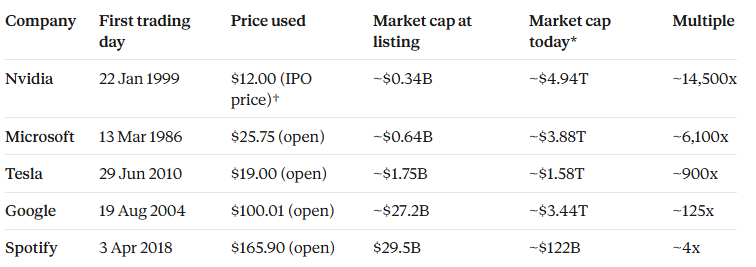
When Microsoft IPO’d in March 1986, the market cap was $640M. Today it sits at $3.88T, a 6,100x gain. Nvidia’s listing, just before the dot-com crash, happened at a $340M market cap. Today, it’s trading at $4.94T, a 14,500x gain.
Spotify, the only European company in our comparison, listed in April 2018 (via direct listing) at a $29.5B market cap. Today it trades at $122B, a more modest, but still highly respectable 4x gain.
What has happened to the New Nordic listings?
So, we were wondering: if we zoom in on the New Nordics and on tech IPOs over the past 40 years (that would allow us to include Microsoft on the timeline), how have they performed? Who are the New Nordic tech companies that have gone public? Where did they list? How have they performed? And for many of them, what happened post-IPO?
Using Claude, we analyzed the data and tried to get a sense of the market, how it is holding up and how our best tech companies perform in public markets. Let’s dig in. You can find the full dataset here.
1. The public map of the New Nordics
In part I, we mapped the private side of the New Nordics: the unicorns, the decacorns and the capital behind them. Now we turn to the public side. The next stage of the journey.
Today, 565 companies headquartered in Sweden, Norway, Finland, Denmark, Iceland, Estonia, Latvia and Lithuania are listed and tracked with a market cap. Together they are worth about $2.86T.
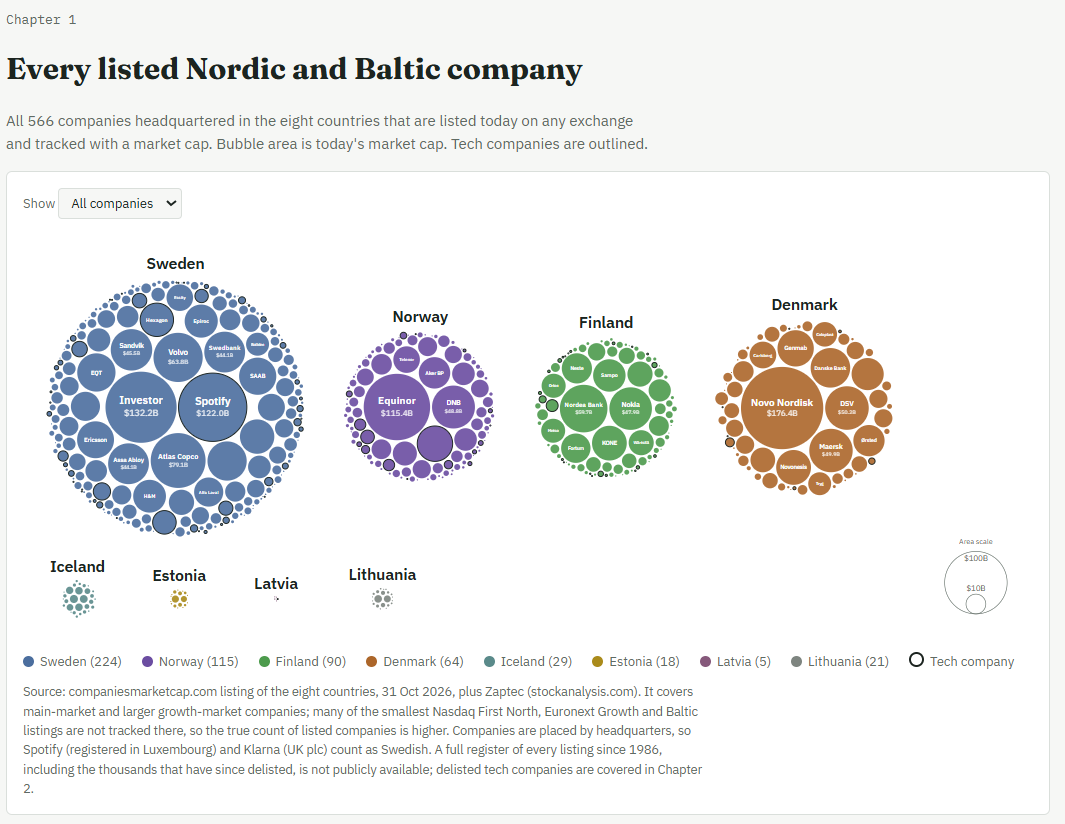
The picture is familiar. The biggest bubbles are banks, pharma, energy and industrials: Novo Nordisk, Investor, Equinor, Atlas Copco, Volvo, Nordea. There is one clear exception sitting among them: Spotify, at $122B the third most valuable listed company in the region.
Tech is still a small slice. The 94 tech companies that have listed since 1986 and are still public are worth about $295B combined, roughly a tenth of the region’s listed value. Spotify alone is more than 40% of that.
The Baltics and Iceland barely register. Iceland’s market is banks, seafood and real estate. Estonia, Latvia and Lithuania have produced Bolt, Vinted, Skype, Wise-founders and Nord Security, yet not one listed tech company of scale. Their tech champions are private, or they listed elsewhere.

2. From listing to today
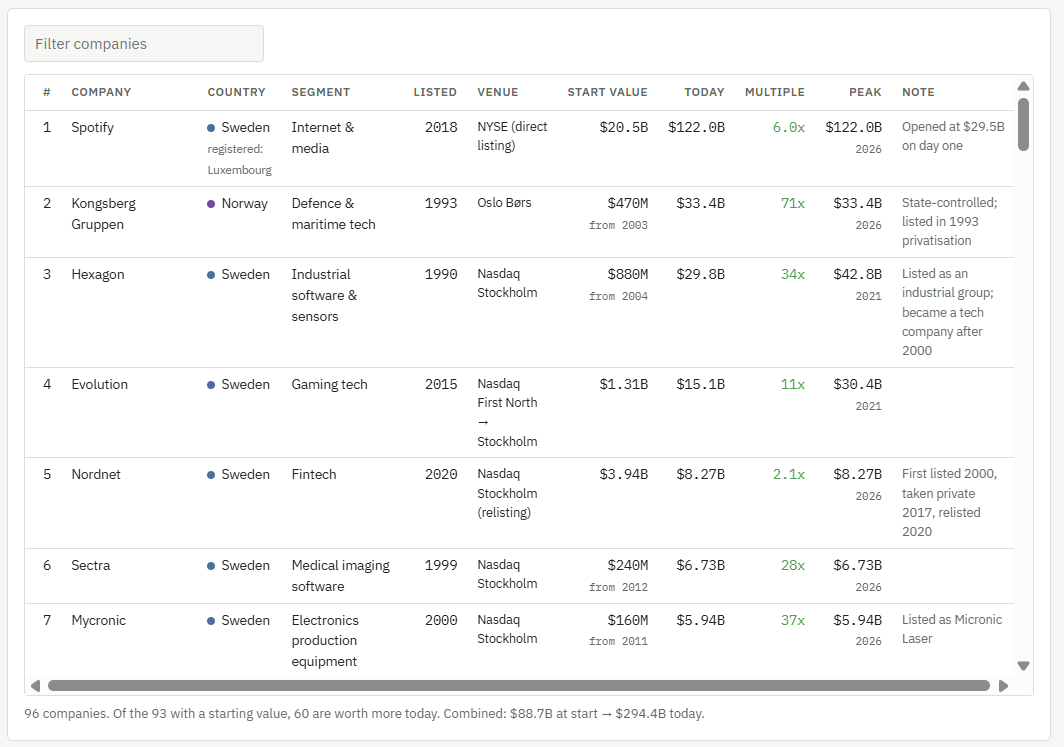
We followed those 94 tech listings from the year they listed to today, and added 16 that listed and were later bought.

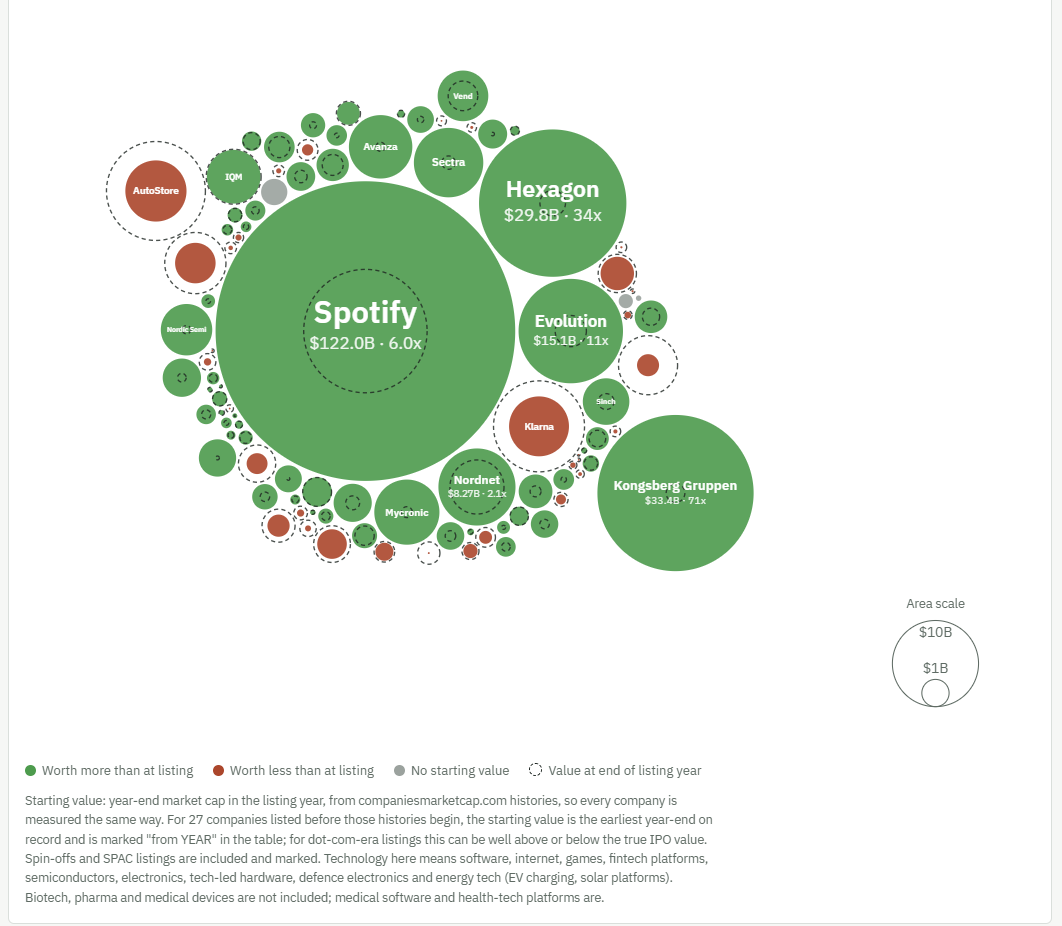
In the chart, the filled bubble is today’s value and the dashed ring is the value at the end of the listing year. Green bubbles grew, red ones shrank. (Interactive format here.)
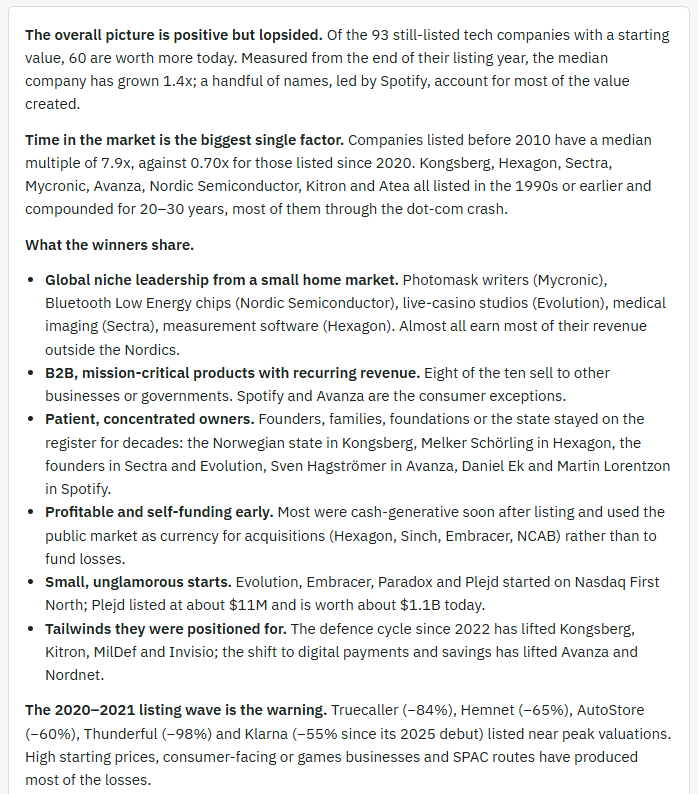
The headline is positive: 59 of the 91 companies with a starting value are worth more today than when they started. Combined, they have grown from about $88B to about $294B.
But the median tells a more sober story. The typical New Nordic tech listing is worth about 1.4x what it was at the end of its listing year. A few winners carry the average.
What separates winners from the rest? Above all, time.
- Listed before 2010: median multiple of about 8x.
- Listed 2010–2019: median of about 2.3x.
- Listed 2020 or later: only 8 of 26 are above their starting value.
3. The 2020–2021 class is the warning
The listing boom of 2020 and 2021 brought a wave of Nordic tech IPOs, many at peak prices. Most have gone backwards:
- Truecaller: down about 84% from its 2021 listing-year value
- Hemnet: down about 65%
- AutoStore: down about 60% from its $12B+ debut
- Thunderful: down about 98%
- Klarna: down about 55% since its 2025 NYSE debut
The pattern is consistent: high entry prices, consumer apps and games, and listings timed to the market rather than to the business. The public market has been patient with companies that listed early and grew into their valuations. It has been unforgiving with companies that listed at the top.
There are bright spots in the recent cohort, and they rhyme with the older winners. MilDef (defence electronics, about 6x since 2021), Smartoptics (optical networking, about 5x) and Yubico (security hardware) are B2B, global and technical.
4. Country by country
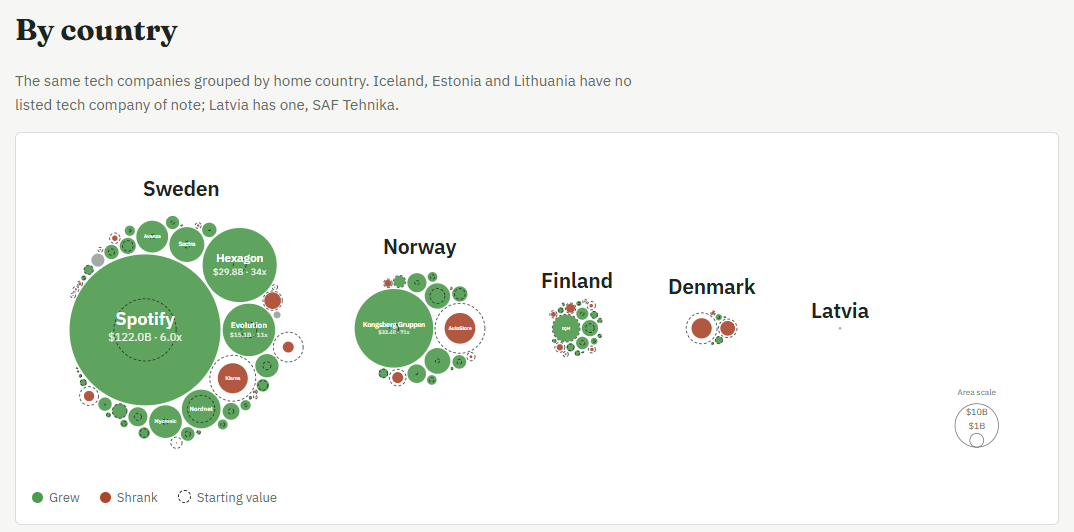
Sweden is in a league of its own: 49 listed tech companies, about $224B in value today, led by Spotify, Hexagon, Evolution, Sectra, Mycronic and Avanza. Nasdaq Stockholm and its growth market, First North, have been the region’s tech listing engine.
Norway comes second at about $56B, but its story is concentrated. Kongsberg alone is worth $33B, followed by AutoStore, Nordic Semiconductor, Schibsted (now Vend), Kitron and Atea.
Finland has 22 listed tech companies but only about $11B in value. Its biggest recent listing, IQM ($4B), went to Nasdaq in New York. Its biggest tech companies (Supercell, Wolt, ICEYE, Oura) are either private or have been sold.
Denmark has surprisingly few: 7 listed tech companies worth about $4B, led by Netcompany and Trustpilot (listed in London). Denmark’s best tech listings, SimCorp and Navision, were bought by Deutsche Börse and Microsoft.
Iceland, Estonia, Lithuania: no listed tech company of note. Latvia: one, SAF Tehnika.
5. The top ten success stories
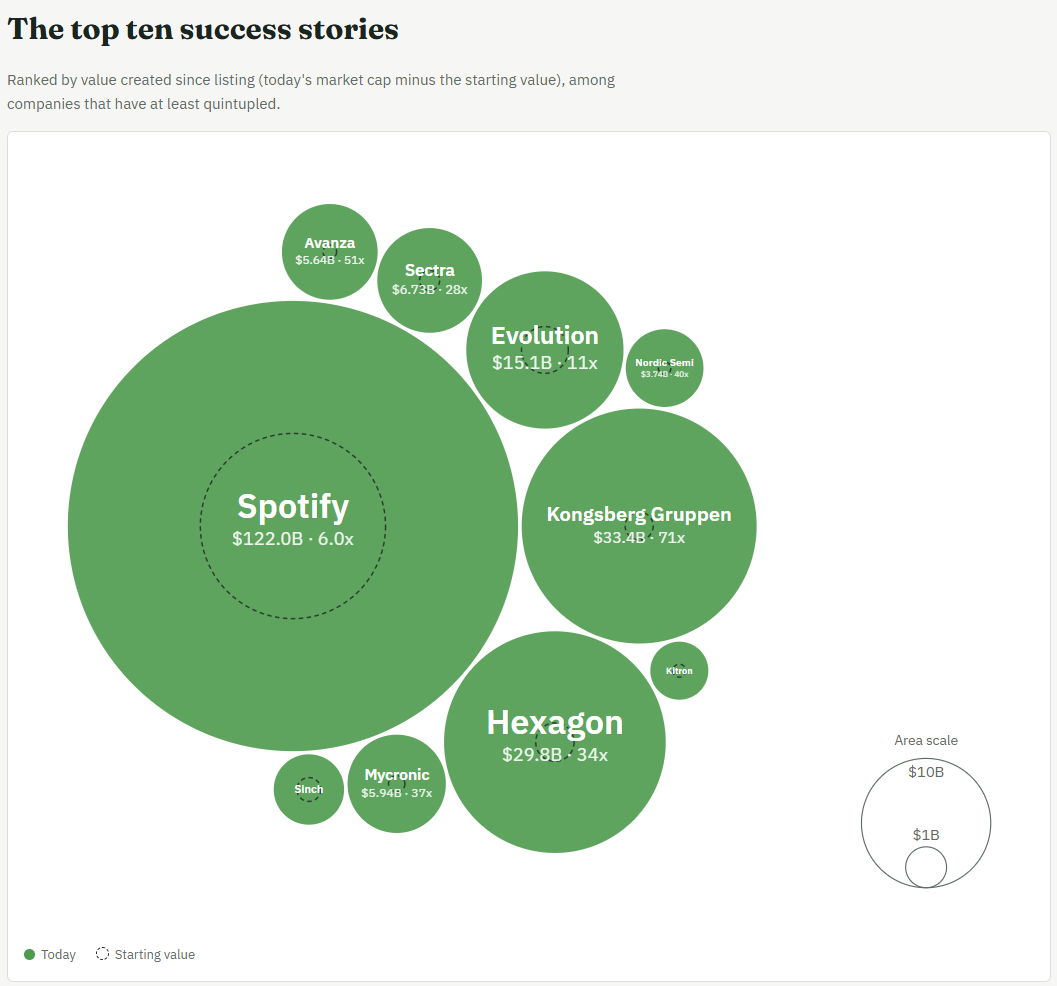
Ranked by value created since listing, among companies that have at least quintupled:
- Spotify (Sweden, 2018): +$101B, 6x from end-2018
- Kongsberg (Norway, 1993): +$33B
- Hexagon (Sweden): +$29B
- Evolution (Sweden, 2015): +$14B, 11x
- Sectra (Sweden, 1999): +$6.5B
- Mycronic (Sweden, 2000): +$5.8B
- Avanza (Sweden, 1999): +$5.5B
- Nordic Semiconductor (Norway, 1996): +$3.7B
- Sinch (Sweden, 2015): +$2.7B, 9x
- Kitron (Norway, 1997): +$2.0B
Honourable mention: Plejd. It listed on First North in 2016 at about $11M and is worth about $1.1B today, close to 100x. It is the highest multiple from listing in our data.


6. What do the winners have in common?
Looking across the ten, six patterns stand out.
Global niche leaders from a small home market. Mycronic dominates photomask writers. Nordic Semiconductor bet early on Bluetooth Low Energy. Evolution owns live-casino studios. Sectra leads in medical imaging, and Hexagon in measurement software. Almost all earn most of their revenue outside the Nordics.
B2B and mission-critical. Eight of the ten sell to businesses or governments, usually on long contracts. Spotify and Avanza are the consumer exceptions.
Patient, concentrated owners. The Norwegian state in Kongsberg. Melker Schörling in Hexagon. The founders in Sectra and Evolution. Sven Hagströmer in Avanza. Daniel Ek and Martin Lorentzon in Spotify. These owners stayed on the shareholder register through crashes and cycles, often for decades.
Profitable early. Most were cash-generative soon after listing. They used their shares as a currency for acquisitions (Hexagon, Sinch, NCAB, Embracer) rather than to fund losses.
Small, unglamorous starts. Evolution, Embracer, Paradox and Plejd all began on First North. Several of the top ten listed in the 1990s at a few hundred million dollars or less.
Positioned for a tailwind. The defence cycle since 2022 has lifted Kongsberg, Kitron, MilDef and Invisio. Digital savings have lifted Avanza and Nordnet. Connected devices have lifted Nordic Semiconductor.
In short, the New Nordic public-market winners look less like Silicon Valley rockets and more like compounding machines.
7. Listed, then sold
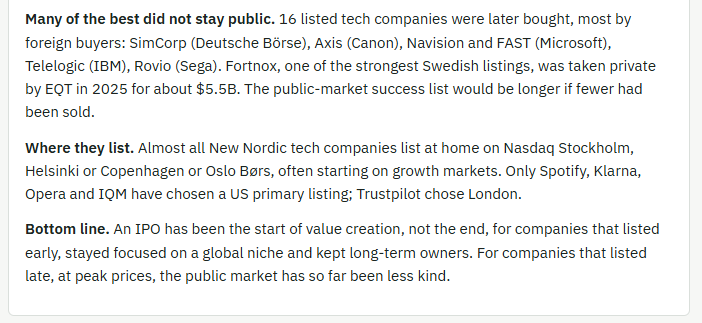
One more thing stands out: many of the region’s best public tech companies did not stay public.
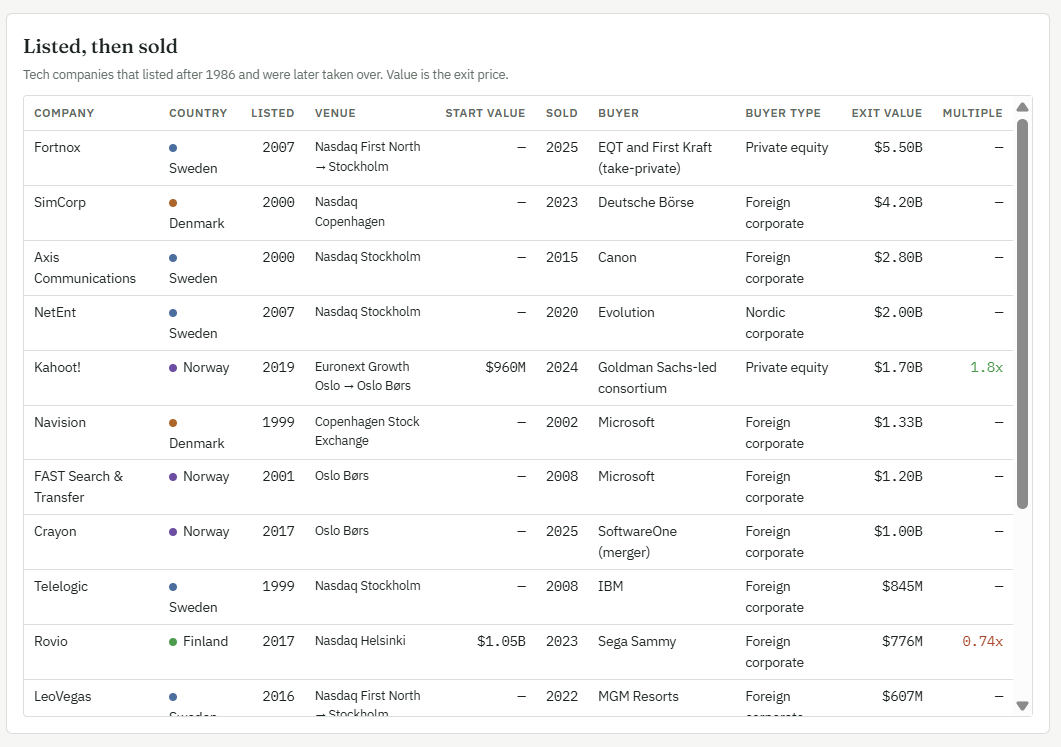
At least 16 Nordic tech companies listed after 1986 and were later bought, for about $24B combined. Eleven went to foreign buyers, including:
- SimCorp to Deutsche Börse ($4.2B)
- Axis to Canon ($2.8B)
- Navision and FAST to Microsoft
- Telelogic to IBM
- Rovio to Sega
- LeoVegas to MGM
Fortnox, one of Sweden’s best-performing listings, was taken private by EQT in 2025 for about $5.5B. Kahoot! went the same way.
This connects to part I: the region is very good at building companies and very willing to sell them. Had fewer been sold, the public-market success list would be longer – and more of the value would still be compounding in Nordic hands.
8. Where they list
Almost all New Nordic tech companies list at home: on Nasdaq Stockholm, Helsinki or Copenhagen, or on Oslo Børs, often starting on a growth market. Only four have chosen a US primary listing: Spotify, Klarna, Opera and IQM. Trustpilot chose London.
The home markets have served the long-term compounders well. The question for the next generation – Lovable, Legora, ICEYE, Oura, Vinted, Bolt – is whether they will list at home, list in New York, or be sold before they list at all. Oura has already pulled one US IPO.
9. So, how are New Nordic tech companies performing after entering public markets?
On balance: well, but unevenly, and with a clear lesson.
For companies that listed early, held a global niche and kept long-term owners, the IPO was the start of value creation, not the end. Many of the region’s largest tech companies today were small listings 20–30 years ago.
For companies that listed late, at peak prices, the public market has so far been far less kind.
Which brings us back to where we started. An IPO is not an exit. It is the next chapter. The New Nordic companies that treated it that way are the ones on our top ten list.
What do you think? Who will be the next Nordic company to list and compound for 30 years – and will it list at home?
This is part II in a three-part series where we explore scaling up, private and public markets for tech companies in the New Nordics. Read part I, How the Nordic scale up scene stacks up. Part III, Nordic Scale-Ups Summary, is coming next week.
About the data: market caps are from companiesmarketcap.com, 31 October 2026. Each company is measured from its market cap at the end of its listing year. For 27 older listings, whose records start later, the earliest available year is used instead. Companies are grouped by headquarters, so Spotify (registered in Luxembourg) and Klarna (UK plc) count as Swedish. Kongsberg and Hexagon are counted as tech companies today. The full interactive report, with all tables and charts, is available here.
Chris Rangen is a strategic advisor to governments, innovation agencies, innovation clusters, investment firms and fund-of-funds globally. He has worked on questions around scale ups, capital and ecosystem development in more than 65 countries. He also teaches venture capital and scale up financing at globally leading business schools, including IMD’s Venture Asset Management Program. Today he works with private and public sector leaders on ‘how can Europe and the Nordics compete?’
He can be reached at [email protected], +47 924 15 949.