

In our work with emerging VC fund managers globally, most say they add value. Yet, few can tell you exactly how.
That gap — between the claim and the clarity — is what Scott Newton and I set out to explore. In 2024, we interviewed venture capital fund managers across Europe and the Middle East, asking one deceptively simple question: How, exactly, do you create value in your portfolio companies after first investment?
What emerged was surprising. Not in the variety of answers — but in the structure underneath them.
The best GPs didn’t just have strong opinions. They had a system.
Today, we teach this system. Here is a preview.
Part I: The GP Value Creation Toolbox
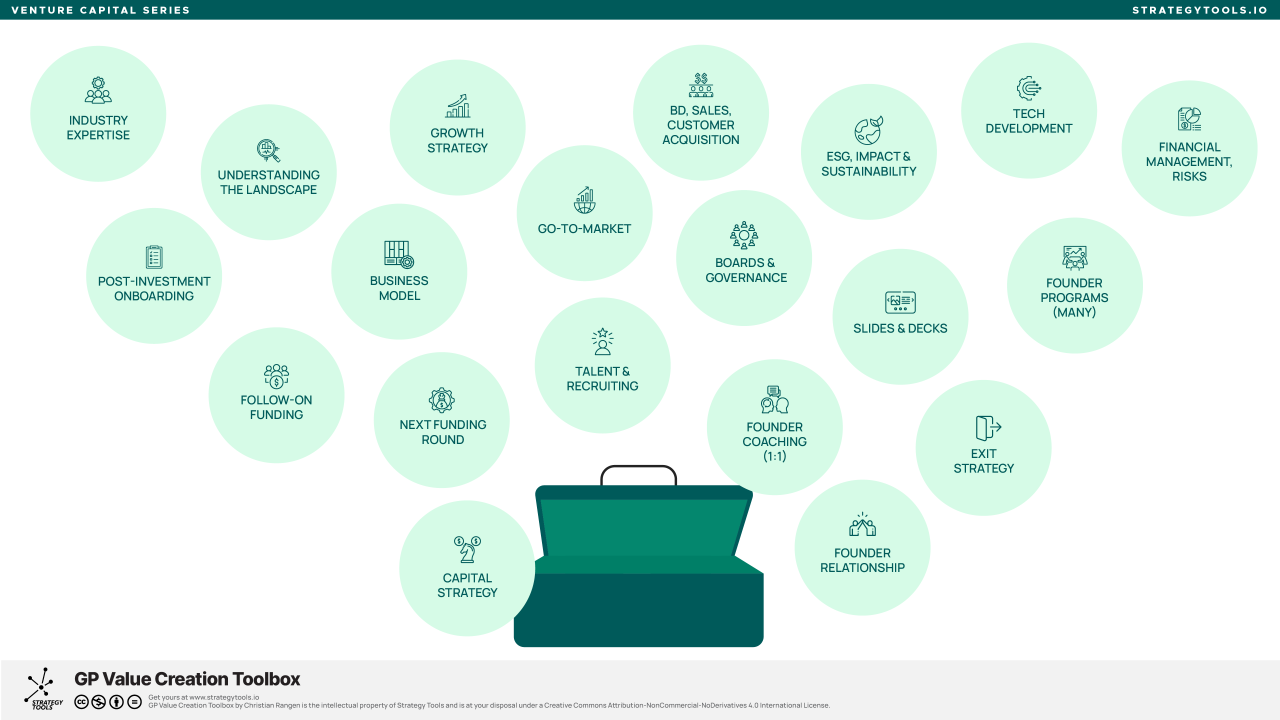
We mapped every answer, every framework, every instinct onto a single visual: The GP Value Creation Toolbox.
Twenty distinct levers. One toolkit. Endless combinations.
Here they are — the full set of tools elite GPs use to build value after investment.
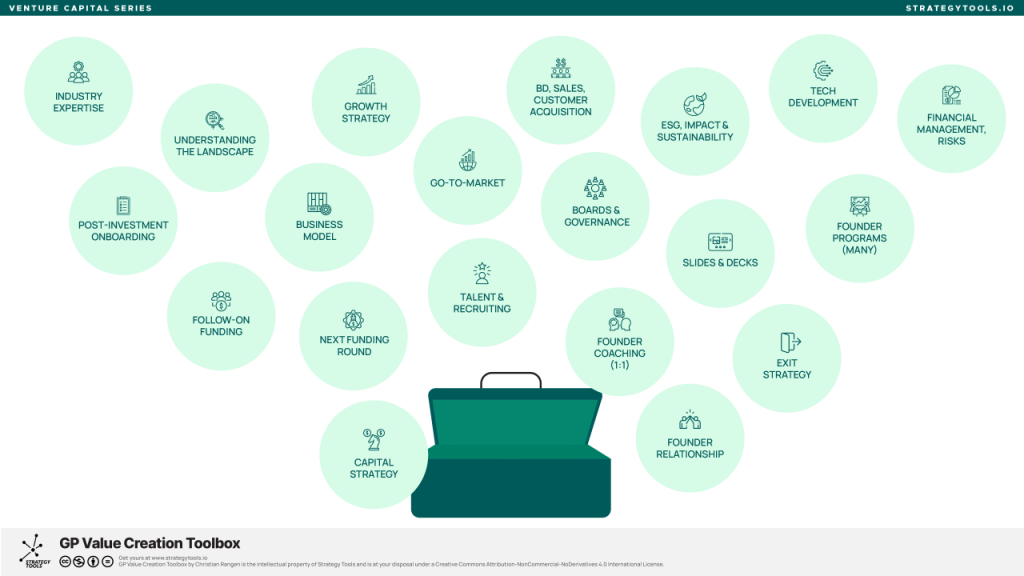
The 20 Elements
1. Industry Expertise You can’t add value in a sector you don’t understand deeply. The best GPs aren’t generalists. They have lived-in knowledge of the spaces they back — the players, the dynamics, the unwritten rules.
2. Understanding the Landscape Market maps. Competitive dynamics. Who’s consolidating, who’s disrupting, who’s about to exit. GPs who can hand a founder a real-time view of their competitive landscape aren’t just advisors — they’re intelligence assets.
3. Post-Investment Onboarding The first 90 days after an investment close are critical. The best GPs have a deliberate onboarding process: aligning on strategy, setting communication rhythms, building trust before the first crisis hits. Many GPs skip this entirely.
4. Growth Strategy How does this company grow from €3M to €30M ARR to €100M ARR? What levers matter most? Which markets to enter — and in what sequence? Growth strategy is where pattern recognition across a portfolio turns into real competitive advantage for founders.
5. Business Model Pricing power. Unit economics. Revenue architecture. Many early-stage companies are still iterating on their fundamental model. GPs who have seen ten variations of a similar business can shortcut months of experimentation.
6. Go-to-Market GTM is where most startups stall. Channel strategy, ICP clarity, sales motion design — the right GTM architecture is worth more than most seed rounds. GPs who can diagnose and fix a broken GTM are invaluable.
7. BD, Sales & Customer Acquisition Can you open doors? Real doors — to enterprise buyers, strategic partners, distribution channels? This is one of the most concrete, measurable forms of GP value add. Intros that turn into contracts – and fast. That’s the metric.
8. Talent & Recruiting The single most common thing founders ask for: help hiring great people. The best GPs have a talent pipeline. They know who’s ready to make the jump from a corporate role to a Series A startup. They’ve seen which VP of Sales profiles work at this stage — and which ones don’t.
9. Boards & Governance A well-run board is a startup superpower. A dysfunctional one is a slow-motion disaster. GPs who understand board dynamics, governance design, and how to build diverse, high-functioning boards give founders a huge leg up — particularly as they scale.
10. ESG, Impact & Sustainability This isn’t optional anymore. Institutional LPs require it. Enterprise customers ask for it. Regulatory environments demand it. GPs who help founders build credible ESG frameworks early avoid painful retroactive work later — and unlock capital from impact-oriented investors.
11. Tech Development CTO hiring, tech stack decisions, build vs. buy tradeoffs, AI integration — technical GPs (or those with strong technical networks) can directly influence product velocity at critical moments. Knowing which tech debt to tolerate and which to fix now is worth real money.
12. Slides & Decks This might sound tactical. It isn’t. A great fundraising narrative — told through a sharp, compelling deck — is the difference between closing a round in 60 days or 9 months. GPs who can shape that story, frame the metrics, and coach the pitch save founders enormous time and frustration.
13. Founder Programs (Many) Peer learning cohorts. Expert workshops. Executive education. The best funds build structured programs that bring portfolio founders together — creating learning, connection, and informal support networks that are genuinely hard to replicate.
14. Founder Coaching (1:1) Raw coaching. Not mentoring, not advising — real, structured, 1:1 developmental work. The founder’s psychological state, decision quality under pressure, communication with co-founders and teams: these are performance variables that compound. GPs who invest here generate returns that don’t show up in the quarterly reporting — until exit.
15. Founder Relationship Trust is the foundation of everything. Founders need to know you’re in their corner — not just monitoring your position. The quality of the GP-founder relationship determines whether founders bring you their real problems early, or manage you from a distance. The former saves companies. The latter loses them.
16. Financial Management & Risks Runway management, FX exposure, burn rate discipline, working capital optimization. This sounds unsexy. It is unsexy. It also determines whether a company survives long enough to become great. GPs who embed financial rigour early prevent a shocking number of avoidable crises.
17. Follow-on Funding Knowing when to double down — and having the conviction and reserves to do so — is one of the most powerful value creation levers available to a GP. The best follow-on decisions are based on deep portfolio intelligence, not just momentum.
18. Next Funding Round How do you help a company go from Seed to Series A? Series A to B? The narrative, the metrics story, the investor targeting, the round architecture — GPs who have closed these rounds many times are hugely valuable co-navigators for founders doing it for the first or second time.
19. Capital Strategy Grants. Venture debt. Revenue-based financing. Strategic capital. The modern capital stack is complex and multi-layered. GPs who understand the full landscape — not just equity — help founders minimize dilution and maximise financial resilience.
20. Exit Strategy Where does this end? M&A, secondary, IPO — each path requires different preparation, different timing, different relationships. Exit planning begins at investment, not at the Series D. The GPs who think about this from day one build more valuable companies and generate better returns for everyone – and faster liquidity for LPs
Twenty levers. No GP masters all of them.
That’s not a weakness — it’s a design principle. The best GPs are honest about where they’re excellent, build teams to cover the gaps, and focus their time ruthlessly on the 3–5 areas where they are genuinely world-class.
Question is, what are your strengths?
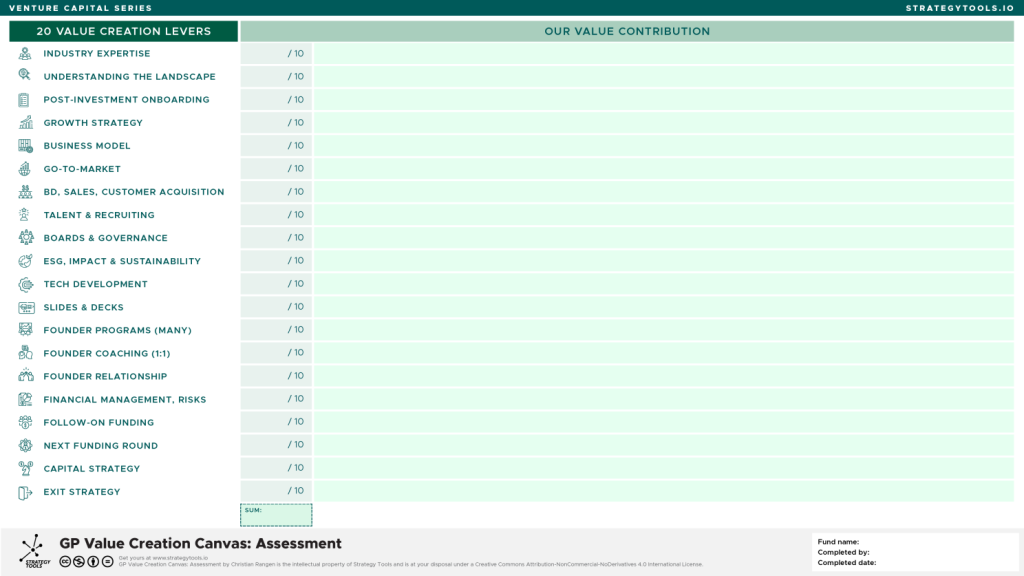
We encourage you to test out the GP Value Creation Canvas for a delightful self-assessment. Remember, focus on your top 3-4 areas of superpowers, not your weaknesses. Strengths win every day.
Part II: Three Partners. Three Toolboxes.
All three are seasoned VC partners. All three use the toolbox. None of them use it the same way. Meet Mike, Suzi, and Abdullah.

Mike — London
The B2B Revenue Accelerator
Mike runs a B2B VC fund out of London. Before VC, he spent a decade in enterprise sales and commercial leadership roles across technology, logistics and fintech. He knows the corporate buyer landscape better than most founders will ever need to.
He’s a graduate of the Newton Venture Program at London Business School, where he first encountered a structured framework for thinking about post-investment value creation. It changed how he operates.
Mike’s Four Focus Areas:
Growth Strategy. Mike doesn’t just talk strategy — he builds it alongside founders. In his first working session, he runs a structured growth session: core markets, expansion sequencing, pricing positioning. By month three, every portfolio company has a documented 18-month growth plan with clear milestones.
BD, Sales & Customer Acquisition. This is where Mike is genuinely elite. He maintains a curated list of 400+ enterprise buyers across sectors in the UK and Northern Europe. His portfolio companies get warm intros — not LinkedIn forwards, but real advocacy to procurement heads, Chief Digital Officers, and transformation leads who trust his judgment. Several portfolio companies have counted a single Mike intro as their biggest revenue event of the year.
Go-to-Market. Mike has seen enough GTM failures to know the patterns immediately. Wrong ICP. Misaligned sales motion. Pricing that signals the wrong buyer. He runs a structured GTM audit in the first 90 days post-investment and has a three-page diagnostic framework he developed himself. His portfolio companies close their first enterprise contracts faster than almost any fund in London.
Business Model. Revenue architecture is Mike’s quiet strength. From usage-based pricing to multi-year enterprise contracts, he helps founders build commercial models that scale — and that attract the right class of follow-on investor.
What Mike tells founders: “I’m not a generalist. I’m a commercial accelerator. If you need help closing your first ten enterprise customers, I’m the best call you’ll make this year.”

Suzi — Zurich
Ms. Exit
That’s what they call her in the LP community. Suzi runs a growth-stage fund out of Zurich. Before VC, she spent 15 years in investment banking — M&A, structured finance, cross-border transactions across Europe and the US. She has closed more liquidity events than most GPs have seen.
Like Mike, she’s a Newton Venture Program graduate. The frameworks she encountered there gave language and structure to the instincts she’d already developed across a decade of deal-making. She now teaches in the program herself — on capital strategy and exit execution.
She does not believe in luck. She believes in preparation.
Suzi’s Four Focus Areas:
Capital Strategy. Suzi engineers capital structures the way architects design buildings — with load-bearing precision. She maps every portfolio company’s full capital landscape: what mix of venture debt, strategic capital, and equity serves them at each stage. Founders who work with Suzi arrive at their Series B and C with clean, optimized cap tables and multiple paths forward.
Next Funding Round. Suzi’s fundraising preparation starts 12-18 months before a company needs to raise. She builds the investor target list, shapes the narrative, stress-tests the metrics story, and runs mock LP meetings. Her companies don’t get caught flat-footed. They arrive at the market ready — and they close fast.
Follow-on Funding. Suzi is clear-eyed and disciplined about follow-on. She uses a rigorous portfolio assessment framework to determine which companies deserve concentrated capital and which are in a different trajectory. Her LPs trust her judgment here. That trust is what allows her to make the big calls at the right time.
Exit Strategy. This is Suzi’s masterclass. She starts building exit optionality at investment — identifying potential acquirers, mapping strategic buyer landscapes, maintaining relationships with corporate development teams at the most likely buyers. She runs an Exit Canvas on every portfolio company annually and adjusts the strategy as the market evolves. Two of her portfolio companies have been acquired by counterparts she identified — and began relationship-building with — three years before the transaction closed.
Her special skillset: generate partial liquidity along the way.
What Suzi tells founders: “You hired me to make you money. The exit is everything. We start planning it today.”

Abdullah — Dubai
The People’s GP
Abdullah leads a growth and impact fund from Dubai, with a focus on MENA-origin founders building globally. He is, by any measure, a people person. He’s been in VC for 12 years. He has mentored, coached, and board-built his way to one of the strongest founder reputation scores of any GP in the region.
If you ask Abdullah’s founders what he does for them, they don’t talk about financial engineering or GTM frameworks. They talk about the phone calls. The midnight check-ins. The board member he introduced who unlocked the Saudi Arabia market. The way he shows up when things get hard.
Abdullah’s Three Focus Areas:
Founder Coaching (1:1). Abdullah is a certified executive coach. This isn’t incidental — it’s central to his GP identity. He runs structured quarterly coaching sessions with each portfolio CEO: leadership, decision-making under pressure, communication, conflict with co-founders. He has worked with two founders through near-company-ending crises. Both companies survived. Abdullahwas the reason.
Founder Relationship. Abdullah treats founder relationships like long-term partnerships, not portfolio positions. He remembers birthdays. He visits companies in-person five times a year, minimum. He has shared meals with the families of founders across five countries. This isn’t just warmth — it’s strategic. Founders who trust Abdullah tell him the truth. That means he knows about real problems 60 days before they become catastrophic ones.
Boards & Governance. Abdullah has built more international boards for MENA founders than anyone else in the region. He understands the specific challenge: founders who need global credibility, access, and diverse functional expertise — but who often start with boards that are purely local and financially oriented. Abdullah maintains a curated network of board-ready executives across London, New York, Singapore, and Riyadh. He has placed over 30 independent board members in portfolio companies. Each placement is deliberate — matched to the company’s next growth phase, not its last one.
What Abdullah tells founders: “Capital is the least of what I bring you. Call me when it’s hard. That’s when I’m most useful.”
What This Means for You
Three partners. Three cities. Three very different expressions of the same toolbox.
Mike accelerates revenue. Suzi engineers liquidity. Abdullah builds people and governance.
None of them is trying to do everything. All of them are building a reputation — a brand — around the specific areas where they can be genuinely exceptional. That clarity attracts better founders, better LP relationships, and better portfolio outcomes.
The GP Value Creation Toolbox has 20 elements. You don’t need to master all 20.
But here’s the question that matters:
Which 3–5 areas are you building toward world-class?
And equally important: Do your founders know that’s what you’re doing?
The gap between “we add value” and “here’s exactly how” is where most GPs live. The best ones have closed that gap — with intent, with a system, and with the humility to know their own edges.
Audit your own toolbox. Figure out where you score Underperforming, OK, Great, or Outstanding.
Then pick your lanes. Go deep. Build a reputation that precedes you.
That’s how VCs add value.
The GP Value Creation Toolbox and GP Value Creation Canvas are developed by Christian Rangen and Scott B. Newton and available at www.strategytools.io. Use them in your next portfolio review, your next fund strategy session, or your next GP team offsite.
Want to go deeper? Explore the Fund Manager Masterclass and the Newton Venture Program — where Mike and Suzi both sharpened their edge.