


So, you are building an early-stage startup, and somewhere along the line, a prospective investor asks ‘can you give us access to your data room?’. Panic sets in. Files get clobbered together. Documents are dumped in a series of folders and founders hope that is sufficient.
Don’t do this.
In this article we will explore why you need a data room, what should go into the data room and the most common mistakes we often see in our investment readiness programs around the world. This article is written for founders at late seed to Series A, but the lessons can be equally valuable for earlier seed and later Series B and C companies.
Already have a data room? Read the follow-up, How Is Your Data Room Holding Up?, with lessons from 40+ data rooms we reviewed.

What’s a data room, anyway?
Let’s start with the basics. What is a data room?
For investors that are considering investing into your company, primarily with an equity investment, SAFE, SLIP, KISS or possibly also a CLA, these investors will often want to do a bit of digging and learn about the (actual) status, health and robustness of your company.
Many investors are required to develop extensive investment memos, financial models, equity return models and so on, and your data room is one of the key sources of information they will use for this purpose. The better information you can provide them with, the easier you are making their job for them.
Do you always need a data room?
No, you do not always need a data room. In fact, many startups have the negotiation power to share selected documents, and simply not share a full data room.
But for most startups, yes, it is good practice to have. Increasingly, as you move into the seed stages, late seed and Series A, yes, you will most likely need to have a solid data room in place.
Do we need a data room at early-stage, and does it evolve over time?
No, a pre-seed company is not always likely to have a data room.
At this stage, you can choose to focus on a few versions of the deck, financial model and the SAFE note (or investment instrument of your choice). But once you get to Seed stage, and absolutely at late seed-to-series A, you are expected to have a robust and well-structured data room in place.
Who will be reading our data room?
There are usually two sets of people and roles that will be spending time in your data room. First, there is the deal lead, often a more senior person. This can be a partner, an investment director or a senior investment manager. This person will likely skim the data room, maybe spending 5–10 minutes just taking a glance. He or she might open a file or two, might pause on your outcome assessment, but will not engage seriously.
The second person is the investment analyst, a more junior person. He or she is a part of the deal team, but tasked with building out the case, doing a good amount of analysis and assessment, and spending a significant amount of time preparing the possible deal. He or she can spend hours and hours digging deep into your files and folders. Make sure your data room addresses both of these people.
Should we have two data rooms?
Yes, you might want to consider setting up two data rooms. The first one contains the most public, transparent information. It has your deck, your key financials, info on the team, cap table, some high level stuff around customer and markets, but this data room is clearly stated “level I” or “pre-access”.
Your second data room has the full menu of documents. In this one, you have a lot of company sensitive information, product- and technology roadmap, board meeting minutes, your investor CRM (albeit with names possibly removed), your exit- and liquidity plans, your detailed financials and so on. This is the ‘full access’ data room.
The reason you might want to consider two, is the first one is shared to interested investors, who might just “want to have a look”, while the second one is reserved for investors only after they have issued you a non-binding term sheet.
What goes in the data room?
In our view, there are 14 chapters you want to cover in your data room. They are laid out below in the Data Room Canvas.
You can also download the canvas here.
Each chapter is clearly marked with numbers and any subfolders are equally structured with numbers, making it easy to follow and navigate. You can also find the full list at the end of the article, easy for you to copy over for your own use case.
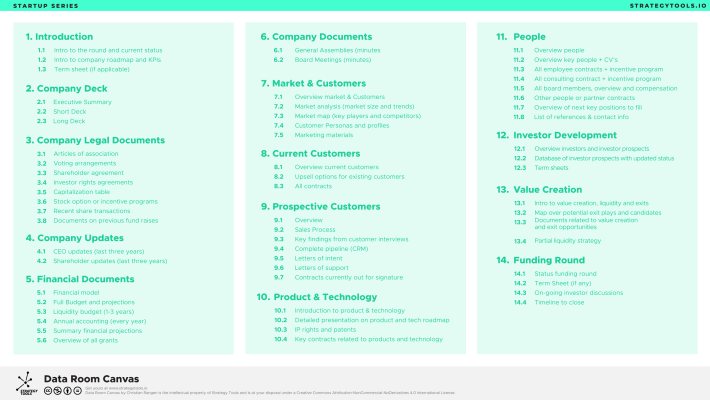
You might look at this, and say “wow, that’s a lot of information”. Board meeting minutes, legal company documents, founder references, product roadmap, growth strategy, exit- and liquidity strategy, timeline to close the round.
Yes, there is a lot of information, but remember, you are asking investors to join you to build this company over a 5-, 10-, 15-year journey. Everyone knows the odds are heavily stacked against your mutual success. You might be asking for $2M, maybe $5M, maybe $20M, your investors are right to do the heavy lifting to learn the company’s critical information, but also learn whether you are a good fit for each other over the next ten years.
Should you have videos in your data room?
Yes, we strongly recommend you to consider one or more videos inside your data room. This can easily be done with Loom, where you just put a URL inside the key folders or documents.
Generally, we would recommend the following videos.
- Welcome, introduction to our data room (1-3 minutes overview of what’s in the data room and how to navigate it)
- Pitch deck (2-10 min walk through of the pitch deck)
- Financial model (2-10 min walkthrough of the financial model)
- Sales and customers (2-10 min walkthrough of the commercial health of the business)
- Round status and timeline (2-5 min walkthrough on how the funding round is coming together and getting ready to close)
Who should build and own the data room?
We recommend assigning one person as the ultimate owner of the data room and everything in it. This can be the CFO, the chief of staff or a more junior finance manager. It should usually not be the CEO. Whoever owns it, is then responsible to update and review it on a frequent basis.

The five most common mistakes we see in data rooms
One, the numbers don’t add up
Your deck says $400.000 revenue. Your accounting says 210.000. Your cap table shows 150.005 shares, your deck says 210.405 shares. Your customer pipeline says 14 prospective customers ready to close, your deck says 211.
Make sure your numbers are aligned and clearly communicated. This is often the number one reason why investors step away from a deal, asking themselves “which numbers should we actually trust?”
Two, your documents are outdated
The pitch deck says March 2025. Your one-pager says December 2025. Your file is called «Pitch_Latest_file_Jan_2026», but you are already in November 2026. The impression you leave here is one of ‘we have been trying to fundraise for a while and it is taking longer than we would ever have expected’. Don’t do this. Simply update your files around ‘today’s date’. It’s easy. Just do it.
Three, your data room is a mess
Way too often we see a complete lack of structure and organization, where pdf’s, pngs, .docs and .xls are floating around, with no coherent structure to navigate. Follow the menu we have shared above and try to keep it clean, simple and well structured.
Four, nothing around the funding round
Status on the funding round, timeline to close, possible lead investors, commitment from your existing investors; make sure to include a good amount of information to show this round is actually happening and here’s our timeline for it.
Do not leave this out of your data room.
Five, lacking most of the critical information for new investors
Growth strategy beyond the next 12 months? Capital strategy to fund the company to become a market leader? Outcome assessments and scenarios? Plans for liquidity and exits? Target equity value for the next round? Timeline and prospective leads for the next round?
Most data rooms are unfortunately weak on the things that matter to your investors. What will their equity value look like in two years? How will they get some money back?
Don’t leave this up to the imagination of the investors to figure out. Own this part of the narrative too. If you don’t they will need to cook it up for their own investment memos.

Bringing it all together
A funding round is never ‘won’ or ‘closed’ in the data room. But, we have seen many great companies lose their investors along the way because they were not ready to raise and the data room was severely lacking. If you want to increase the odds of your next closing, and make it easier for your investors to arrive at a yes, then a robust data room is one big step closer to your success. Good luck!
Want to read more?
How Is Your Data Room Holding Up?
Read here.
Founder? These are the six decks you need
Read here.
Ready to raise capital? Here’s your materials checklist
Read here.
Entrepreneurial Finance Readiness Level
Read here.
Founders; Here’s How to Run your fundraising process
Read here.
Bonus Full data room structure
1. Introduction
1.1 Intro to the round and current status
1.2 Intro to company roadmap and KPIs
1.3 Term sheet (if applicable)
2. Company Deck
2.1 Executive Summary
2.2 Short Deck
2.3 Long Deck
3. Company Legal Documents
3.1 Articles of association
3.2 Voting arrangements
3.3 Shareholder agreement
3.4 Investor rights agreements
3.5 Capitalization table
3.6 Stock option or incentive programs
3.7 Recent share transactions
3.8 Documents on previous fund raises
4. Company Updates
4.1 CEO updates (last three years)
4.2 Shareholder updates (last three years)
5. Financial Documents
5.1 Financial model
5.2 Full Budget and projections
5.3 Liquidity budget (1-3 years)
5.4 Annual accounting (every year)
5.5 Summary financial projections
5.6 Overview of all grants
6. Company Documents
6.1 General Assemblies (minutes)
6.2 Board Meetings (minutes)
7. Market & Customers
7.1 Overview market & Customers
7.2 Market analysis (market size and trends)
7.3 Market map (key players and competitors)
7.4 Customer Personas and profiles
7.5 Marketing materials
8. Current Customers
8.1 Overview current customers
8.2 Upsell options for existing customers
8.3 All contracts
9. Prospective Customers
9.1 Overview
9.2 Sales Process
9.3 Key findings from customer interviews
9.4 Complete pipeline (CRM)
9.5 Letters of intent
9.6 Letters of support
9.7 Contracts currently out for signature
10. Product & Technology
10.1 Introduction to product & technology
10.2 Detailed presentation on product and tech roadmap
10.3 IP rights and patents
10.4 Key contracts related to products and technology
11. People
11.1 Overview people
11.2 Overview key people + CV’s
11.3 All employee contracts + incentive program
11.4 All consulting contract + incentive program
11.5 All board members, overview and compensation
11.6 Other people or partner contracts
11.7 Overview of next key positions to fill
11.8 List of references & contact info
12. Investor Development
12.1 Overview investors and investor prospects
12.2 Database of investor prospects with updated status
12.3 Term sheets
13. Value Creation
13.1 Intro to value creation, liquidity and exits
13.2 Map over potential exit plays and candidates
13.3 Documents related to value creation and exit opportunities
13.4 Partial liquidity strategy
14. Funding Round
14.1 Status funding round
14.2 Term Sheet (if any)
14.3 On-going investor discussions
14.4 Timeline to close